
Binocular Conflict Inside a Single Image
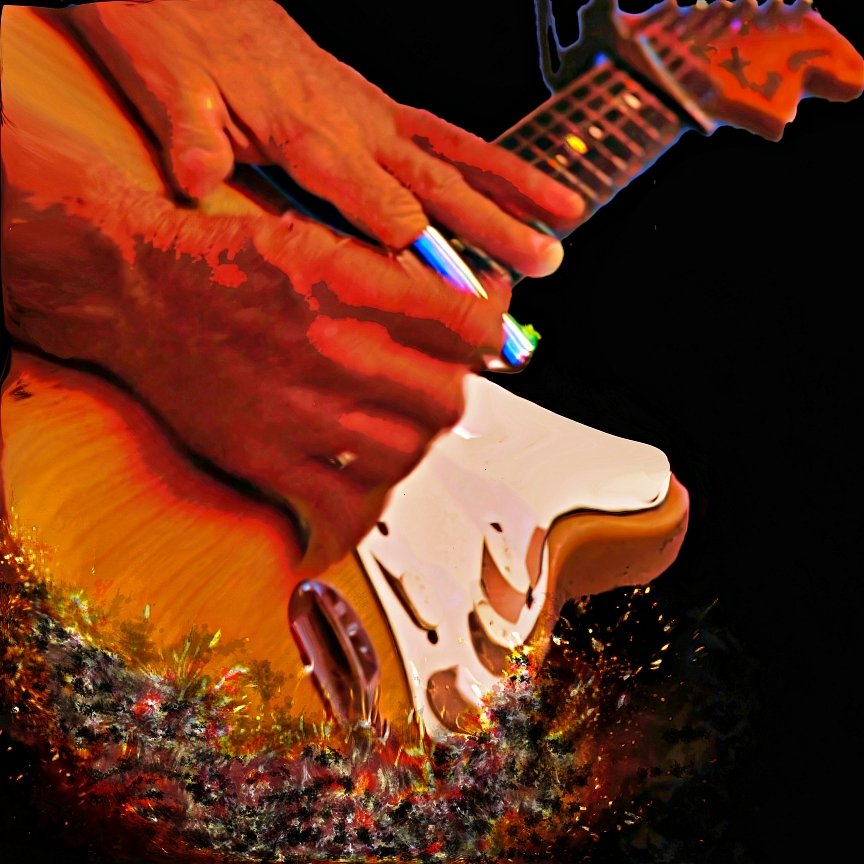
Spark 4 Square
You cannot see this piece all at once.
Your eye moves.
It toggles.
It chooses.
First the guitar.
Then the ignition.
Then the void between them.
The mind tries to hold all three, but it cannot.
That instability is not a flaw.
It is the structure.
This image creates a binocular conflict inside a single frame.
Why You Can’t See It All at Once
The guitar is solid.
It is tactile.
It belongs to the physical world.
The spark is atmospheric.
It does not behave like an object.
It behaves like emergence.
Between them sits a field of black that is not background.
It is separation.
A dimensional seam.
Your visual system wants one spatial logic.
This image offers two.
So perception oscillates:
Matter.
Energy.
Matter.
Energy.
You cannot fuse them in a single glance.
That tension is the experience.
The “Different Dimensions” Effect
The energy in this piece does not begin in the guitar.
It is drawn in.
The dark surrounding the instrument is not empty space.
It represents the unseen field that surrounds everything —
the constant vibration we do not normally notice.
When the musician touches the strings, something happens.
The instrument does not create energy from nothing.
It converts.
Energy from the surrounding field is pulled inward through attention, through touch, through intention.
The guitar becomes a conductor.
The amplifier becomes a translator.
Sound becomes the proof.
The spark does not decorate the instrument.
It precedes it.
That is why it feels dimensional.
Dark Energy → Light → Sound
Universe → field
Field → ignition
Ignition → instrument
Instrument → translation
Translation → sound
The flame is not destruction.
It is conversion made visible.
What appears as fire is the moment the invisible becomes perceptible.
The square frame contains the moment so we can study it.
Inside it, the unseen turns into light.
Light becomes motion.
Motion becomes tone.
What we hear is not just vibration of string.
It is a translation event.
Why It Feels Hard to Look At
You cannot fully see both the guitar and the spark simultaneously because they operate in different perceptual registers.
One is weight.
One is flux.
One is wood and wire.
One is particle and wave.
The brain wants resolution.
This piece denies it.
It holds the viewer at the threshold —
the instant before energy becomes sound.
That unsettled feeling is the same sensation musicians experience when they tune into something larger than themselves.
Spark 4 Square suggests that music is not something we manufacture.
It is something we tune into.
The player draws energy from the unseen world,
channels it through wood and wire,
and releases it as sound.
What we hear is not just a note.
It is the universe, translated.