
Closing the Gap
CLE
Closing the Gap: Letting the Image Breathe Through the Letters
Sometimes the work tells you what’s wrong—you just have to sit with it long enough to hear it.
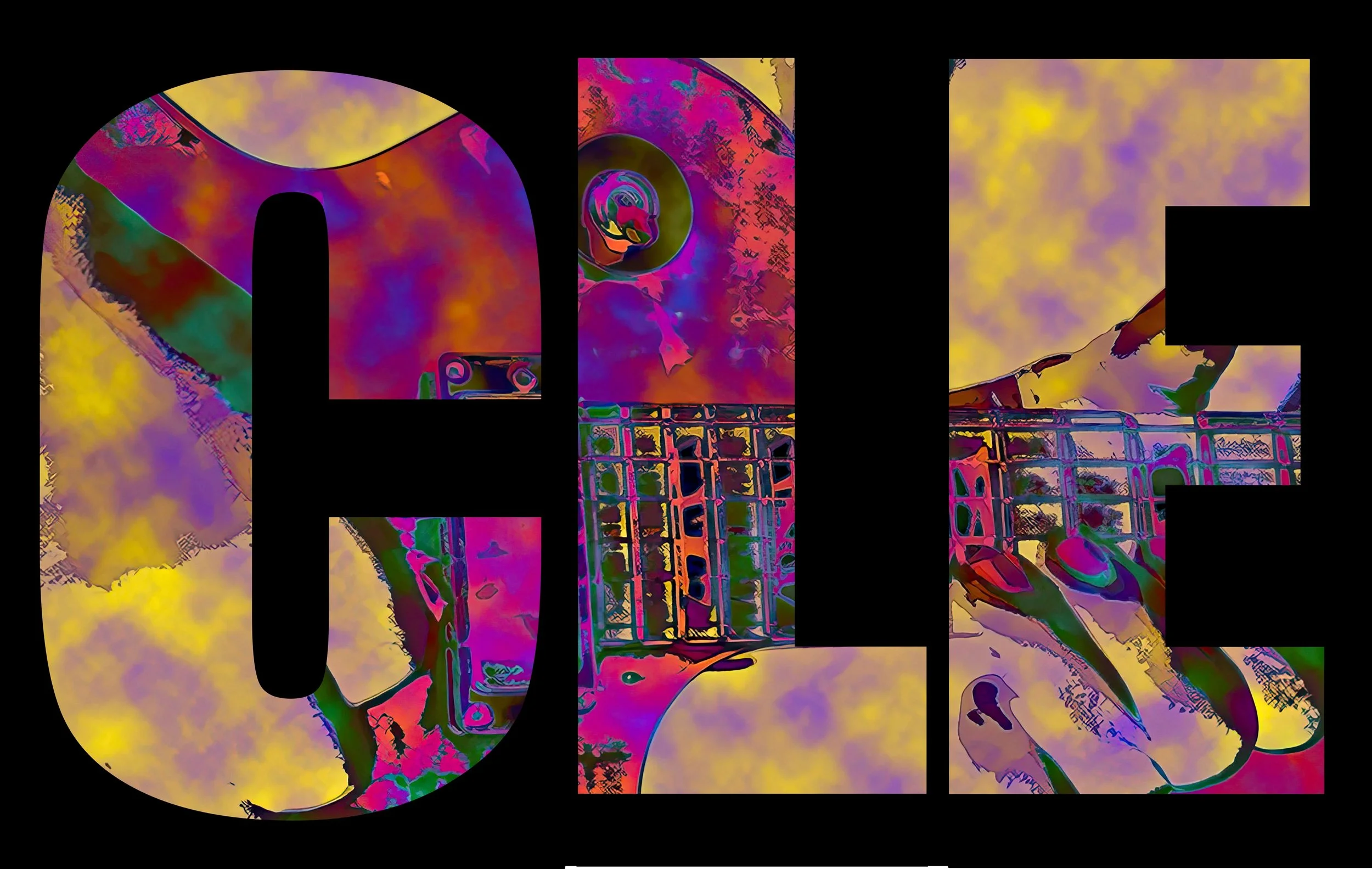
I had been looking at this CLE piece for a couple of weeks. Not actively working on it. Just seeing it. Letting it exist in the room, on the screen, in passing moments. It wasn’t bad. In fact, it worked. But something about it felt held back—like it hadn’t fully committed to what it wanted to be.
At first glance, the structure made sense. Three bold letters. Strong presence. Clean separation. Each letter containing its own fragment of the image. It was clear, readable, and safe.
That was the problem.
The letters were doing too much of the talking.
The image—the actual substance of the piece—was being confined, almost politely, inside each character. It existed, but it didn’t flow. Each letter became its own compartment, and the eye would reset as it moved from C to L to E. Instead of reading as one unified visual statement, it read as three separate moments placed next to each other.
So I left it alone.
And after a couple of weeks of just looking at it, the adjustment became obvious.
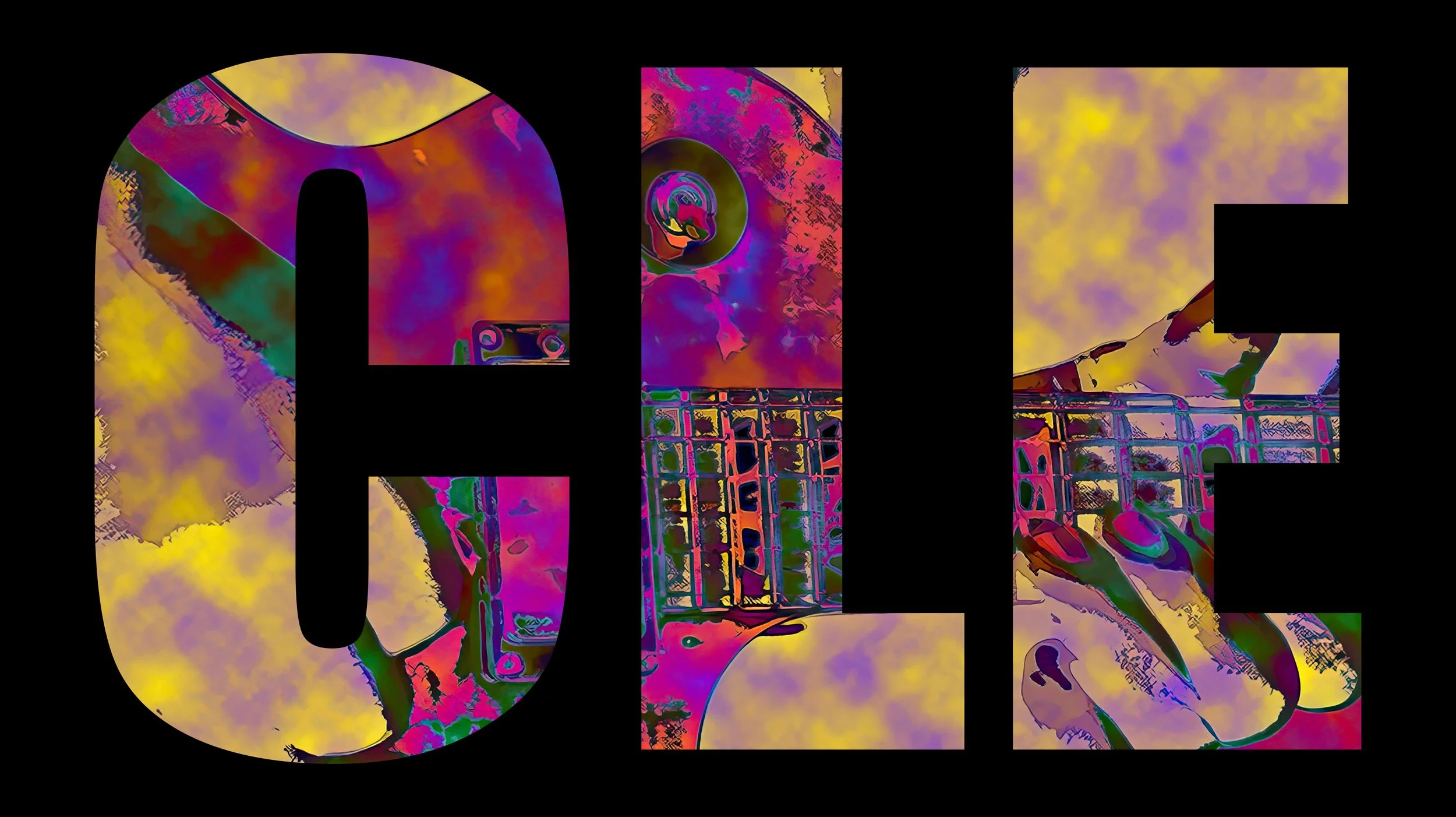
I brought the letters closer together.
Then I enlarged them.
That was it. No new elements. No added effects. Just a shift in spacing and scale.
But that small move changed the entire structure of the piece.
By tightening the spacing, the image began to move across the letters instead of stopping inside them. The divisions didn’t disappear, but they softened. The composition started to read as a continuous field rather than three isolated containers.
By enlarging the letters, I reduced their dominance. They stopped being the subject and started acting as a framework—almost like cutouts or windows—allowing the image to come forward.
The letters still define the piece. It still says CLE. But now the meaning isn’t carried by the typography alone. The visual content inside the letters has room to speak, to connect, to exist as a whole.
That’s where the piece finally aligned with what I’ve been exploring—this idea of referential abstraction. The letters remain recognizable. The object—the guitar—remains present. But the composition is no longer about labeling something. It’s about revealing it through structure.
Nothing about the original version was wrong.
It just wasn’t finished.
Sometimes the most important part of the process isn’t adding more—it’s stepping back long enough to see what needs to be removed, reduced, or realigned.
This adjustment didn’t make the piece louder.
It made it more honest.
CLE
CLE
This piece begins with something direct.
Three letters. A place. A name we recognize.
CLE.
There is no abstraction in the structure.
It is clear, immediate, and familiar.
A marker of identity.
A shorthand for where we are from
and what we carry with us.
But inside the letters, the image does not stay fixed.
Color shifts.
Form breaks and reforms.
The guitar appears, then dissolves.
What should be stable becomes active—
as if the identity itself is still being made.
This is where the work moves beyond design.
Regional pride often settles into symbols.
Clean lines. Clear meaning.
Something that can be worn, displayed, repeated.
This piece begins there—
but does not remain there.
Inside the structure of CLE,
the image resists becoming a logo.
It does not simplify.
It does not resolve into a single statement.
Instead, it holds onto variation.
Noise. Energy. Movement.
The guitar remains present,
but not as an object.
It exists as a source—
a reference point within a field of change.
This is referential abstraction in a different form.
Not removing the object entirely,
but embedding it inside something recognizable—
and allowing it to shift beneath the surface.
There is a tension here.
Between clarity and complexity.
Between identity and expression.
Between something made to be seen quickly
and something that asks to be looked at longer.
This tension reflects a larger question.
What happens when art meets commerce?
Does it simplify itself
to become accessible?
Or can it carry complexity
into a space meant for repetition and use?
This piece does not answer that question.
It holds it.
It allows the letters to function as an entry point—
something immediate and shared.
But within that shared form,
it keeps the image alive.
Unfixed.
Unresolved.
Still becoming.
This is Cleveland—
not as a static symbol,
but as something experienced.
Something built from layers.
From sound.
From memory.
From the constant movement of people and place.
CLE is not just where we are.
It is what we continue to make.
Mind’s Eye
Mind’s Eye
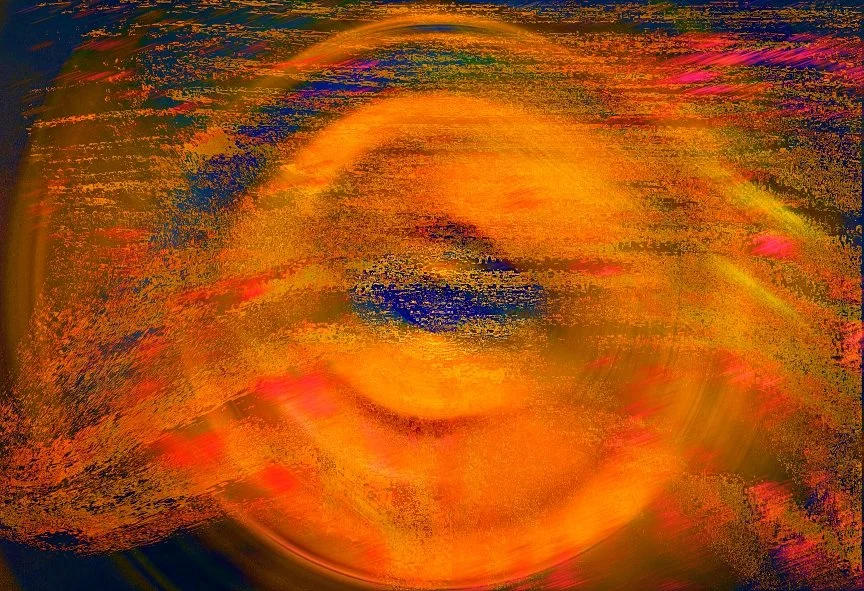
This piece is not an image of something.
It is the moment something begins to appear.
There is no object here to recognize.
Only the act of recognition itself.
At the center, a form gathers.
Not fully seen. Not fully known.
It holds just enough structure to suggest focus—
the way a thought begins to take shape before it becomes clear.
Around it, everything moves.
Color drags across itself.
Impressions overlap.
What we see is not a single image,
but the accumulation of attempts to see.
This is how the mind works.
We do not receive perfect pictures.
We assemble them—
from memory, from expectation, from fragments of experience.
The eye in this piece is not literal.
It is not an object.
It is a function.
It is the place where perception organizes itself.
The surrounding field resists clarity.
It breaks form apart as quickly as it tries to build it.
There is tension between what wants to resolve
and what refuses to be fixed.
This is where the work lives.
Not in what is seen,
but in the instability of seeing.
Within this instability, something real emerges—
not as an object,
but as an event.
A moment of awareness.
A brief alignment between the viewer and the unseen.
This is the mind’s eye.
Cleveland Field (Without Square)
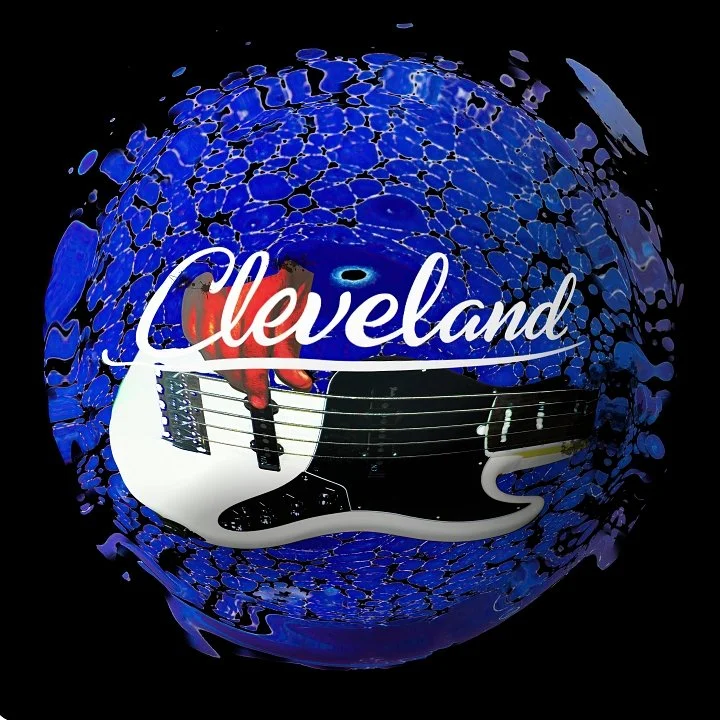
Cleveland Field (Without Square)
Cleveland Field (Without Square)
This image does not sit inside a frame.
It holds itself together.
It was created with the intent of being printed on a t-shirt.
To exist without edges.
To live directly on the surface.
What looks like a bubble is not air.
It is pressure — built from sound.
The blue is not imagined.
It is pigment dispersing in liquid — a real event, captured at the moment of expansion.
This image was not created.
It was found.
But the eye does not stop at what it is.
It recognizes what it resembles.
A field.
A system.
A force under tension.
The guitar does not sit on top of this.
It is inside it.
Bent by it.
Shaped by it.
The silence is not empty.
It is a field.
Music happens when something moves through it.
This is not decoration.
It is containment.
A moment where energy gathers,
distorts form,
and briefly becomes visible…
before disappearing again into the black.
Starmaker
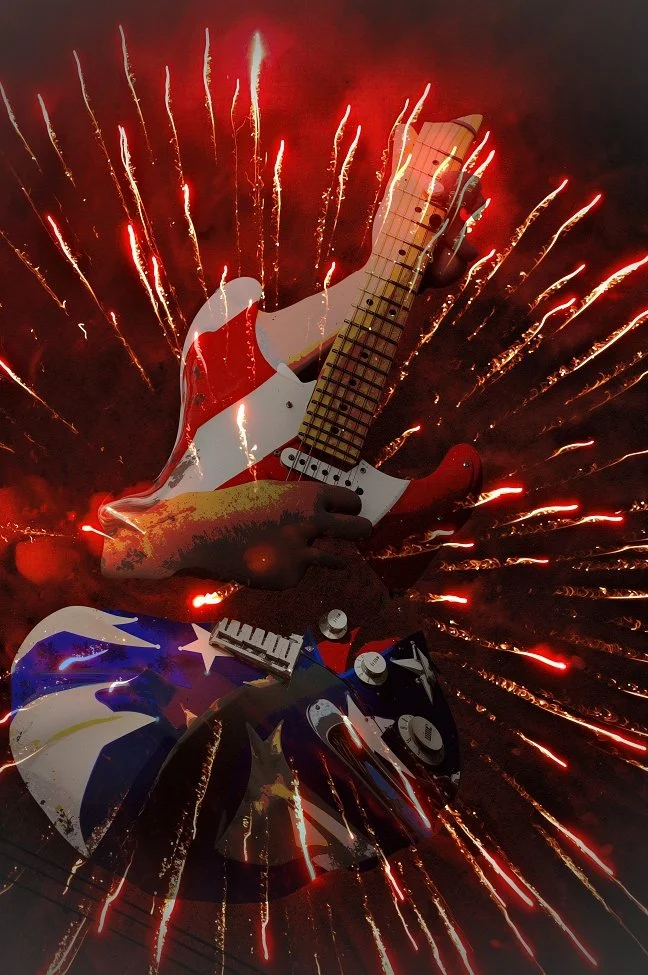
Starmaker
At first glance the answer seems obvious.
The guitar is surrounded by exploding light.
Fireworks radiate outward like stars being born in the sky.
The instrument sits at the center of it all.
It would be easy to say the guitar is the Starmaker.
But look closer.
A guitar on a stand is silent.
Wood, metal, wires, and paint — a beautiful machine waiting in stillness.
It holds possibility, but it cannot ignite anything by itself.
The hands are what awaken it.
Touch the strings and the quiet object begins to vibrate.
Energy moves through the instrument.
Sound begins to form.
And what was silent suddenly becomes something that can fill a room, a crowd, or even a lifetime of memory.
So perhaps the hands are the Starmaker.
Yet that answer is incomplete too.
Great players know that not all guitars are the same.
Certain instruments have voices that unlock something deeper in the musician.
A guitar’s wood, shape, and resonance shape the sound in ways the hands alone cannot.
Some guitars pull music out of a player that other guitars never could.
The player needs the instrument just as much as the instrument needs the player.
In this piece the fireworks do not belong solely to the guitar, and they do not belong solely to the hands.
They erupt from the moment where the two meet.
Where intention touches vibration.
Where human energy meets a resonating machine.
Where sound is born.
The surrounding darkness becomes the night sky — the empty space where stars appear.
And in that instant, music does something mysterious.
Sound becomes light.
And somewhere between the hands and the guitar, a Starmaker is created.
Blue Energy
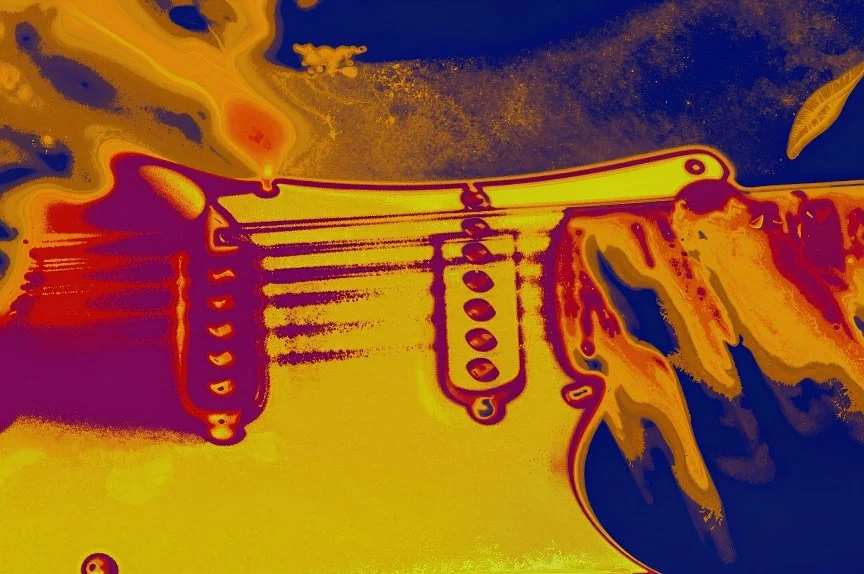
Blue Energy
Every instrument sits inside a field we cannot see.
The guitar does not begin the process.
The energy already exists.
It surrounds everything.
In this piece the blue field represents that unseen presence — the quiet pressure of the universe that is always there but rarely noticed. Most of the time it remains invisible to us. We only become aware of it when something channels it.
The moment a musician touches the strings, something changes.
The instrument does not create the energy.
It converts it.
The hand becomes the point of contact between the human body and the field surrounding it. Energy moves through intention, through touch, through vibration. The strings become conductors, pulling that surrounding field inward and translating it into something we can perceive.
Sound.
What appears in the warmer colors — the yellows, reds, and oranges — is the visible result of that conversion. The blue energy collapses into motion and pressure, and the guitar becomes the translator between the unseen and the audible.
This is why instruments feel alive in the hands of a musician.
They are not simply tools.
They are receivers.
The guitar glosso appears here as both object and conduit. The recognizable form anchors the image, but the surrounding abstraction reveals something deeper: the relationship between field, body, and vibration.
We do not see the energy itself.
We only see the moment it becomes music.
Studio Journal — Without Square

Ghost Inside the Waveform (Black)
Every once in a while a piece tells you what it needs.
Ghost Inside the Waveform existed before the black was added.
The signal was there. The distortions were there. The vertical lines stretched and bent like a frequency being pulled apart. But something was missing.
The unseen.
Without the void around it, the piece felt decorative — an interesting pattern, but not an event. The waveform had nowhere to exist. It floated on the surface instead of emerging from something deeper.
So the black was added.
And suddenly the piece changed.
The black is not just a background.
It is the field.
In physics we understand that most of the universe is invisible. The energy is there long before we see its effects. We only perceive it when something converts it into light, heat, or sound. A musician touches a string and vibration becomes audible. An amplifier converts motion into electricity and electricity into pressure waves. What was unseen becomes something we can experience.
This piece sits right at that moment.
The vertical distortions resemble a waveform — the visual trace of energy moving through time. But instead of a clean signal, the pattern bends and stretches as if something is passing through it. A presence. A memory. A ghost inside the frequency.
That idea only works when the surrounding darkness exists.
The black void is the source — the unseen field where the signal begins. The waveform becomes a small window into that field, a place where energy is pulled inward and briefly made visible.
Left to right, the piece feels like a tuning process.
Noise slowly organizes itself. Interference becomes rhythm. Rhythm becomes signal. The ghost inside the waveform is not a literal figure but a disturbance — something that has moved through the energy and left its trace behind.
The work began with a photograph of a guitar. The instrument was the original object. Through digital transformation it dissolved into pure frequency language. The guitar disappeared, but its function remained.
An instrument converts energy.
That is what the image now shows.
Not the guitar itself, but the moment where unseen energy is drawn inward and translated into sound.
In that sense the black void is not empty space.
It is the place where everything begins
Journal Addendum — Within the Square
One more thought belongs with this piece.
Ghost Inside the Waveform exists within the square. The signal, the distortion, and the trace of energy are all contained inside the frame. At first glance that might seem different from the idea of Without Square, where energy breaks or escapes the boundary.
But in truth they are not opposites.
Within the Square is simply a moment of Without Square.
The square is not the source of the energy. It is only the place where we observe it. The waveform we see is a small portion of a much larger field that surrounds it. The black void reminds us that the signal did not begin at the edge of the frame. It came from beyond it.
The square acts like an instrument — a viewing window that allows us to witness something that actually exists outside of it.
In this way the piece becomes a contained event, a brief appearance of energy drawn from the unseen field and translated into visible signal. The ghost inside the waveform is not trapped by the square. We are simply catching a glimpse of it there.
Ghost Inside the Waveform
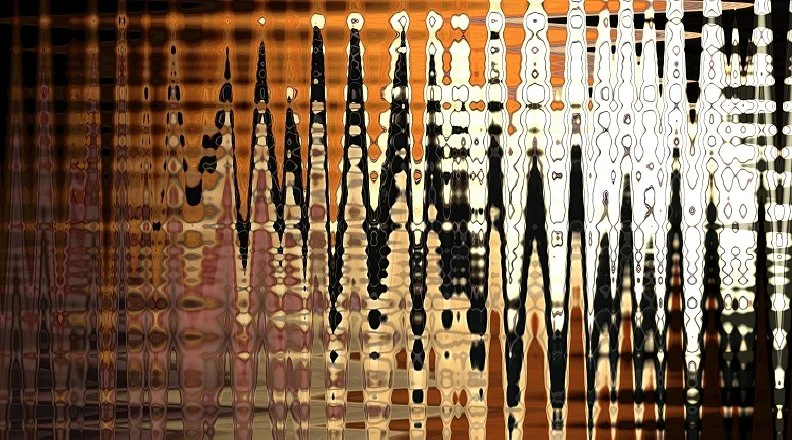
Ghost Inside the Waveform
Sometimes the guitar disappears.
Not the sound — the instrument itself.
What remains is something else entirely. The wood, the strings, and the body of the guitar dissolve into a field of vibration. The instrument that once held the sound becomes invisible, leaving only the pattern of the energy it released.
This piece feels like that moment.
I found this image buried in an old file. My memory tells me it likely began as a photograph of a guitar, but the process that followed pulled the image so far apart that the original form is no longer visible. Whatever the starting point was, it has been stretched and transformed until the object itself has vanished.
What remains is the residue — the structural memory of vibration.
Vertical columns appear like standing waves frozen in place. Narrow lines echo the spacing of strings. Dense clusters form where energy once concentrated. Warm copper tones suggest wood and resonance, while the brighter areas feel like sound escaping into open space.
The guitar itself can no longer be seen.
But something of it still remains.
Like a fingerprint left in the air after a chord rings out, the instrument survives only as a pattern. The music has moved on, yet the structure of its vibration lingers in the visual field.
A ghost inside the waveform.
In that sense, the piece becomes less about the object and more about what the object releases. A guitar does not create sound from nothing. It converts energy — from the player’s hands, from the tension of the strings, from the resonant body of the instrument — into waves that move outward into the surrounding space.
Here, that invisible motion becomes visible.
The instrument disappears, but the vibration remains.
Flame Out
Flame Out
Flame Out
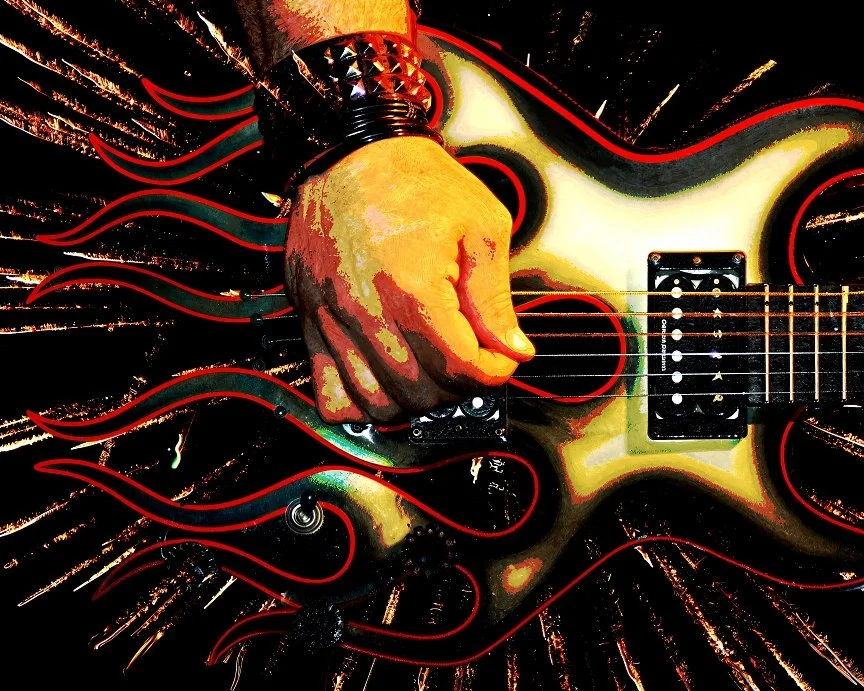
At first the bursts behind the guitar look like fireworks.
But they can also be something else.
Light.
Energy entering the scene the way sunlight enters the world every morning, bringing life to everything it touches.
The guitar itself is not alive.
It is a machine.
Wood, metal, pickups, switches.
A precise device built to translate vibration into sound.
But the moment the hand strikes the strings, something changes.
The instrument begins to react.
Red shapes erupt from behind the guitar. At first they read like flames, but look longer and they begin to move like something organic — curling, reaching, coiling like the tentacles of a squid or octopus.
They are not decoration.
They are force.
The tentacles push against the darkness behind the instrument, contracting like living muscle, driving the guitar forward.
Across the page.
And toward the edge of the picture.
Part machine.
Part organism.
The sunlight brings the energy.
The human touch releases it.
The guitar becomes the place where it comes alive.
For a moment the instrument is no longer just an object in a picture.
It is a creature of sound.
And the tentacles shove it forward until it can no longer be contained by the frame.
It flames out —
right off the paper.
Closed Circuit
Closed Circuit
(Feedback Loop)
A guitar does not create sound alone.
It enters a system.
String to pickup.
Pickup to amp.
Amp to speaker.
Speaker to air.
Air back to pickup.
A loop.
When the loop aligns, something changes.
The sound no longer fades.
It sustains itself.
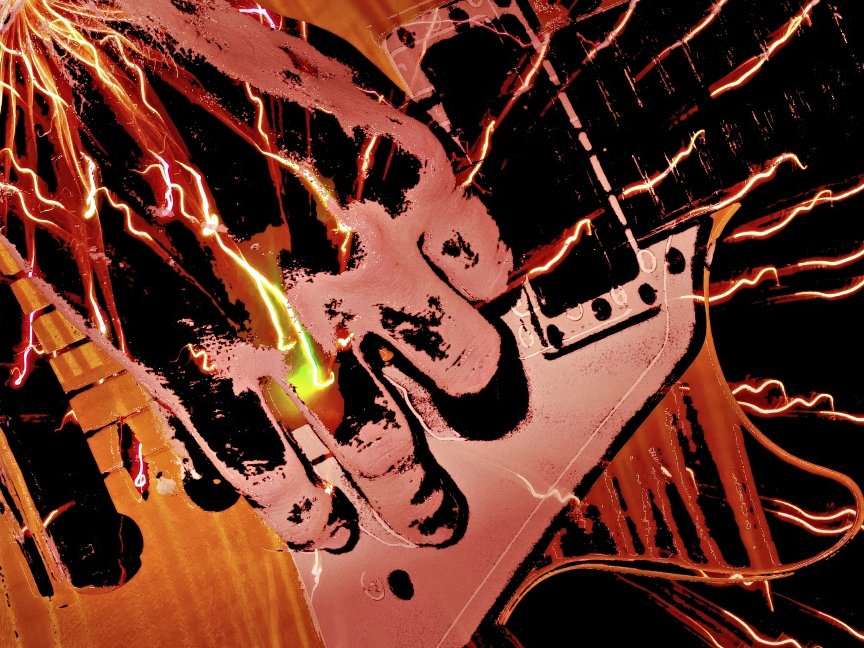
This piece captures that moment.
The hand is not striking wildly.
It is completing a circuit.
The white body becomes a grounding plate.
The surrounding dark is not emptiness.
It is resistance — the unseen field waiting for connection.
When contact is made, energy becomes visible.
The streaks are not decoration.
They are feedback locking in.
There is a thin line between control and chaos.
Too little gain and the signal dies.
Too much and it collapses into noise.
But when the loop stabilizes,
the instrument begins to sing on its own.
Not because it was forced.
Because it was aligned.
The musician does not manufacture the fire.
He stands in the loop.
Guitar → amplifier → air → return.
Closed circuit.
Sustain is not volume.
It is relationship.
Staccato versus Legato
Firework Summer
Firework Summer
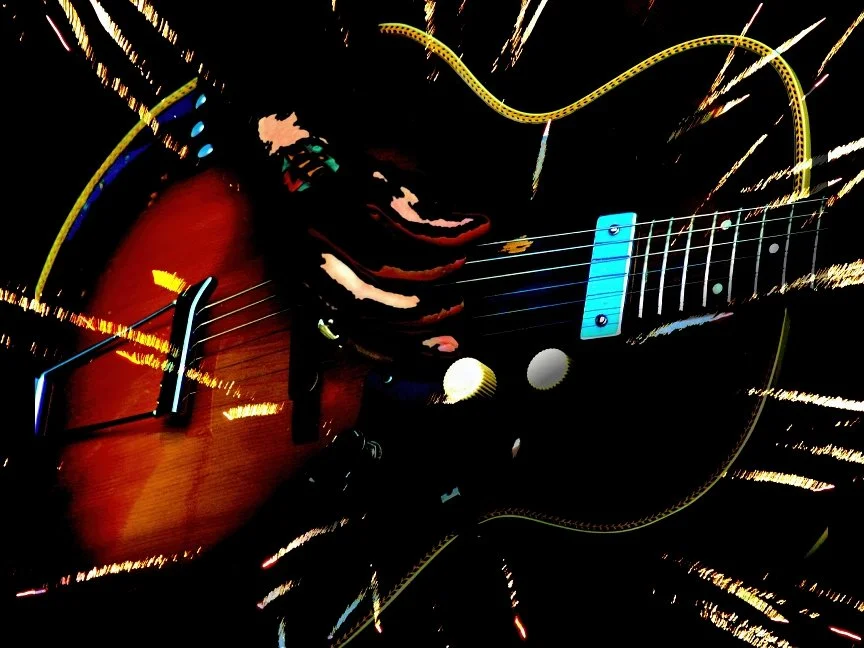
The guitar does not explode.
It glides.
The hand moves in a single breath across the strings.
Curved wood. Warm finish. Continuous motion.
Nothing is abrupt.
Nothing is broken.
That is legato.
A sustained thought.
A note that refuses to be chopped into pieces.
Energy that chooses flow instead of fracture.
But the world does not answer in curves.
It answers in sparks.
Each firework is a sharp declaration.
A flash.
A strike.
A punctuation mark in the dark.
That is staccato.
The guitar speaks in continuity.
The night replies in fragments.
Smooth intention meets sharp reaction.
Inside the player, the movement is seamless.
Outside the player, the response arrives in bursts.
The musician feels one line.
The universe delivers a thousand exclamation points.
Summer Fireworks is not about noise.
It is about articulation.
The body of the guitar bends.
The cable loops gently.
The red surface breathes.
Then the sparks cut through it all —
bright, fast, unapologetic.
Legato is how we feel.
Staccato is how the world responds.
And somewhere between the glide and the burst,
music becomes visible.
Restraint
This piece began as exploration.
Not discipline.
Not concept.
Just movement.
I made the first version and something clicked. It felt complete. The tension was there. The compression. The heat in the hand against the metal.
But I didn’t stop.
I kept going.
Not because it was wrong —
because I was curious.
What if I pushed it further?
What if I intensified it?
What if there was more inside it waiting?
Exploration is honest.
But it has no brakes.
Each version drifted farther from the original spark. More adjustment. More manipulation. More intention layered on top of intention.
And slowly, the energy flattened.
Not because it became bad.
Because it became over-explained.
At some point I realized I was no longer discovering — I was decorating.
So I had to do something harder than pushing forward.
I had to turn around.
I followed the trail back.
Back through the edits.
Back through the decisions.
Back to the moment where the piece first held tension without asking for help.
That moment was restraint.
Restraint is not about doing less.
It’s about knowing when the exploration has already revealed what it needed to reveal.
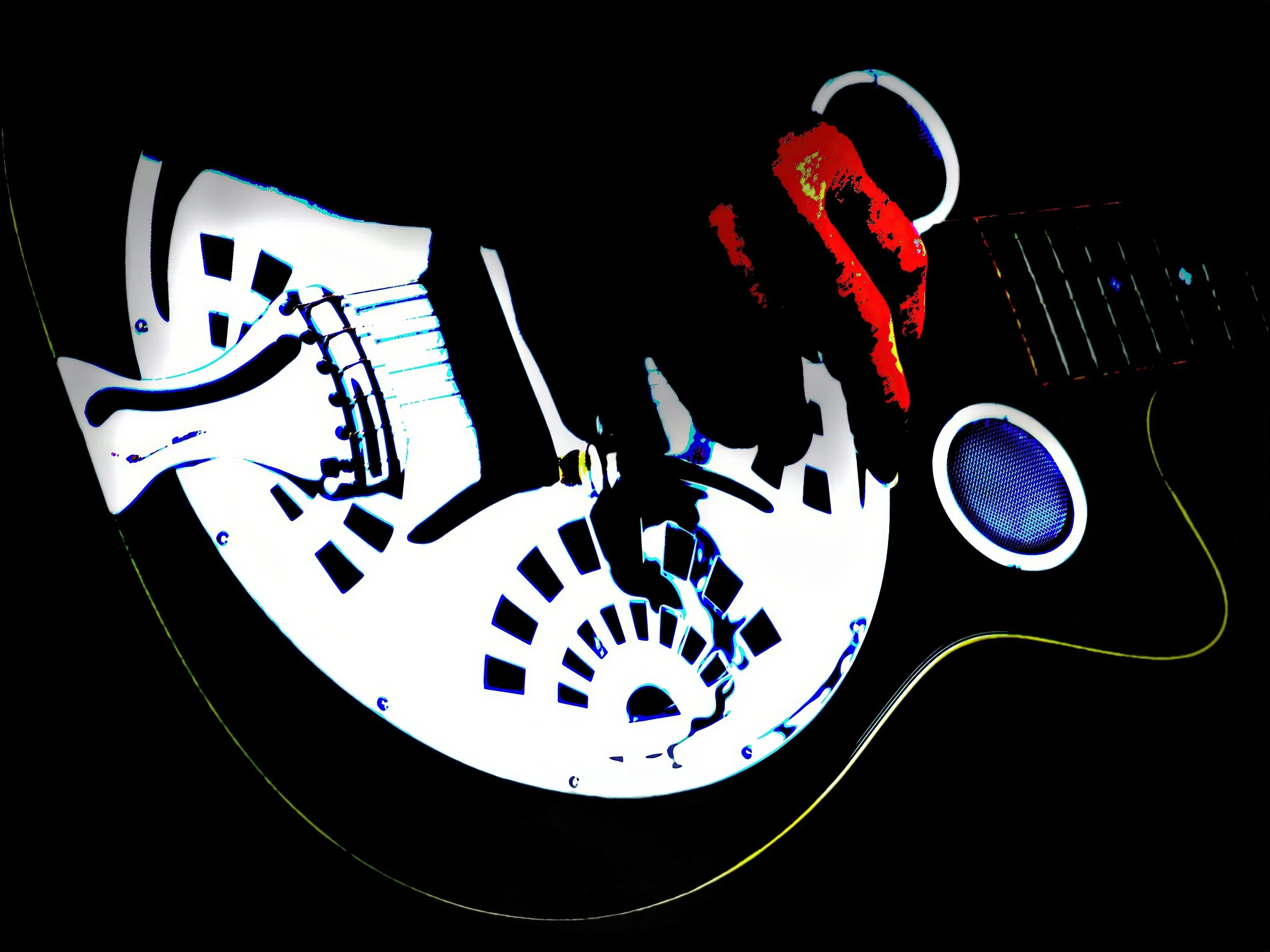
The resonator guitar is built on compression.
Metal cone. Focused projection.
Energy forced through a narrow point.
The image had to do the same.
The photograph is warm, human, contextual.
The artwork strips that away.
It holds the breath before sound.
When I returned to the earlier version, I saw it clearly:
The piece wasn’t asking to grow.
It was asking to stop.
Exploration took me away from it.
Restraint brought me back.
Crazy Girls Guitar
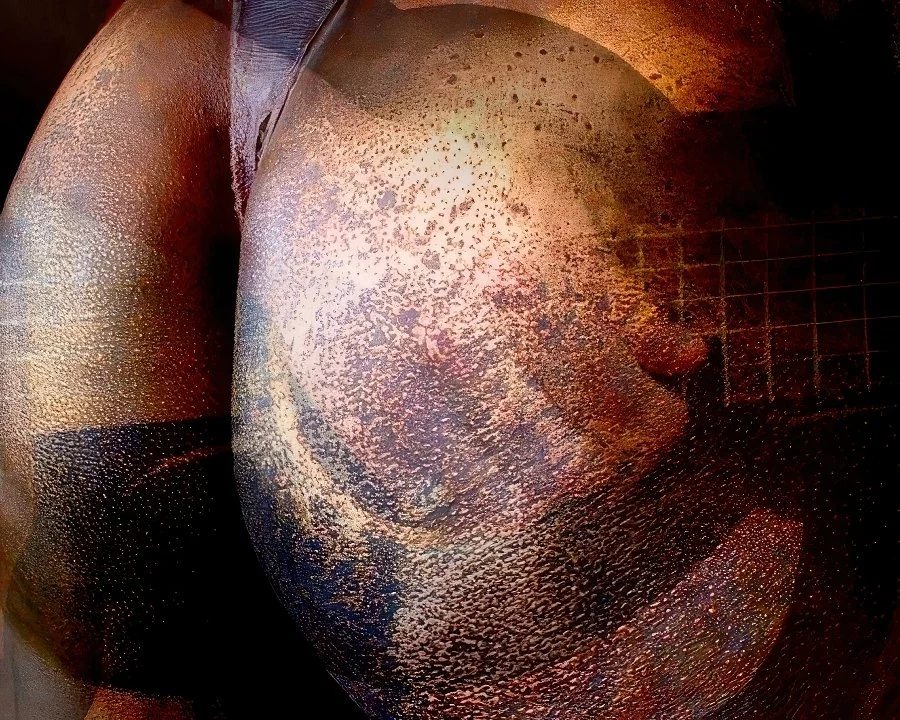
Crazy Girls Guitar
Years ago, outside the Riviera in Las Vegas, a line of bronze figures stood frozen in permanence. The sculpture for Crazy Girls was spectacle cast in metal — exaggerated, theatrical, unapologetically performative. Desire turned into surface. Performance turned into monument.
Bronze does not move.
It does not vibrate.
It does not convert energy.
It only reflects it.
When I photographed that statue, I wasn’t chasing provocation. I was drawn to the idea of performance made permanent — attention frozen in time.
Later, I paired that image with a guitar.
And something shifted.
The guitar is the opposite of bronze.
It only exists when touched.
It only becomes itself when played.
It is not spectacle — it is conversion.
There is a hand in this piece. It rests on the curve of the bronze form. And here is the tension: is it playing the guitar, or is it caressing the body?
It must read as both.
Not a grasp.
Not aggression.
A caress.
The fingers are relaxed. The contact is intentional. It mirrors how a musician naturally rests a hand on the lower bout of a guitar — curved, attentive, controlled. The human body and the guitar share form. Both are shaped by curves. Both respond to touch.
That ambiguity is the fulcrum.
Because learning to play guitar is not just about wanting to be seen. It is about wanting to connect.
Young energy begins without language. Attraction, restlessness, intensity — they arrive before discipline. The guitar becomes a translator. A conversion device.
Desire → discipline
Impulse → tone
Attention → intention
The bronze figures represent spectacle — the pull of the visible world. The guitar represents the invisible work required to turn energy into sound. The hand becomes the bridge between the two.
Is it touching the body?
Or touching inspiration?
That question is the ignition.
In this piece, the surface feels molten — oxidized, volcanic, as if heat is trying to move beneath the metal. But bronze cannot move. It is frozen. Only the guitar can vibrate. Only the strings can convert pressure into frequency.
A caress is relational.
Music is relational.
One is surface.
The other is transformation.
Crazy Girls Guitar lives in that narrow space between attraction and creation. Between attention and intention. Between spectacle and sound.
Bronze remains still.
The guitar turns touch into something that travels.
And that is the difference between being looked at
and being heard.
Binocular Conflict Inside a Single Image
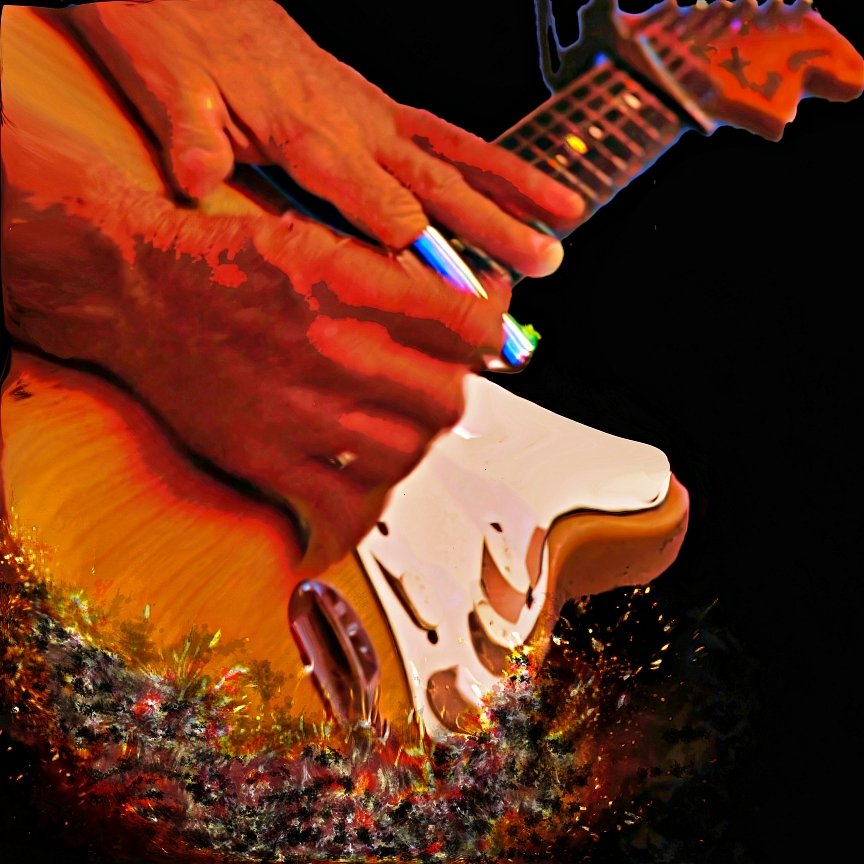
Spark 4 Square
You cannot see this piece all at once.
Your eye moves.
It toggles.
It chooses.
First the guitar.
Then the ignition.
Then the void between them.
The mind tries to hold all three, but it cannot.
That instability is not a flaw.
It is the structure.
This image creates a binocular conflict inside a single frame.
Why You Can’t See It All at Once
The guitar is solid.
It is tactile.
It belongs to the physical world.
The spark is atmospheric.
It does not behave like an object.
It behaves like emergence.
Between them sits a field of black that is not background.
It is separation.
A dimensional seam.
Your visual system wants one spatial logic.
This image offers two.
So perception oscillates:
Matter.
Energy.
Matter.
Energy.
You cannot fuse them in a single glance.
That tension is the experience.
The “Different Dimensions” Effect
The energy in this piece does not begin in the guitar.
It is drawn in.
The dark surrounding the instrument is not empty space.
It represents the unseen field that surrounds everything —
the constant vibration we do not normally notice.
When the musician touches the strings, something happens.
The instrument does not create energy from nothing.
It converts.
Energy from the surrounding field is pulled inward through attention, through touch, through intention.
The guitar becomes a conductor.
The amplifier becomes a translator.
Sound becomes the proof.
The spark does not decorate the instrument.
It precedes it.
That is why it feels dimensional.
Dark Energy → Light → Sound
Universe → field
Field → ignition
Ignition → instrument
Instrument → translation
Translation → sound
The flame is not destruction.
It is conversion made visible.
What appears as fire is the moment the invisible becomes perceptible.
The square frame contains the moment so we can study it.
Inside it, the unseen turns into light.
Light becomes motion.
Motion becomes tone.
What we hear is not just vibration of string.
It is a translation event.
Why It Feels Hard to Look At
You cannot fully see both the guitar and the spark simultaneously because they operate in different perceptual registers.
One is weight.
One is flux.
One is wood and wire.
One is particle and wave.
The brain wants resolution.
This piece denies it.
It holds the viewer at the threshold —
the instant before energy becomes sound.
That unsettled feeling is the same sensation musicians experience when they tune into something larger than themselves.
Spark 4 Square suggests that music is not something we manufacture.
It is something we tune into.
The player draws energy from the unseen world,
channels it through wood and wire,
and releases it as sound.
What we hear is not just a note.
It is the universe, translated.
Less Is More
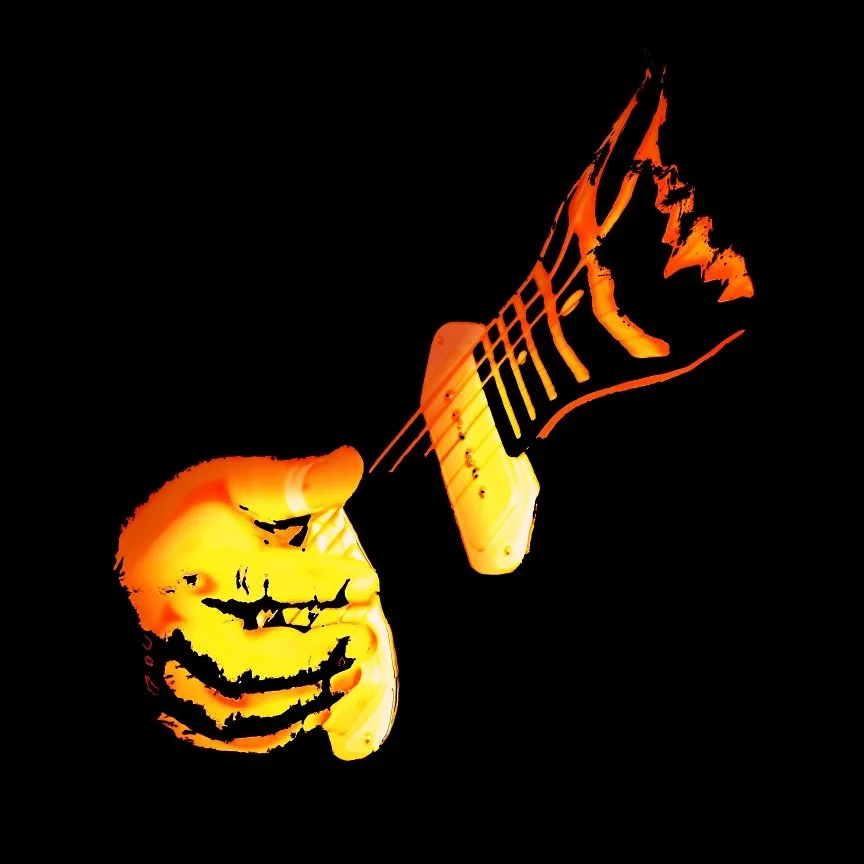
Less is More
There’s a phrase every guitar student hears at some point.
Usually after they’ve just played too much.
Less is more.
It sounds simple. Almost corrective. But it isn’t about playing smaller. It’s about playing truer.
When we begin, we want to fill the room. Fill the silence. Fill the air with sound so no space is left untouched. More notes. Faster lines. Bigger gestures. We equate density with depth.
But somewhere along the way, if we stay with it long enough, something shifts.
We start to hear the space.
We notice that music does not live only in what is played — it lives in what is allowed. The air between notes begins to carry weight. The pause becomes expressive. The restraint becomes musical.
In this piece, the black is not absence. It is room. The player does not dominate it. He fits into it.
The hand glows but does not overwhelm. The guitar burns, but in control. The flame does not engulf the frame; it rises and stops. The composition leaves breathing space on all sides.
That is the lesson.
A mature guitarist understands that tone expands outward on its own. It doesn’t need to be pushed. The echo, the resonance, the listener — they all require room. Music becomes relational instead of performative.
Less attack.
More listening.
Less noise.
More meaning.
The discipline is not technical — it’s spatial.
To fit into the room rather than fill it.
To leave room for the other instruments.
For the echo.
For the breath.
For the person on the other side of the sound.
Less is not reduction.
Less is respect.
And when you finally understand that,
the music gets bigger —
because you stopped trying to make it big.
Pony Up 23
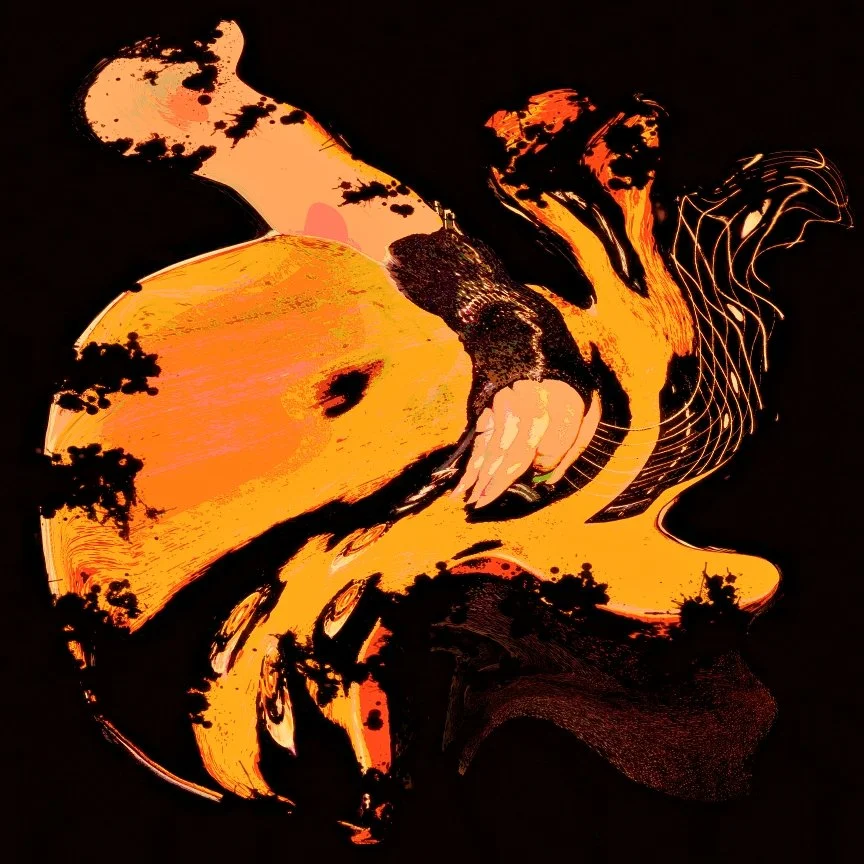
Pony Up 23
There was nothing remarkable about this piece at the beginning.
It started as a form. A gesture. A movement that could have gone anywhere or nowhere. I almost left it alone.
But I didn’t.
The longer I stayed with it, the more it began to rear up.
At first glance, you might see a guitar. The curve of a body. The sweep of strings. The familiar tension of a hand meeting instrument.
Look again.
There is something else rising inside it — something animal. Something muscular. Something that refuses to remain decorative.
The guitar does not sit politely in this image. It does not wait to be played. It becomes force.
“Pony up” is a phrase about stepping forward. About paying what is owed. About choosing to rise instead of remaining seated.
This piece carries that energy.
The form leans left, heavy and grounded, but the lines on the right stretch like reins or wind or tension pulling against restraint. The black fields are not empty space; they are pressure. And inside that pressure — buried in the lower right shadow — there is a micro spark.
Not on the surface.
Not flashing for attention.
But forming.
Energy does not always explode outward.
Sometimes it gathers.
Without Square has never been about making an object disappear. It has been about allowing it to destabilize just enough to reveal process. In Pony Up 23, the object does not dissolve — it transforms.
The instrument and the animal share a body.
The strings are no longer just strings.
They are tension lines.
Control lines.
Possibility lines.
Is it a horse becoming a guitar?
Is it a guitar becoming a horse?
Or is it simply force taking the shape it needs in order to move?
The piece does not answer.
It rises.
And sometimes that is enough.
A Moment in Time I Don’t Take Lightly
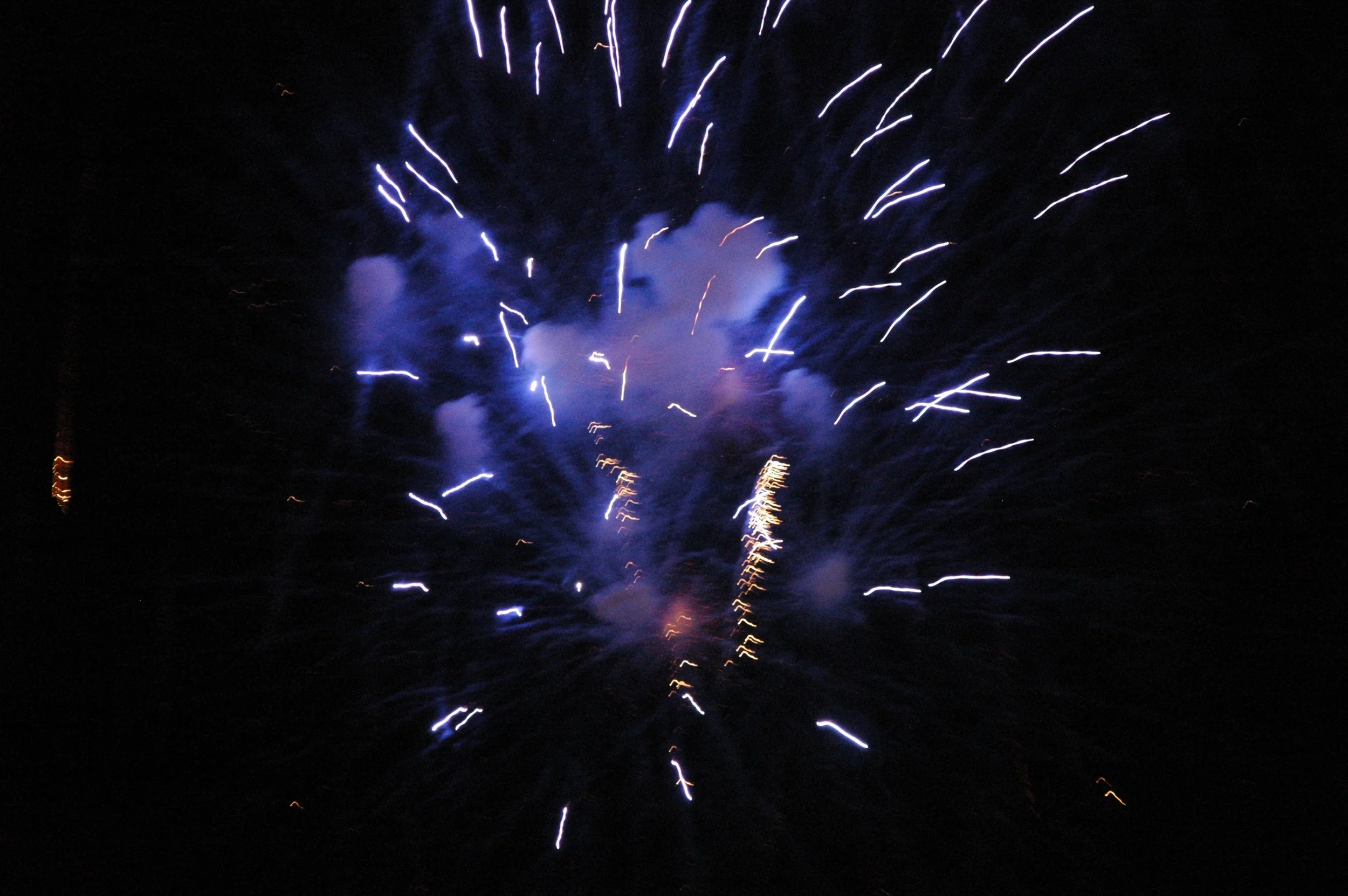
A Moment in time
I feel incredibly privileged and lucky to have the time, the health, and the financial stability that allow me to look inward, find the art in my soul, and let it breathe.
I don’t say that casually. Time, health, and stability are not givens. They are fragile, unevenly distributed, and easily lost. To have all three at once is not something I assume. It’s something I notice. It’s something I hold carefully.
Because of that, this moment carries responsibility.
I’m not making work to chase relevance or attention. I’m not trying to explain myself into existence. I’m listening for what asks to be made when the noise settles. Some days that arrives as music. Some days as an image. Sometimes it arrives as nothing at all — just the awareness that silence, too, is part of the work.
Lately, I’ve been moved by watching others step forward with their stories. Strangers, carrying years of living into a few vulnerable minutes. Their courage opens something in me. Not envy. Not comparison. Recognition. We respond because we see ourselves reflected back — our losses, our persistence, our unfinished hopes.
That exchange matters.
Art isn’t separate from life. It’s how life speaks when words fall short. It’s how one person’s honesty becomes another person’s permission. When we allow ourselves to feel a stranger’s truth, distance collapses. We remember what connects us.
So today, I’m choosing not to rush. Not to force meaning or conclusions. I’m letting the work arrive at its own pace. Letting the art breathe also means letting myself breathe — staying present with gratitude, with memory, with whatever this moment offers.
This is a moment in time I don’t take lightly. And for now, that awareness is enough.
Bottleplay 3
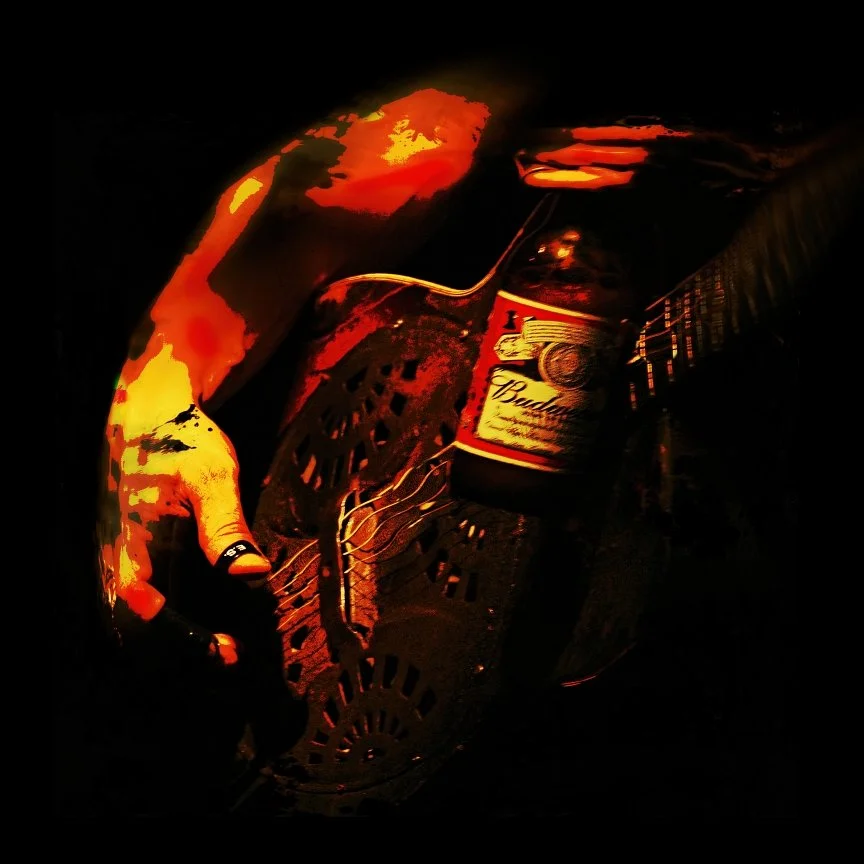
Bottleplay 3
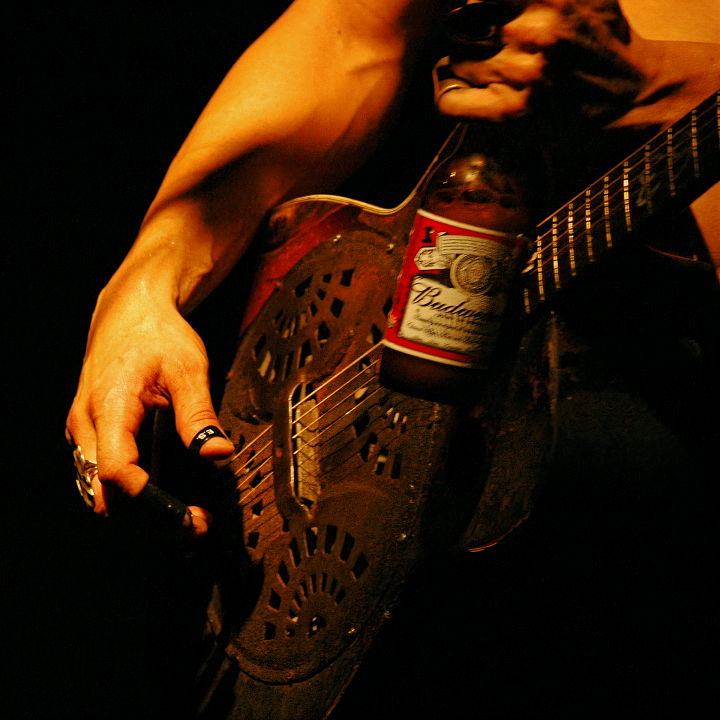
Bottleneck Slide
A photograph is a claim of permanence.
It says: this happened, and it will stay this way.
The original image does exactly that. A hand, a bottle, a moment fixed long enough to be trusted. The object knows what it is. The frame holds it in place. Nothing moves unless memory moves it later.
Bottleplay 3 begins there — and then refuses to stay.
Once brought into Without Square, the image lets go of its obligation to be still. The square no longer pins the moment down. The edges loosen. Gravity becomes optional. What was once fixed becomes suspended, not frozen but hovering — caught between states rather than locked into one.
This isn’t abstraction for its own sake. It’s a shift in time.
In the photograph, the bottle is permanent.
In Without Square, it becomes temporary again.
The hand no longer documents possession; it suggests motion. The object no longer rests inside a moment; it drifts through it. The image stops saying this was and starts asking what if it doesn’t stay.
You might still recognize where this came from. That recognition arrives quickly — and then dissolves. What replaces it is movement without destination. A form no longer anchored to use, brand, or outcome. A moment allowed to continue rather than conclude.
This is what Without Square changes.
It doesn’t destroy the photograph — it releases it.
I like the original image because it holds time still.
I like this version because it gives time back its motion.
Matchbook 26 — Without Square
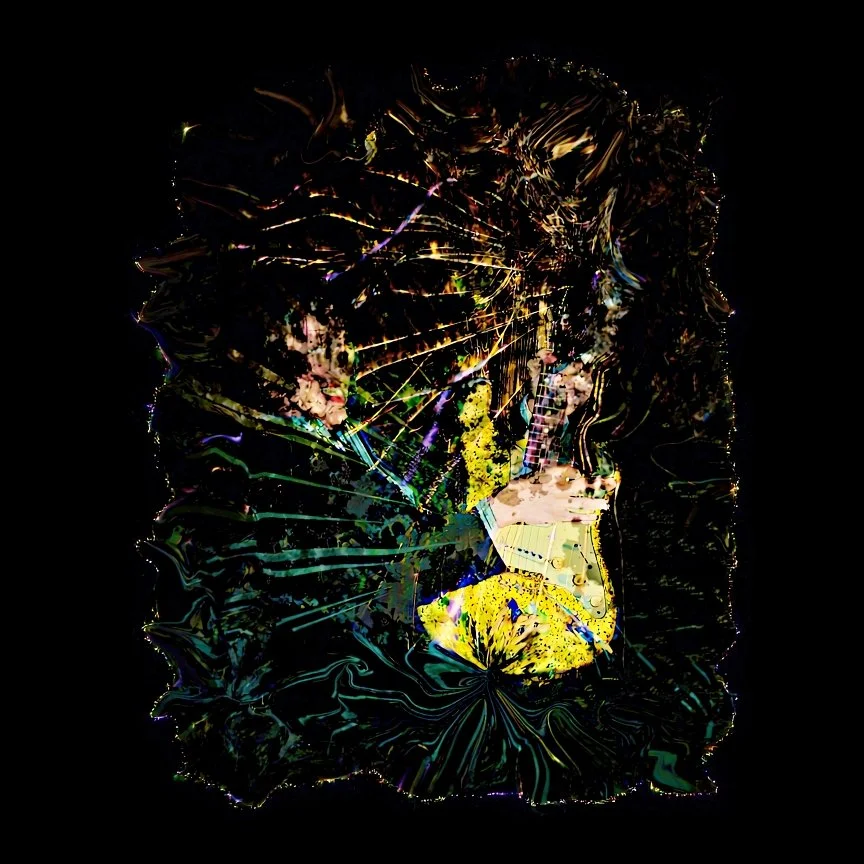
Matchbook 26
The world as we knew it is disappearing right in front of our eyes.
Not abruptly. Not all at once.
But steadily enough that it is becoming harder to believe what we see, and harder still to agree on what is real.
Climate change dominates headlines—even when it’s softened into phrases like “a one-in-a-hundred-year storm.” Masked, armed men aggressively threaten and hurt people of all kinds. AI is rapidly developing toward forms of intelligence that disrupt nearly everything—good and bad—that has been. The familiar world is still here, but it is barely visible now, like an afterimage.
Without Square began with that instability. It is not a rejection of form, but a rejection of the frame that once promised certainty. The square—long trusted as structure, balance, containment—can no longer be assumed. When the square disappears, the image must either hold itself together or reveal what happens when it cannot.
Matchbook 26 exists in that moment.
At first glance, there is something recognizable: a guitar, hands, the posture of playing. These are familiar anchors. But recognition doesn’t last. The longer the image is held, the more it refuses to stabilize. Edges dissolve. Light fractures. Motion begins to outweigh object.
This is not a depiction of a musician. It is a depiction of ignition.
The guitar behaves less like an instrument and more like a conductor—its strings extending outward as lines of force. What should be surface becomes heat. What should be form becomes release. The hands remain partially intact, but unstable, suspended between control and erosion. They suggest intention, but not mastery.
The boundary of the image burns irregularly. There is no clean border, no stable frame to step behind. Micro-sparks and filaments of light trace the perimeter as if the image itself is shedding energy into darkness. Containment has failed, but collapse has not yet arrived.
A match is inert until it isn’t.
For a long time it is only potential—paper, sulfur, waiting. Then pressure, friction, contact. In an instant it stops being matter and becomes energy. There is no middle state. One moment it is form; the next it is reaction.
Now imagine all the matches igniting at once.
A matchbook is designed for one flame at a time. When all the matches light in unison, the book burns fast. The object itself becomes irrelevant. What matters is the release.
That is the core image behind Matchbook 26: we try to hang on, but all we have left in our hand is an empty matchbook with a heavily burned edge.
2026 is that ignition moment—the matches going up in flames while we wonder what we will have in its place.
People are asking questions right now, whether they say them out loud or not:
What can still be trusted when familiar structures stop holding?
What remains real when clarity dissolves faster than understanding?
Are we watching destruction—or transformation that doesn’t yet have a familiar shape?
The image does not answer with slogans. It answers structurally. In Without Square, meaning does not arrive through resolution. It emerges through tension. Recognizable forms still exist, but they no longer stabilize the scene. Reality hasn’t vanished—it has become unstable, active, and difficult to pin down.
And yet fire is not only destruction.
Fire reveals.
Fire consumes what cannot endure.
Fire clears space.
So the final question—quietly present in the burn—is not whether something is ending. It is what will be left after the heat passes.
Will it burn away what is cruel and false?
Will it leave room for something more honest to grow?
I think it will.
I believe we can grow into a more pure form of love.
And I am watching.
Guitar Zoom
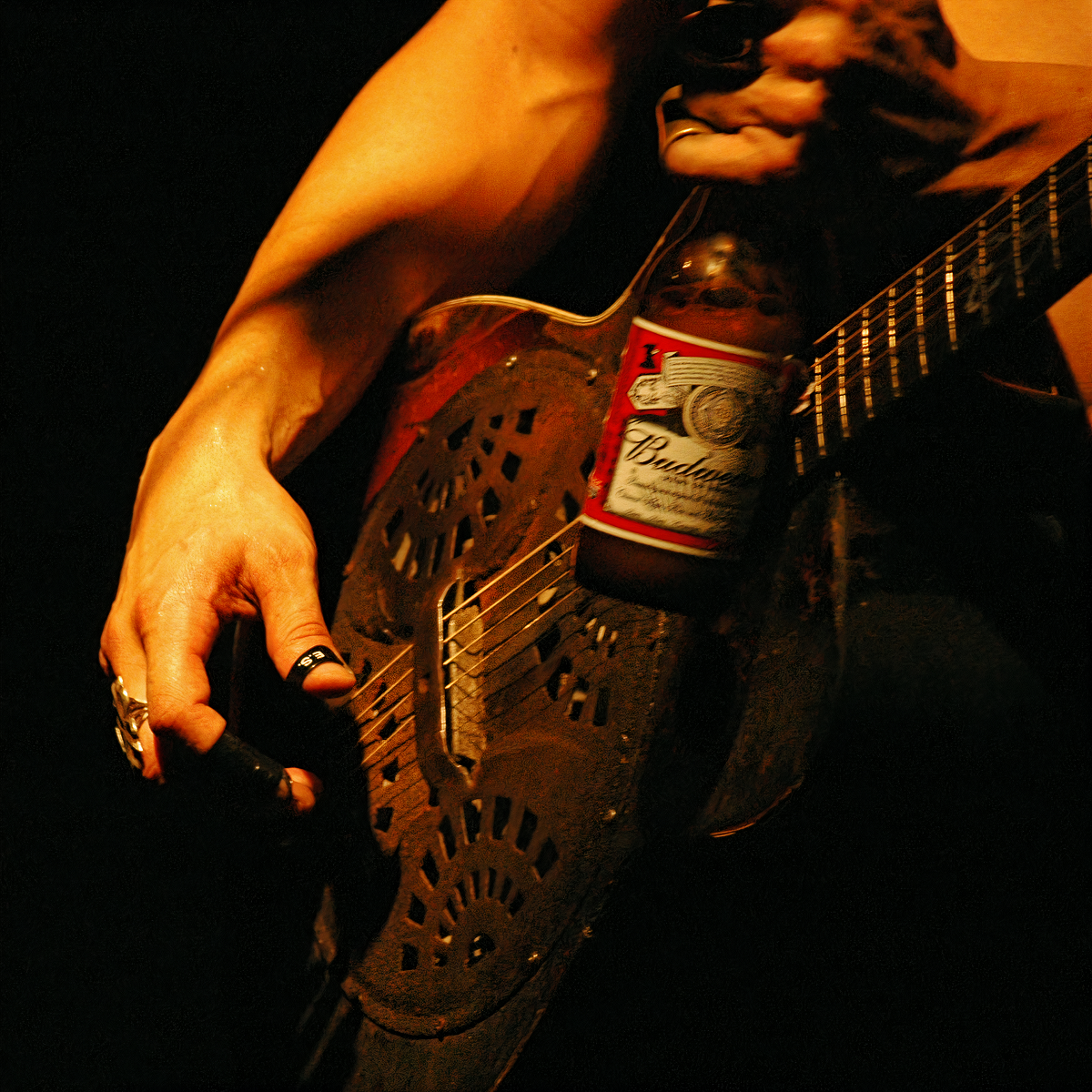
Bottleneck
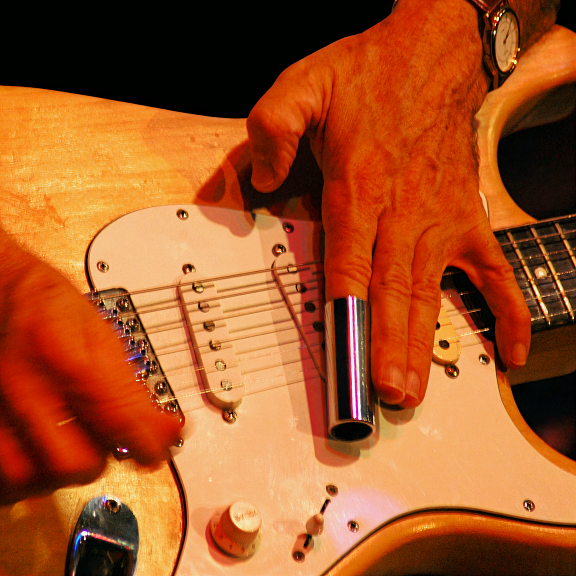
Slow Burn
Where my art began
(“This Is About the Guitar. And the People Who Can’t Put It Down.”)
The idea had to start somewhere.
Before there was a series, before there was a style, before there was abstraction, I was simply a photo enthusiast who loved music. I was a musician, a singer, a songwriter, a guitar player — and like many people who love music deeply, I wanted to be close to it. So I carried my big Nikon and heavy lenses into clubs and theaters, lugging them to local shows and national acts whenever I could.
Many of those national shows were blues-rock shows — not just because I loved the music, but because those were the rooms that would let you bring a camera inside. I shot countless performances, and I shared the images freely with local bands I followed and photographed often. That was part of the culture. Part of the exchange.
But somewhere along the way, I found my shot.
It wasn’t the wide stage.
It wasn’t the face.
It wasn’t the spotlight moment.
It was the extreme close-up of hands and guitar.
This shot was brutally difficult. You had to capture the exact moment — the right angle, the right timing, the right focus — while everything was moving. Hands flying. Strings vibrating. Lights flashing. Sweat. Motion. Noise. Out of hundreds of frames, maybe one would be special.
I took thousands of these photographs to build the collection I have today.
At this distance, it doesn’t matter if the musician is famous. The identity dissolves. What remains is the instrument and the human interaction with it. The guitar becomes the subject. The hands become the story.
The wear on the guitar.
The scratches and dents earned through use.
The rings and bracelets on the player.
The digging-in of fingertips.
The callouses.
The scars.
I often tried to catch the moment when the playing moved up the neck — when both hands could live inside the same frame. To do that, I usually had to be right at the front of the stage, close enough to see details that no one else could. Sometimes it was the blur of motion that made the image. Sometimes it was the impossible sharpness — the kind of sharpness camera companies used to brag about in watch advertisements.
Back then, cameras were compared by their ability to photograph a wristwatch in perfect focus — posed, lit, still.
I captured mine in flashing, strobing light — while everything was moving.
You could read the time on the watch.
You could see the hair on the back of a hand.
You could feel the tension in the strings.
I called these photographs Guitar Zoom.
They were made for guitar players — to decorate the spaces where they live, practice, and think. Because a guitar player is a guitar player all the time. It’s a shared identity. A massive, global group of people drawn to this instrument — from the most talented players to the absolute beginner.
Picking up a guitar is an act of curiosity.
Learning to make it sing is an act of patience.
Writing songs is an act of vulnerability.
Forming a band is harder than finding a spouse — because it’s more than two people learning how to become something together.
And then there’s the guitar itself.
The endless shapes.
The colors.
The wood grains.
The stains.
The fretboards made from dense, exotic woods gathered from around the world.
A guitar is beautiful when it’s perfect.
And it’s beautiful when it’s worn.
Like a well-used book, or a Bible that has been opened and studied thousands of times — the wear matters. The wear means something. Each guitar develops a personality. Some gain fame. Most simply gain history.
But eventually, I wanted more than the photograph.
I knew that thousands of concert photographers probably had images like these sitting quietly in their archives. I wanted to take this shot — this same framing, this same subject — and push it further. To move it from a great picture into enduring art. Something instantly recognizable as mine.
My style.
My voice.
My signature.
I wanted to capture energy.
Sound.
Transformation.
The movement from solid to sound.
From sight to memory.
From wave to particle.
From realism into abstraction — while always remaining the same shot: hands and guitar.
That pursuit has never stopped.
I love the guitar.
I love playing.
I love listening.
I love exploring pedals to create new sounds.
I love plugging into different amps to chase the elusive tone — the one that feels like recognition.
This work is for everyone who loves guitars.
For the players who spend countless hours practicing, only to realize the more they learn, the more there is to learn. For the beginner — even the toddler running tiny hands across the strings, startled by the sound they just created. The laugh. The smile. The moment of discovery.
It’s about the connection.
Sound leaves the hand, travels through space, enters another human being, becomes electrical signal, memory, emotion — and sometimes, meaning. Sometimes connection. Sometimes the simplest and most elusive thing we have.
This is where Guitar Zoom began.
And it’s still giving me more.
The chase of what can be removed.
What can be bent.
What can be recolored.
What can dissolve — while the essence remains.
My hope is that when you look at one of these pieces, you don’t just see it.
You hear it.
You feel the whole — and then you discover the tiny distortions, the details hiding inside the abstraction. The place where form becomes sound, and sound becomes memory.
This is Guitar Zoom.
This is where it all started.
And I’m still chasing it.
Where it all began
The idea had to start somewhere.
Before there was a series, before there was a style, before there was abstraction, I was simply a photo enthusiast who loved music. I was a musician, a singer, a songwriter, a guitar player — and like many people who love music deeply, I wanted to be close to it. So I carried my big Nikon and heavy lenses into clubs and theaters, lugging them to local shows and national acts whenever I could.
Many of those national shows were blues-rock shows — not just because I loved the music, but because those were the rooms that would let you bring a camera inside. I shot countless performances, and I shared the images freely with local bands I followed and photographed often. That was part of the culture. Part of the exchange.
But somewhere along the way, I found my shot.
It wasn’t the wide stage.
It wasn’t the face.
It wasn’t the spotlight moment.
It was the extreme close-up of hands and guitar.
This shot was brutally difficult. You had to capture the exact moment — the right angle, the right timing, the right focus — while everything was moving. Hands flying. Strings vibrating. Lights flashing. Sweat. Motion. Noise. Out of hundreds of frames, maybe one would be special.
I took thousands of these photographs to build the collection I have today.
At this distance, it doesn’t matter if the musician is famous. The identity dissolves. What remains is the instrument and the human interaction with it. The guitar becomes the subject. The hands become the story.
The wear on the guitar.
The scratches and dents earned through use.
The rings and bracelets on the player.
The digging-in of fingertips.
The callouses.
The scars.
I often tried to catch the moment when the playing moved up the neck — when both hands could live inside the same frame. To do that, I usually had to be right at the front of the stage, close enough to see details that no one else could. Sometimes it was the blur of motion that made the image. Sometimes it was the impossible sharpness — the kind of sharpness camera companies used to brag about in watch advertisements.
Back then, cameras were compared by their ability to photograph a wristwatch in perfect focus — posed, lit, still.
I captured mine in flashing, strobing light — while everything was moving.
You could read the time on the watch.
You could see the hair on the back of a hand.
You could feel the tension in the strings.
I called these photographs Guitar Zoom.
They were made for guitar players — to decorate the spaces where they live, practice, and think. Because a guitar player is a guitar player all the time. It’s a shared identity. A massive, global group of people drawn to this instrument — from the most talented players to the absolute beginner.
Picking up a guitar is an act of curiosity.
Learning to make it sing is an act of patience.
Writing songs is an act of vulnerability.
Forming a band is harder than finding a spouse — because it’s more than two people learning how to become something together.
And then there’s the guitar itself.
The endless shapes.
The colors.
The wood grains.
The stains.
The fretboards made from dense, exotic woods gathered from around the world.
A guitar is beautiful when it’s perfect.
And it’s beautiful when it’s worn.
Like a well-used book, or a Bible that has been opened and studied thousands of times — the wear matters. The wear means something. Each guitar develops a personality. Some gain fame. Most simply gain history.
But eventually, I wanted more than the photograph.
I knew that thousands of concert photographers probably had images like these sitting quietly in their archives. I wanted to take this shot — this same framing, this same subject — and push it further. To move it from a great picture into enduring art. Something instantly recognizable as mine.
My style.
My voice.
My signature.
I wanted to capture energy.
Sound.
Transformation.
The movement from solid to sound.
From sight to memory.
From wave to particle.
From realism into abstraction — while always remaining the same shot: hands and guitar.
That pursuit has never stopped.
I love the guitar.
I love playing.
I love listening.
I love exploring pedals to create new sounds.
I love plugging into different amps to chase the elusive tone — the one that feels like recognition.
This work is for everyone who loves guitars.
For the players who spend countless hours practicing, only to realize the more they learn, the more there is to learn. For the beginner — even the toddler running tiny hands across the strings, startled by the sound they just created. The laugh. The smile. The moment of discovery.
It’s about the connection.
Sound leaves the hand, travels through space, enters another human being, becomes electrical signal, memory, emotion — and sometimes, meaning. Sometimes connection. Sometimes the simplest and most elusive thing we have.
This is where Guitar Zoom began.
And it’s still giving me more.
The chase of what can be removed.
What can be bent.
What can be recolored.
What can dissolve — while the essence remains.
My hope is that when you look at one of these pieces, you don’t just see it.
You hear it.
You feel the whole — and then you discover the tiny distortions, the details hiding inside the abstraction. The place where form becomes sound, and sound becomes memory.
This is Guitar Zoom.
This is where it all started.
And I’m still chasing it.