
Torque
Torque
Torque
I found this piece on an old drive dated March 3, 2006.
This was the pre-iPhone world. Before social media feeds. Before filters, presets, algorithms, and named aesthetics. Before “glitch” became a style, before abstraction needed subcategories, before images were built for captions instead of contemplation.
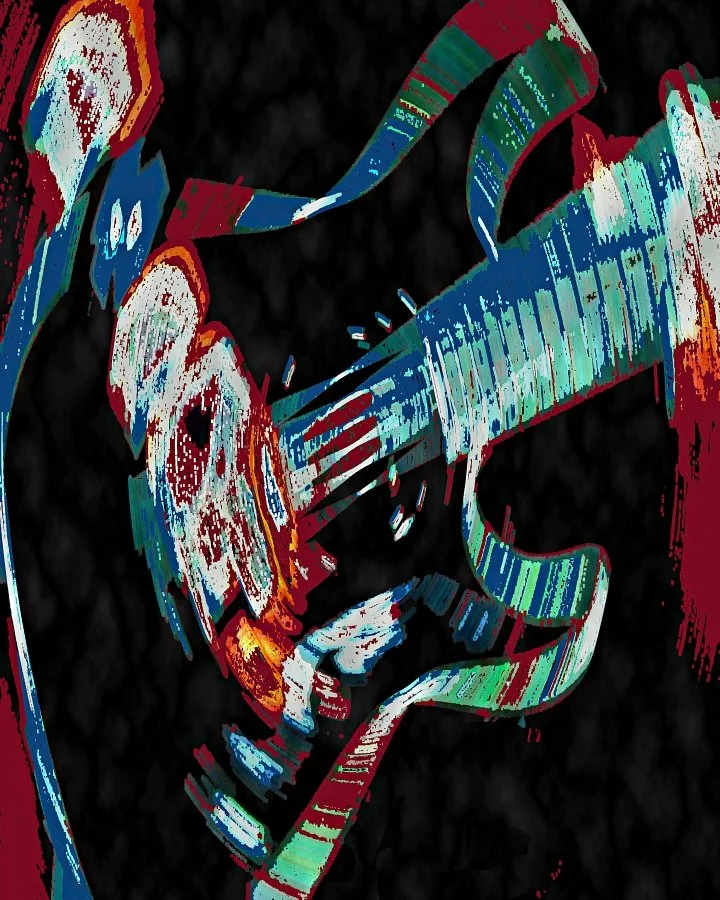
At the time, I didn’t have the language for what I was doing. I only knew I was trying to hold onto a moment — not the guitar itself, but the force acting on it. Rotation. Resistance. The instant where motion stops being visual and starts becoming sound.
The image isn’t about distortion for its own sake. It’s about stress. Torque is force applied through rotation, but it only exists because something pushes back. Without resistance, there is no torque — only spin.
That tension is what remains legible here. The guitar never fully disappears, but it doesn’t resolve either. It stays caught between structure and release. The hand, the instrument, the strike — all present, all unstable.
The background matters more than I realized then. The black here isn’t pure. It’s clouded, textured, unsettled. It still carries atmosphere — a sense of space rather than absence. This differs from the pure black I would arrive at later, where the void becomes absolute and intentional. Here, the black still breathes. It hasn’t yet hardened into silence.
What feels most uncanny now is how closely this work previews what would later become Without Square — years before that language existed, before the decision to remove containment altogether became deliberate.
The image is already resisting enclosure. The guitar does not sit comfortably inside the frame. Motion pushes outward, blurs edges, refuses to settle. Even the background behaves less like a boundary and more like weather. The square is present, but it’s already being questioned.
In later work, the square would disappear entirely. The black would become absolute. Containment would be removed on purpose. Here, none of that had been decided yet — but the pressure against it is visible. The work is already testing how much structure it can dissolve without losing contact.
What’s unsettling is not that this looks like something I would make now. It’s that it feels like something that waited.
This file wasn’t curated or preserved intentionally. It wasn’t carried forward as part of a plan. It simply remained dormant until the surrounding work caught up to it — as if the ideas had to mature elsewhere before this piece could re-enter the conversation.
I don’t experience this as nostalgia. It feels more like recognition at a distance. A signal sent forward without knowing who would receive it — only to find that the receiver turned out to be the same person, years later, finally prepared to understand it.
This wasn’t chasing a trend. It came before most of them.
This wasn’t a beginning or an ending. It was a moment of alignment — captured before I knew why it mattered.
The name came later.
Torque
Because this work predates the term, it’s worth defining what glitch means here.
Glitch (in art)
In art, glitch refers to the intentional use of error, malfunction, or disruption—often drawn from digital systems—to create visual, sonic, or conceptual meaning.
Plain definition
A glitch is a breakdown in a system that becomes the work itself.
Instead of correcting the error, the artist preserves or amplifies it.
Where the term comes from
Originally an engineering term (mid-20th century) meaning a brief fault in an electrical or mechanical system
Adopted by artists once digital tools became common and errors became visible
In visual art
Glitch can include:
Pixel corruption
Compression artifacts
Data misalignment
Color channel separation
Frame tearing or repetition
Distorted edges caused by software or file misuse
Crucially: these effects are not decorative when used seriously—they expose the system underneath the image.
Conceptually, glitch art is about:
Revealing the hidden structure of technology
Interrupting smooth, consumable images
Questioning ideas of perfection, control, and realism
Letting process show instead of hiding it
A glitch says: this image is not natural — it is constructed.
Important distinction
Accidental glitch: a mistake
Artistic glitch: a chosen condition
Once the artist decides to keep it, it stops being an error and becomes material.
Why glitch mattered historically
Glitch art emerged as a recognizable movement in the early 2000s—alongside:
Early digital cameras
File compression
Internet image sharing
Software instability
It was a reaction against the promise that digital tools would make images cleaner, truer, and perfect.