
Jonny 5 without time
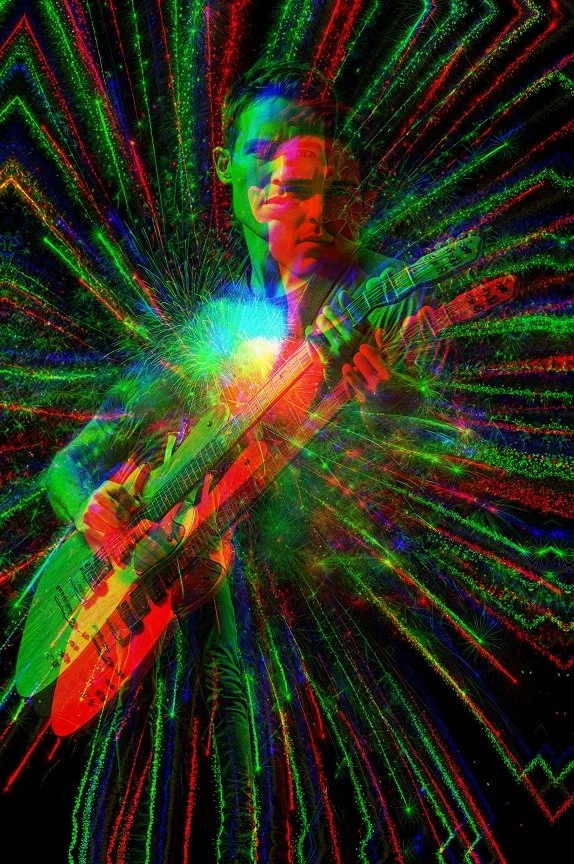
Jonny 5 Out of Time
Jonny 5 — Out of Time
There is something unsettling about this image, and it took me time to understand why.
When I look at Jonny 5 — Out of Time, I can’t hold the entire face at once. If I lock onto one version of the face, the other disappears. When my eye shifts, the first collapses. I can’t see both simultaneously. The image refuses to resolve.
This isn’t an accident.
The faces are not just doubled in space—they are separated by color. One resolves through red, the other through green. The human eye treats these colors as opposites. When one becomes dominant, the other is suppressed. Perception turns into a switch rather than a blend.
The result is a kind of visual instability. The image doesn’t exist all at once. It exists over time. You don’t see it in a single moment—you move through it.
That experience mirrors what the piece is about.
This isn’t a portrait of a musician frozen in performance. It’s an image of sound outrunning the body that produced it. Identity fragments. Time slips. The figure exists in more than one state but cannot be perceived as whole. What you see depends on where you place your attention.
In that sense, Jonny 5 — Out of Time pushes Out-of-Square beyond form and into perception itself. The square isn’t just abandoned physically—it’s abandoned cognitively. The image refuses a single, stable reading. It demands participation. It requires the viewer to accept incompleteness.
The instability isn’t something to solve. It’s the subject.
If the image feels unresolved, that’s because it is. It exists in transition—like sound, like memory, like vibration. You’re not meant to see everything at once.
You’re meant to move.
And if that feels uncomfortable, it may be because the mind wants edges, certainty, and completion.
This piece offers none of that.
It may only fully make sense
if your mind is not square.