
Fractured Float 4
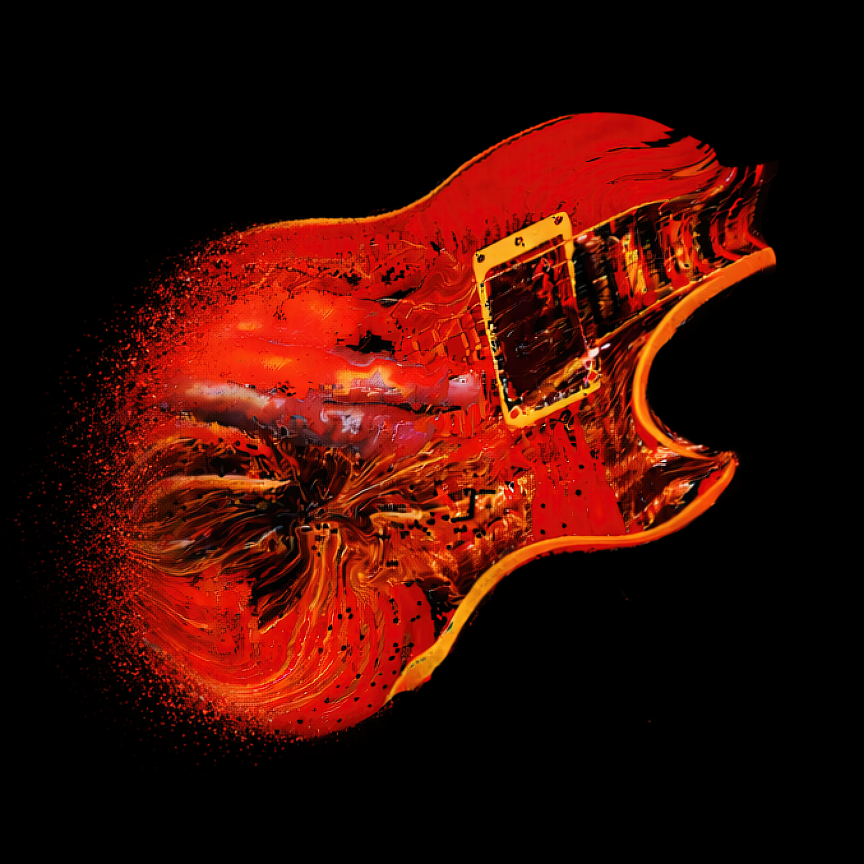
A first work after the manifesto. A statement of what comes next.
There are moments in an artist’s life when a piece arrives not as an experiment, but as a recognition. Not as a variation, but as a confirmation. Fractured Float 4 is that moment for me. It is the first work completed after articulating my manifesto—my commitment to referential abstraction, to Without Square, and to a language that refuses containment while remaining anchored to a real object.
This piece is not simply an image. It is an event in which form, energy, and perception meet. What follows is an extended articulation of what Fractured Float 4 is, what it is doing, and why it matters within the larger arc of my work.
From Object to Event
At its core, the work still contains a guitar. The referent is not erased; it is honored. But it is no longer illustrated. The guitar is no longer presented as a thing to be looked at. It has become something to be experienced.
This is the defining principle of referential abstraction: the object remains present, but meaning is carried by transformation rather than depiction. The guitar does not disappear—it evolves. It becomes vibration, memory, resonance, fracture. The image does not represent the guitar; it behaves like it.
In Fractured Float 4, the instrument is liberated from geometry. There is no frame, no rectangular boundary, no architectural containment. It is form without enclosure—a presence that exists without edges, floating in a void that is not emptiness but possibility.
Without Square: Form Without Boundary
Much of art history is defined by containment: canvas edges, frames, borders, and architectural limits. Without Square is my refusal of that inherited geometry.
Here, the form is not cropped to fit a rectangle. It is not subordinated to the logic of the wall or the screen. Instead, it occupies space on its own terms—organic, asymmetrical, and unconfined. The piece does not sit inside a shape; it is the shape.
This is not merely aesthetic. It is philosophical. The work asserts that meaning does not require containment, that presence does not require a box, and that an object can exist fully without being enclosed.
Fracture as Energy, Not Decoration
The internal distortion of the form is not a stylistic effect. It is not a filter applied for visual novelty. The fracture reads as force: vibration, pressure, memory bending, time pulling the image apart. It behaves less like surface ornament and more like an energetic field.
This is where the work crosses from image into process. What you see is not just what the guitar looks like—it is what the guitar does. Sound becomes visible. Motion becomes form. Resonance becomes structure.
The fracture is not destruction. It is transformation.
Color as Structural Force
The dominant reds, oranges, and golds are not simply chromatic choices. They are doing conceptual work. They carry heat, compression, ignition. Color becomes architecture.
Rather than decorating the form, color becomes the mechanism through which the form is understood. It is not added; it is intrinsic. This is not “color on an object,” but color as the object’s internal logic.
In this sense, Fractured Float 4 treats color as time, as pressure, as force. It is not describing energy—it is energy.
Micro-Life: The Presence of the Small
One of the most important aspects of the piece is almost invisible at first glance: tiny two-pixel artifacts embedded within the form. These minute details act like grain in film, fiber in paint, or surface noise in vinyl. They introduce biology into the digital.
They give the piece animal life.
Perfection would have sterilized the image. Instead, these micro-elements make it breathe. They introduce irregularity, vulnerability, and presence. The work feels alive not because it moves, but because it is imperfect in the way living things are imperfect.
Flow and Solidity: A Quantum Object
One of the most striking qualities of Fractured Float 4 is its dual nature. It feels simultaneously fluid and solid. It occupies space while resisting containment. It appears stable while suggesting motion.
In this way, the piece behaves almost quantum-like: wave and particle, motion and stillness, identity and dissolution coexisting in a single visual field. The guitar is there—but so is the event of it becoming something else.
This is the visual language I have been searching for: an object that is both itself and the process of transformation.
The Giving Image
I describe this piece as “giving” because it does not exhaust itself. It rewards sustained looking. There is always another micro-event to discover, another path for the eye to travel. The work does not present a single conclusion; it offers a field of attention.
This is the difference between decoration and art.
Design satisfies quickly. Art continues to reveal.
Position Within the Body of Work
Fractured Float 4 is not a variation. It is a threshold.
It stands as the first work created after my manifesto, and it functions as a declaration of intent:
The guitar remains the referent.
Geometry no longer contains the form.
Color becomes structure.
Fracture becomes energy.
Presence replaces representation.