
The Ring Ignition
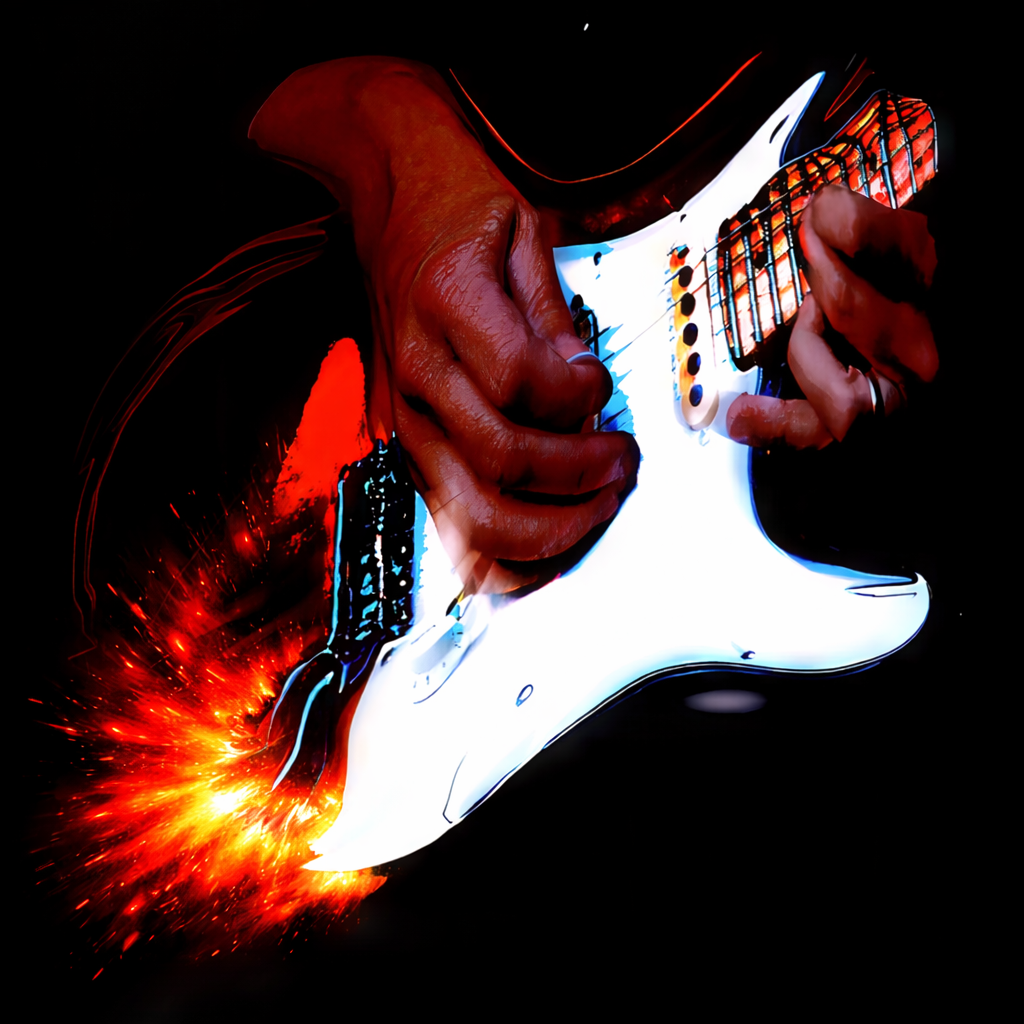
The Ring Ignition
This work begins with recognition.
At first glance, the guitar is unmistakable. The hands are present. The gesture reads immediately. The viewer knows where they are. That clarity is intentional—it allows entry without effort.
But the image does not reward a quick read.
With closer attention, the chain reveals itself. The strings on the fretboard are not static. They bend. They distort. They carry tension forward, not as illustration, but as evidence. The ignition does not begin in the burst of light—it begins at the string itself. The fretboard becomes the first fault line, the point where physical pressure starts its transformation.
The hands are real—but more than real at the same time. They are not symbolic, and they are not abstract. They carry weight, texture, and intention, yet they do not fully belong to a single moment. They appear slightly ahead of the body, pulled forward along the wave that precedes conversion into energy. They exist in a state that is hyper-present and displaced at once.
The guitarist seems present, but on inspection is largely absent—bent out of time, stretched by motion. Flesh, instrument, and force overlap without agreeing on where one ends and the next begins. What looks solid begins to slip. What feels familiar resists being fixed.
This ambiguity is not an effect. It is the subject.
The image lives in the moment where reality destabilizes just enough to reveal process. What is real and what is not cannot be resolved instantly. The viewer must look, re-look, and decide what they trust. The guitar remains legible, but everything around it is in flux—caught in transformation as physical motion becomes electrical current, passes through an amplifier, becomes sound, and finally resolves as a wave.
The ignition fills what was once empty space—not as background, not as atmosphere, but as consequence. Energy leaves the instrument. The system opens. The burst of red, orange, and yellow marks the instant vibration stops being contained and becomes transmission.
The outer ring holds. That boundary matters. The ignition does not explode outward; it remains contained, disciplined, controlled. Pressure becomes heat. Motion becomes signal. Conversion replaces collapse.
This is not an image of sound.
It is an image of transformation.
The guitar allows recognition.
The bending strings begin the chain.
The hands carry intention beyond the body.
What follows is conversion.
What happens next belongs to the viewer.