
What is Real?
What Is Real? — Exploring Reality, Music, and Perception in Contemporary Digital Art
Is it what we touch?
Is it what we see?
Or is it what we don’t see—but feel—in our connection to the power of one that is the universe?
This piece began with that question and never tried to answer it.
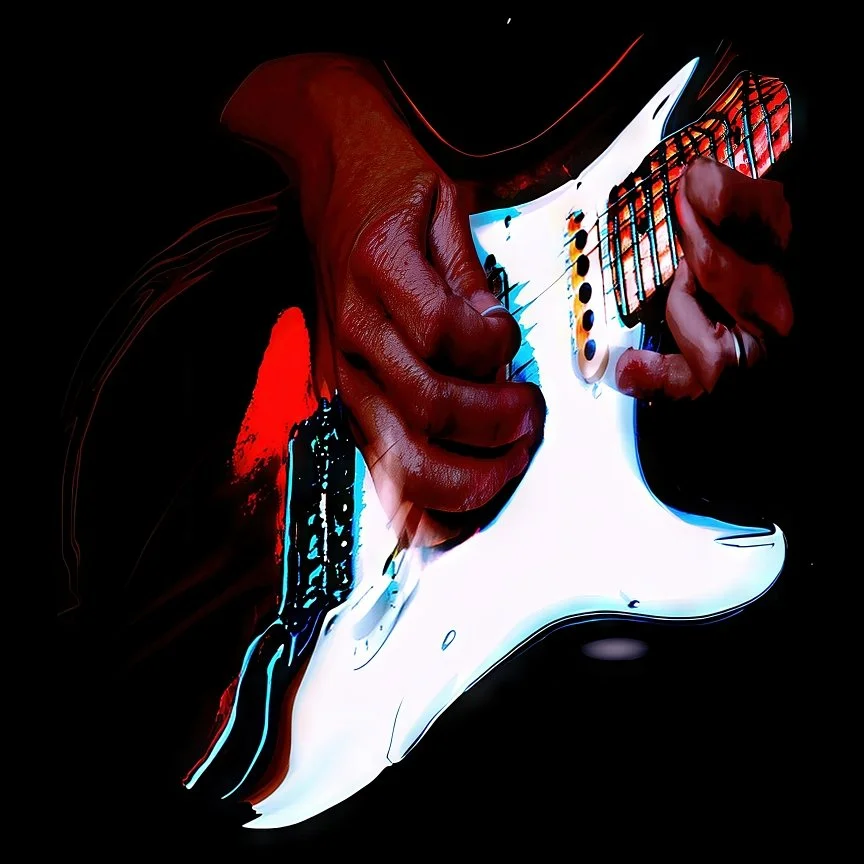
At first glance, the image appears familiar: hands, a guitar, the moment of contact where sound is born. These are objects we recognize. Things we trust. Things we believe to be real because they exist in the physical world.
But the longer you look, the less certain that becomes.
The hands carry a kind of realism—but not a comfortable one. Their surface feels almost engineered, pushed just beyond the natural, sharpened into something intentional and slightly artificial. The guitar, by contrast, dissolves into abstraction. Its form remains, but its certainty does not. Light bends. Edges soften. The instrument becomes more suggestion than object.
Neither side fully claims truth.
This tension is deliberate. The work lives in the space between realism and abstraction, where certainty breaks down. Where what we see cannot be fully trusted, and what we feel begins to matter more than what can be verified.
The act of playing a guitar is not just physical. It is emotional, instinctive, and often invisible. The sound exists briefly, then disappears. The connection remains. That unseen exchange—the pressure of fingers, the vibration of strings, the resonance in the body—is as real as anything solid, even though it cannot be held.
This piece asks whether reality is defined by clarity, or by connection.
Is realism something we recognize with our eyes?
Or something we experience through tension, resonance, and presence?
There is no resolution here. No answer offered. Only a question held in balance.
What is real?
This work exists to sit inside that uncertainty—and to invite the viewer to sit there too.
What Is Real? (Extended)
I realized something today that quietly overturned one of my own assumptions.
I’ve been thinking about art as static — a physical object fixed in space. A print on a wall. A painting mounted and unmoving. Something that exists whether anyone is present or not.
But that isn’t actually true.
The moment art is seen, it stops being static.
What we experience is not the object itself, but light — waves reflecting off the surface of the work, traveling through space, entering the eye, converting into electrical signals, and finally being reconstructed inside the brain. The artwork does not arrive whole. It arrives as energy.
In that sense, visual art is no different from music.
Sound waves vibrate through air. Light waves reflect through space. Both require movement. Both require a receiver. Neither exists as experience without participation.
A painting hanging on a wall in a dark room is inert. Silent. Invisible.
Only when light touches it — and only when that light reaches a viewer — does the work come alive.
So what is real?
Is it the physical object — the paper, the pigment, the aluminum panel?
Or is it the wave event that occurs when light reflects and perception begins?
Music makes this obvious. Sound refuses containment. It escapes the instrument in uncontrolled waves, bouncing, penetrating, expanding outward, changing as it goes — like life itself. Even when recorded, it does not become still. When played back, it once again turns into vibration, breaking through walls, bodies, and space itself.
But visual art does the same thing — more quietly.
Light waves bounce. Reflect. Scatter. Shift with time of day, angle, distance, and the sensitivity of the eye receiving them. No two viewings are identical. No two minds reconstruct the same image in the same way.
The art object may remain unchanged.
The experience never does.
This collapses the idea of “static art.”
The work is not frozen. The work is a continuous event — a collaboration between material, light, and perception.
Which brings me back to the question that anchors this body of work:
What is real?
Is reality the object we can hold?
Or is it the invisible process that turns matter into experience?
This tension lives at the heart of Without Square.
The hands in this work are rendered with a heightened, almost artificial realism — pushed just beyond the natural. They feel solid, physical, present. The guitar, by contrast, dissolves into abstraction. Its edges slip. Its form refuses to settle. It behaves less like an object and more like a field.
Neither claims truth.
Both are unstable.
The hands appear real — but their realism is exaggerated, almost synthetic.
The guitar appears abstract — yet it is the source of sound, vibration, and wave.
What feels solid may be constructed.
What feels unstable may be closer to how reality actually behaves.
This is not an argument against physical art.
It is an argument against the idea that anything we experience is truly fixed.
Even a print on a wall becomes wave, energy, interpretation.
Even a song, once heard, becomes memory and meaning.
Everything passes through the same final stage:
the human nervous system.
Reality is not the object.
Reality is the encounter.
And Without Square is my way of staying inside that question — not resolving it, not framing it neatly, but letting it remain open.
Because the moment we decide something is fully contained, fully known, fully square —
we stop listening to how it actually moves.
Addendum: Particle or Wave
This question keeps widening.
In quantum physics, the most unsettling discovery was not that light behaves like a wave, or that matter behaves like a particle — but that neither description is complete on its own. What something is depends on how it is encountered.
Unobserved, it spreads. Interferes. Exists as probability.
Observed, it collapses. Localizes. Becomes a thing.
So the question was never simply particle or wave.
The question was always: under what conditions does it become one or the other?
That same tension exists here.
An artwork, unencountered, is dormant.
Encountered, it becomes event.
A human body appears particle-like — bounded, measurable, located in space.
But experience is wave-like — emotion, memory, influence, resonance — extending beyond the body, changing others, lingering after presence is gone.
We are solid and diffuse at the same time.
Discrete and continuous.
Observed and observing.
Which brings the question to a place I didn’t expect when I began this work.
The question is no longer What is real?
The question becomes:
Are we particles, or are we waves?
And if the answer is both —The question becomes:
Are we real?
Not as objects.
Not as fixed identities.
But as encounters — changing through observation, collapsing into form only when touched by another consciousness.
Reality may not be what exists.
Reality may be what happens.
And Without Square is my way of staying inside that uncertainty —
not to resolve it, but to remain honest about how unstable, participatory, and unfinished experience actually is.
The Ring