
Matchbook 26 — Without Square
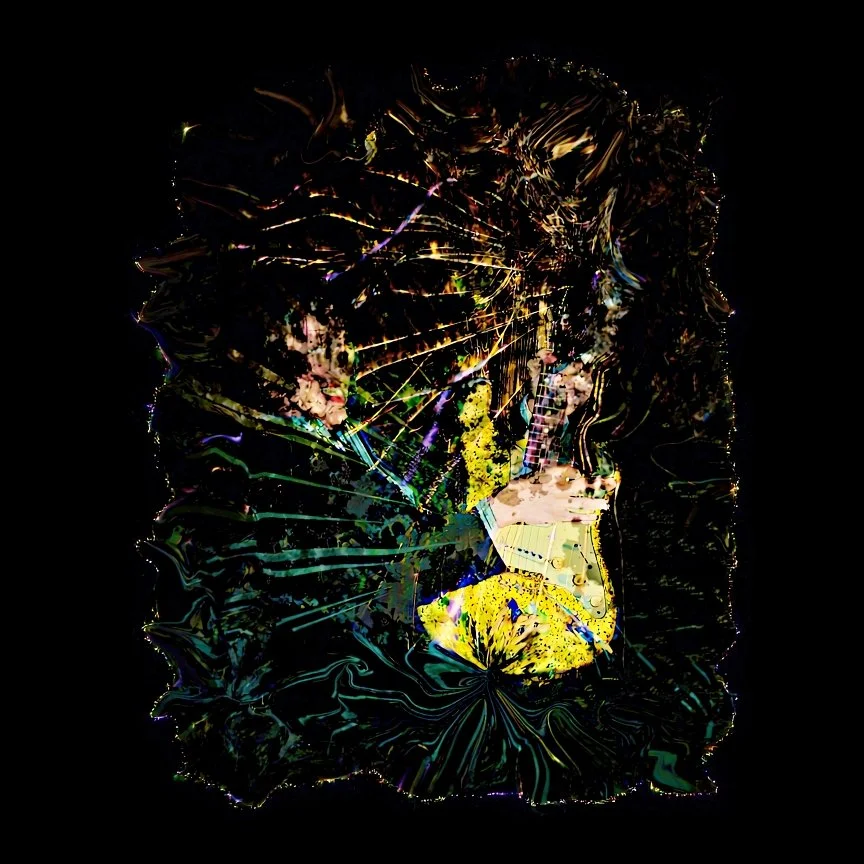
Matchbook 26
The world as we knew it is disappearing right in front of our eyes.
Not abruptly. Not all at once.
But steadily enough that it is becoming harder to believe what we see, and harder still to agree on what is real.
Climate change dominates headlines—even when it’s softened into phrases like “a one-in-a-hundred-year storm.” Masked, armed men aggressively threaten and hurt people of all kinds. AI is rapidly developing toward forms of intelligence that disrupt nearly everything—good and bad—that has been. The familiar world is still here, but it is barely visible now, like an afterimage.
Without Square began with that instability. It is not a rejection of form, but a rejection of the frame that once promised certainty. The square—long trusted as structure, balance, containment—can no longer be assumed. When the square disappears, the image must either hold itself together or reveal what happens when it cannot.
Matchbook 26 exists in that moment.
At first glance, there is something recognizable: a guitar, hands, the posture of playing. These are familiar anchors. But recognition doesn’t last. The longer the image is held, the more it refuses to stabilize. Edges dissolve. Light fractures. Motion begins to outweigh object.
This is not a depiction of a musician. It is a depiction of ignition.
The guitar behaves less like an instrument and more like a conductor—its strings extending outward as lines of force. What should be surface becomes heat. What should be form becomes release. The hands remain partially intact, but unstable, suspended between control and erosion. They suggest intention, but not mastery.
The boundary of the image burns irregularly. There is no clean border, no stable frame to step behind. Micro-sparks and filaments of light trace the perimeter as if the image itself is shedding energy into darkness. Containment has failed, but collapse has not yet arrived.
A match is inert until it isn’t.
For a long time it is only potential—paper, sulfur, waiting. Then pressure, friction, contact. In an instant it stops being matter and becomes energy. There is no middle state. One moment it is form; the next it is reaction.
Now imagine all the matches igniting at once.
A matchbook is designed for one flame at a time. When all the matches light in unison, the book burns fast. The object itself becomes irrelevant. What matters is the release.
That is the core image behind Matchbook 26: we try to hang on, but all we have left in our hand is an empty matchbook with a heavily burned edge.
2026 is that ignition moment—the matches going up in flames while we wonder what we will have in its place.
People are asking questions right now, whether they say them out loud or not:
What can still be trusted when familiar structures stop holding?
What remains real when clarity dissolves faster than understanding?
Are we watching destruction—or transformation that doesn’t yet have a familiar shape?
The image does not answer with slogans. It answers structurally. In Without Square, meaning does not arrive through resolution. It emerges through tension. Recognizable forms still exist, but they no longer stabilize the scene. Reality hasn’t vanished—it has become unstable, active, and difficult to pin down.
And yet fire is not only destruction.
Fire reveals.
Fire consumes what cannot endure.
Fire clears space.
So the final question—quietly present in the burn—is not whether something is ending. It is what will be left after the heat passes.
Will it burn away what is cruel and false?
Will it leave room for something more honest to grow?
I think it will.
I believe we can grow into a more pure form of love.
And I am watching.