
Crazy Girls Guitar
Crazy Girls Guitar
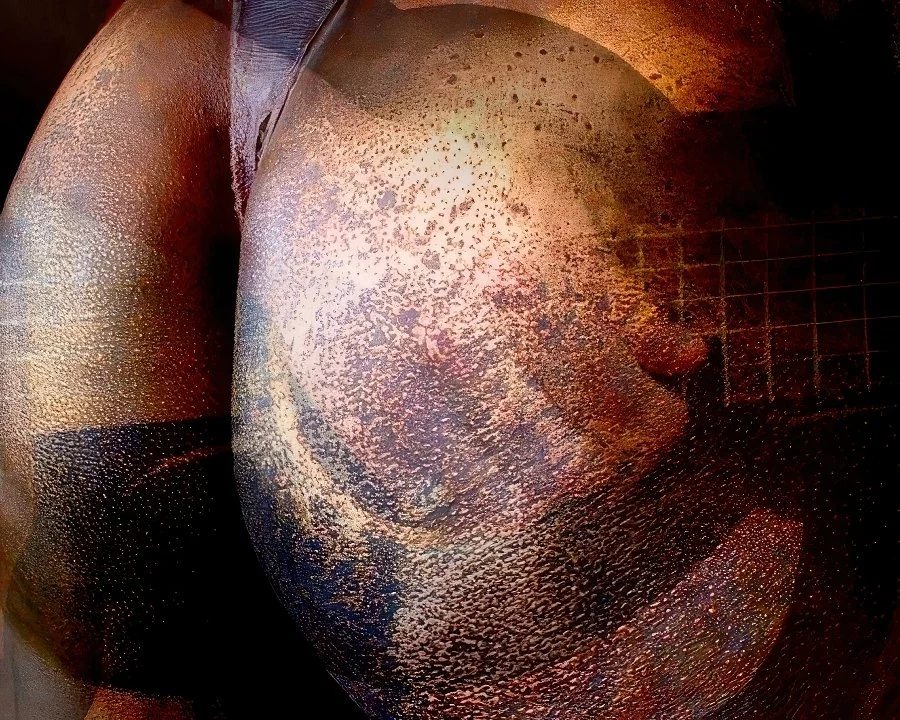
Years ago, outside the Riviera in Las Vegas, a line of bronze figures stood frozen in permanence. The sculpture for Crazy Girls was spectacle cast in metal — exaggerated, theatrical, unapologetically performative. Desire turned into surface. Performance turned into monument.
Bronze does not move.
It does not vibrate.
It does not convert energy.
It only reflects it.
When I photographed that statue, I wasn’t chasing provocation. I was drawn to the idea of performance made permanent — attention frozen in time.
Later, I paired that image with a guitar.
And something shifted.
The guitar is the opposite of bronze.
It only exists when touched.
It only becomes itself when played.
It is not spectacle — it is conversion.
There is a hand in this piece. It rests on the curve of the bronze form. And here is the tension: is it playing the guitar, or is it caressing the body?
It must read as both.
Not a grasp.
Not aggression.
A caress.
The fingers are relaxed. The contact is intentional. It mirrors how a musician naturally rests a hand on the lower bout of a guitar — curved, attentive, controlled. The human body and the guitar share form. Both are shaped by curves. Both respond to touch.
That ambiguity is the fulcrum.
Because learning to play guitar is not just about wanting to be seen. It is about wanting to connect.
Young energy begins without language. Attraction, restlessness, intensity — they arrive before discipline. The guitar becomes a translator. A conversion device.
Desire → discipline
Impulse → tone
Attention → intention
The bronze figures represent spectacle — the pull of the visible world. The guitar represents the invisible work required to turn energy into sound. The hand becomes the bridge between the two.
Is it touching the body?
Or touching inspiration?
That question is the ignition.
In this piece, the surface feels molten — oxidized, volcanic, as if heat is trying to move beneath the metal. But bronze cannot move. It is frozen. Only the guitar can vibrate. Only the strings can convert pressure into frequency.
A caress is relational.
Music is relational.
One is surface.
The other is transformation.
Crazy Girls Guitar lives in that narrow space between attraction and creation. Between attention and intention. Between spectacle and sound.
Bronze remains still.
The guitar turns touch into something that travels.
And that is the difference between being looked at
and being heard.