
Ghost Inside the Waveform
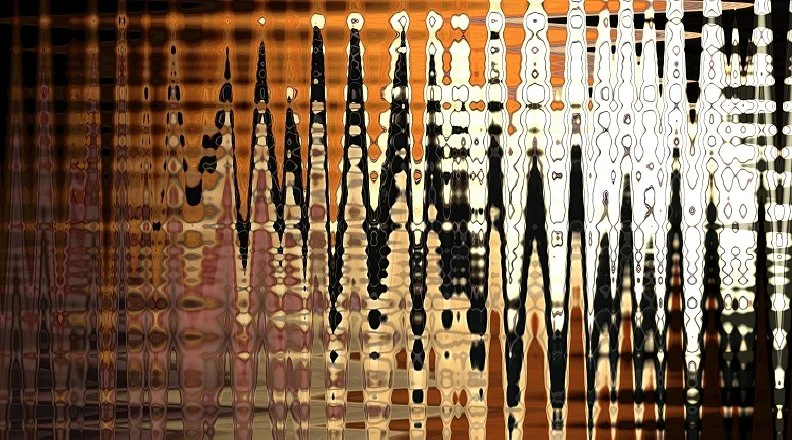
Ghost Inside the Waveform
Sometimes the guitar disappears.
Not the sound — the instrument itself.
What remains is something else entirely. The wood, the strings, and the body of the guitar dissolve into a field of vibration. The instrument that once held the sound becomes invisible, leaving only the pattern of the energy it released.
This piece feels like that moment.
I found this image buried in an old file. My memory tells me it likely began as a photograph of a guitar, but the process that followed pulled the image so far apart that the original form is no longer visible. Whatever the starting point was, it has been stretched and transformed until the object itself has vanished.
What remains is the residue — the structural memory of vibration.
Vertical columns appear like standing waves frozen in place. Narrow lines echo the spacing of strings. Dense clusters form where energy once concentrated. Warm copper tones suggest wood and resonance, while the brighter areas feel like sound escaping into open space.
The guitar itself can no longer be seen.
But something of it still remains.
Like a fingerprint left in the air after a chord rings out, the instrument survives only as a pattern. The music has moved on, yet the structure of its vibration lingers in the visual field.
A ghost inside the waveform.
In that sense, the piece becomes less about the object and more about what the object releases. A guitar does not create sound from nothing. It converts energy — from the player’s hands, from the tension of the strings, from the resonant body of the instrument — into waves that move outward into the surrounding space.
Here, that invisible motion becomes visible.
The instrument disappears, but the vibration remains.