
Groove 8 — Studio Journal
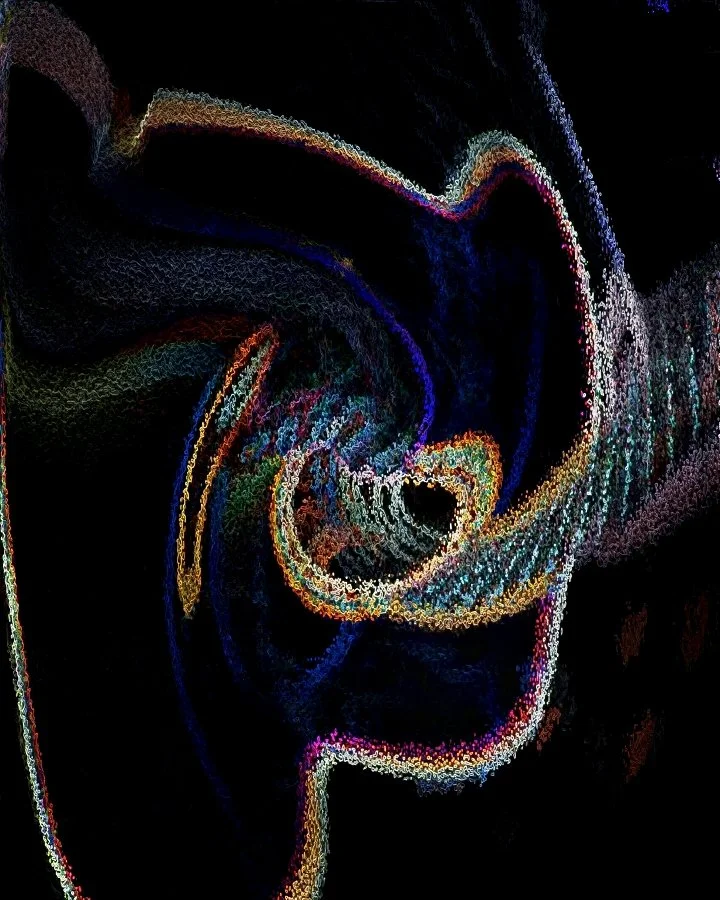
Some pieces start with an image.
Groove 8 started with a feeling — the moment when rhythm locks in and stops being counted and starts being felt.
This piece isn’t about a guitar you can see or a player you can identify. It’s about the energy a guitar releases once it’s played — the bends, the sustain, the vibration that hangs in the air after the strings stop moving. That invisible moment where sound continues even after the hands have paused.
In Groove 8, light becomes motion and motion becomes rhythm. The lines arc and fold the way music does when it’s alive — not rigid, not measured, but responsive. Color behaves like tone, shifting and swelling as if it’s reacting to what came before it. The dark space isn’t empty. It’s the silence that makes the groove possible.
Music has always lived in that space between control and release. You can practice scales, count time, and plan arrangements — but when a groove truly locks in, something else takes over. Groove 8 is an attempt to capture that exact transition: when repetition becomes momentum, and momentum becomes feeling.
When this piece was shared on Facebook, the response was immediate and unexpected. Thousands of likes and reactions came in, along with comments from musicians and non-musicians alike who felt something familiar in it. Some saw motion. Some saw sound. Some described it as something they recognized rather than something they could explain. That reaction mattered, because it confirmed what the piece was trying to do — translate music into something visual and emotional without forcing interpretation.
Abstraction fits music because music itself is abstract. You can’t hold it, frame it, or stop it mid-moment. You experience it as it moves through you. Groove 8 doesn’t tell you what to hear or how to feel. It leaves room for personal memory — a late-night jam, a riff that went longer than expected, a moment when everyone in the room felt the same pulse at once.
Like all Cleveland Guitar Prints works, Groove 8 is created as affordable art meant to live in real spaces. It’s not designed to feel distant or precious. It belongs in music rooms, studios, listening spaces, and homes where sound and creativity are part of everyday life. It doesn’t shout or demand attention — it hums quietly until you notice it.
Some pieces describe something.
Others resonate.
Bill Sanders