
Melt 5 — Referential Abstraction and the Guitar Remembered
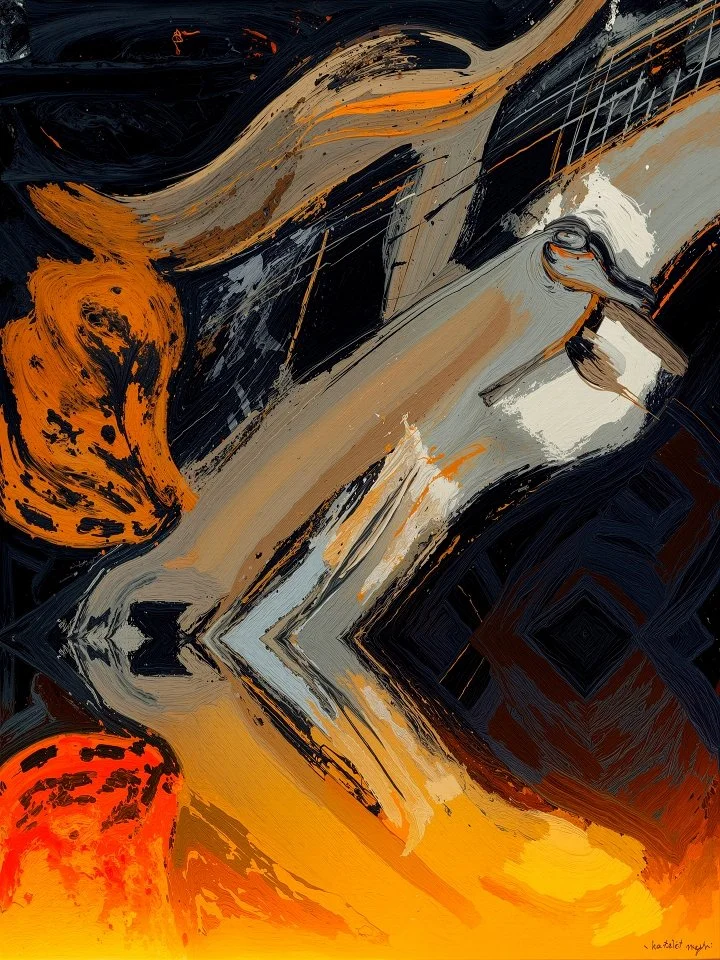
Melt 5 marks a turning point in my work.
For years, the guitar in my art was something you could clearly see — a form, an object, a recognizable instrument tied to music, place, and memory. With Melt 5, that certainty begins to dissolve. The guitar is no longer illustrated. It is remembered.
This is what I’ve come to understand as referential abstraction.
The image does not abandon the guitar. Instead, it lets go of description and holds onto essence. The curves, tension, compression, and energy remain, but the object itself begins to blur — much like memory does over time. What’s left is not a picture of a guitar, but the residue of sound, touch, and experience that the guitar carries.
The surface of Melt 5 feels unstable by design. Forms appear to stretch, soften, and break apart. Edges dissolve. What once held structure now feels as if it’s been exposed to heat — emotional or sonic — and allowed to deform. This “melting” is not destruction; it’s transformation.
At the center of the work is what I call the guitar glosso — the accumulated visual language of the guitar: curves learned by the hand, reflections burned into memory, the weight of the instrument resting against the body. Even when the guitar is no longer clearly visible, the glosso persists. The viewer senses it before recognizing it.
This is important to me.
I’m not interested in abstraction as decoration, nor realism as documentation. I’m interested in the space between recognition and feeling — that moment when something registers emotionally before the mind assigns it a name. Melt 5lives in that space.
Some viewers recognize the guitar immediately. Others don’t see it at all — at least not at first. Both responses are valid. In fact, that tension is part of the work. The painting asks the viewer to sit with uncertainty, to feel before identifying.
In that way, Melt 5 is less about guitars and more about how music exists inside us — distorted by memory, shaped by time, and charged with emotion long after the sound itself is gone.
This piece isn’t an ending. It’s a doorway.
— Bill Sanders
Cleveland Guitar Prints