
The Medium Is Not Neutral: Why Art Presentation Is Philosophy
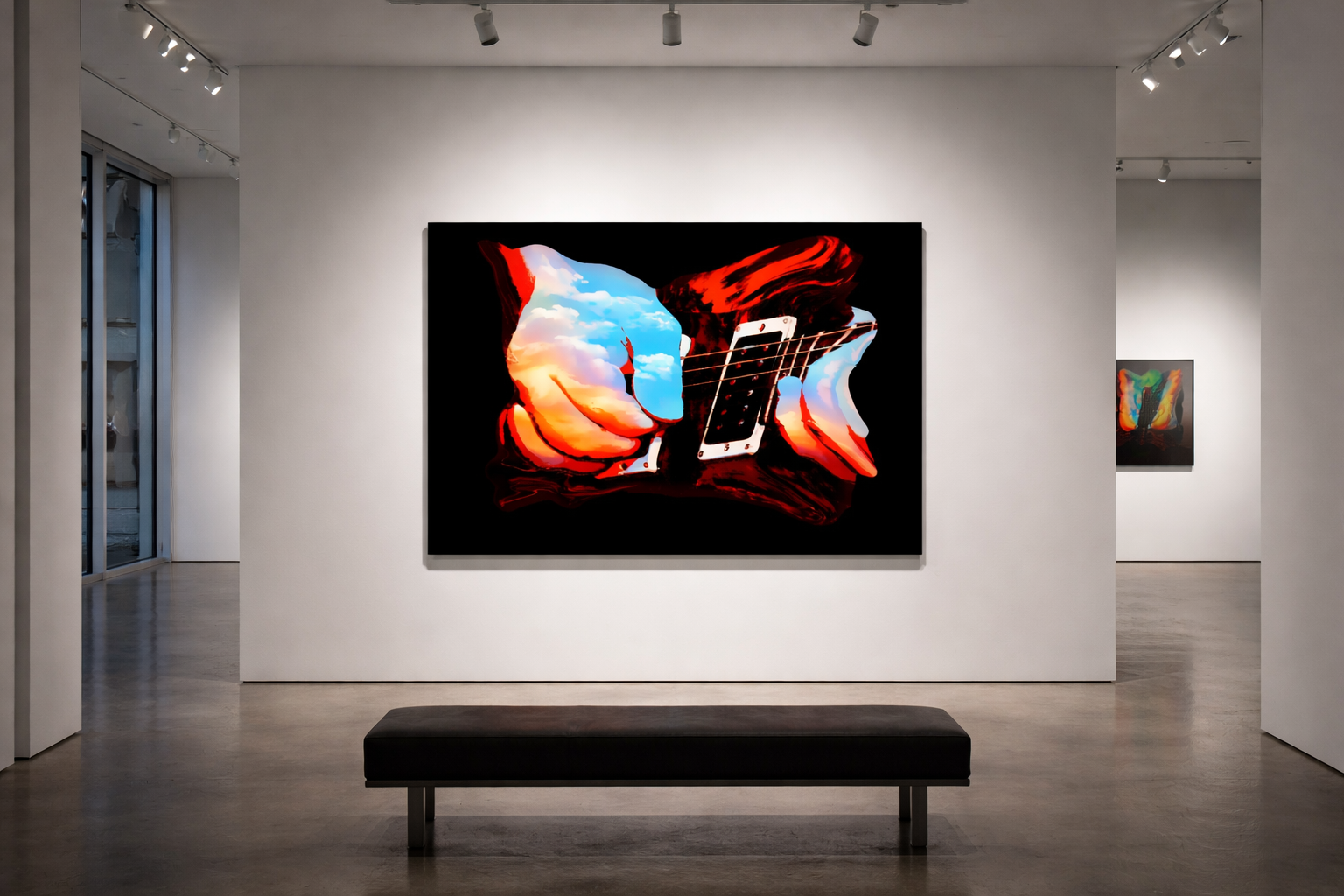
For most artists, presentation is an afterthought. A frame. A mat. A surface choice. Something solved at the end.
But when the work itself is built on reduction, structure, and conceptual restraint, presentation is not cosmetic. It is philosophical.
The way an artwork exists in space is not separate from what the artwork means.
When the Surface Becomes the Message
Paper has a long tradition in fine art. Giclée prints on cotton rag are beautiful, archival, and respected. But paper is fragile. And fragility demands protection.
Protection means glass.
The moment glass enters the equation, the work changes:
• Light reflects.
• The black becomes surface instead of void.
• The viewer sees themselves in the work.
• The image becomes something “behind” something else.
What was meant to be spatial becomes contained.
For art that depends on negative space not as background but as structure, glass is not neutral. It introduces shine. It introduces distance. It re-asserts the rectangle. The square comes back.
At that point, the work is no longer an object in space. It is an image inside a system.
And that system is not what my work is about.
When an Image Becomes an Object
My recent work has moved toward what I call referential abstraction: images anchored in real objects, but stripped of environment, context, and decorative detail. They are not depictions. They are constructed forms.
The black is not background. It is space.
The edges are not borders. They are boundaries of form.
This kind of work does not want to be looked at through something. It wants to be encountered.
That distinction matters.
Why Aluminum Changes Everything
When printed directly on aluminum using archival UV pigment inks (not glossy dye-sublimation), something fundamental shifts:
• There is no glass.
• There is no frame.
• There is no reflective plane between viewer and work.
• The black remains absolute.
• The edge becomes physical.
• The piece casts a shadow and occupies space.
The artwork is no longer an image in a container.
It becomes an object in the room.
This is not a production choice. It is an ontological one.
Paper says: I am an image that must be protected.
Glass says: I must be separated from the world to exist.
Aluminum says: I exist as I am.
That is the difference between decoration and structure.
Gloss Is Not Innocent
A common mistake is to assume that richness comes from shine.
For my work, gloss is not enhancement—it is interference.
Reflection turns space into surface.
Surface collapses void.
Void is the architecture of the piece.
If the black reflects a window, a gallery light, or a passing body, the work is no longer holding space. It is reacting to the environment.
Restraint is not absence. It is authority.
And authority does not shimmer.
Without Square Is Not a Style Choice
The idea of Without Square is not simply removing a border. It is the refusal of containment as a governing principle.
Not “how can I make the image look like it floats?”
But: “What is this object allowed to be?”
If the format reintroduces enclosure, reflection, or decorative surface, the philosophy breaks—even if the image itself is unchanged.
This is why certain materials feel wrong even when they look “better.” They add. They embellish. They soften. They turn structure into surface.
My work is not asking to be enriched.
It is asking to remain precise.
Presentation Is Meaning
Every decision—paper, glass, acrylic, aluminum—is a statement about what the work is.
Is it:
• an image to be viewed?
• a surface to be admired?
• or an object to be encountered?
My work is not trying to be beautiful in the traditional sense. It is trying to be clear.
Clear in form.
Clear in edge.
Clear in space.
Clear in intent.
Which means the medium cannot be decorative. It must be structural.
The Conclusion
Art is not finished when the image is done.
It is finished when its physical existence aligns with its philosophy.
For this body of work, that means:
• No glass
• No frames
• No gloss
• No reflective surfaces
• No reintroduced square
• Black as absolute space
• The edge as form, not border
Because in the end, the medium is not just how the art is shown.
The medium is what the art is allowed to be.