
Bill’s Black — Why the Space Matters as Much as the Form
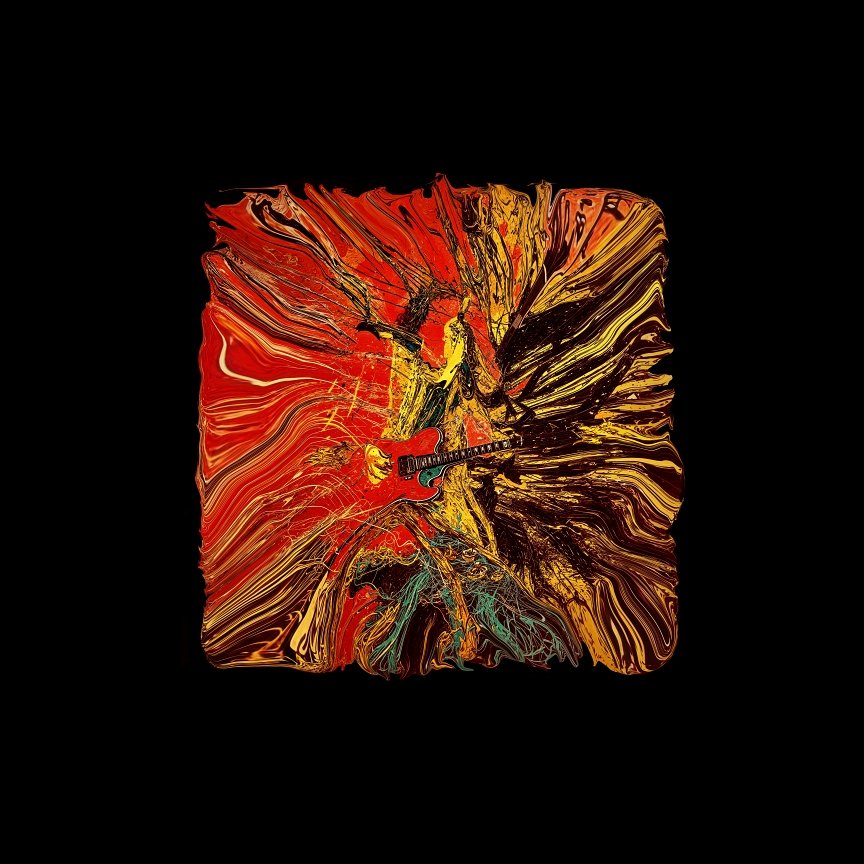
Rockstar 7 Bam!
For most of my life, I’ve been obsessed with what surrounds the subject as much as the subject itself. That instinct didn’t start in art. It started years ago when I was in the paint business.
Customers would come in asking for “black.” Not charcoal. Not soft black. Not warm black. Just black. But anyone who’s ever worked with color formulas knows the truth: most blacks aren’t truly black at all. They’re mixtures. They carry undertones—blue, brown, red—that soften the depth. They behave politely. They behave safely.
I wanted something different.
So I began making my own: a gallon of clear base, loaded with eight ounces of black colorant. No compromises. No undertones. Just density. The blackest black I could physically create. We called it Bill’s Black, and it did exactly what I wanted it to do—it erased distraction and let everything placed against it speak with absolute clarity.
I didn’t realize it then, but that instinct never left me.
Today, in my artwork, I find myself returning to the same idea: black not as background, but as space. Not decoration. Not framing. Space. The place where form either survives on its own strength or disappears.
In my current body of work—what I’ve come to call Without Square—the image is no longer confined by tidy edges or polite borders. The subject floats. It breathes. The black is not there to “fill in.” It is there to remove everything that isn’t essential. What remains is presence.
This is where my idea of referential abstraction lives. My work always refers back to something real—a guitar, a player, a gesture, a moment in sound. But instead of illustrating that object, I reduce it to energy, movement, and structure. The black field becomes the silent stage on which that form exists. The object is not framed. It is revealed.
Just as in paint, pure black allows no excuses. If the edges are sloppy, you see it. If the composition is weak, you feel it. There is nowhere to hide. The form either holds its own, or it doesn’t.
That is what I’m after.
The black around these pieces is not absence. It is discipline. It is honesty. It is the same instinct that once drove me to mix a color so dark it absorbed everything else in the room. The space matters because it tells the truth about the object inside it.
This is not about making images that decorate walls. It’s about creating forms that exist—forms that stand in silence and still carry sound, motion, and meaning.
The square is gone.
The frame is gone.
What remains is the work—and the black that lets it speak.