
Torque
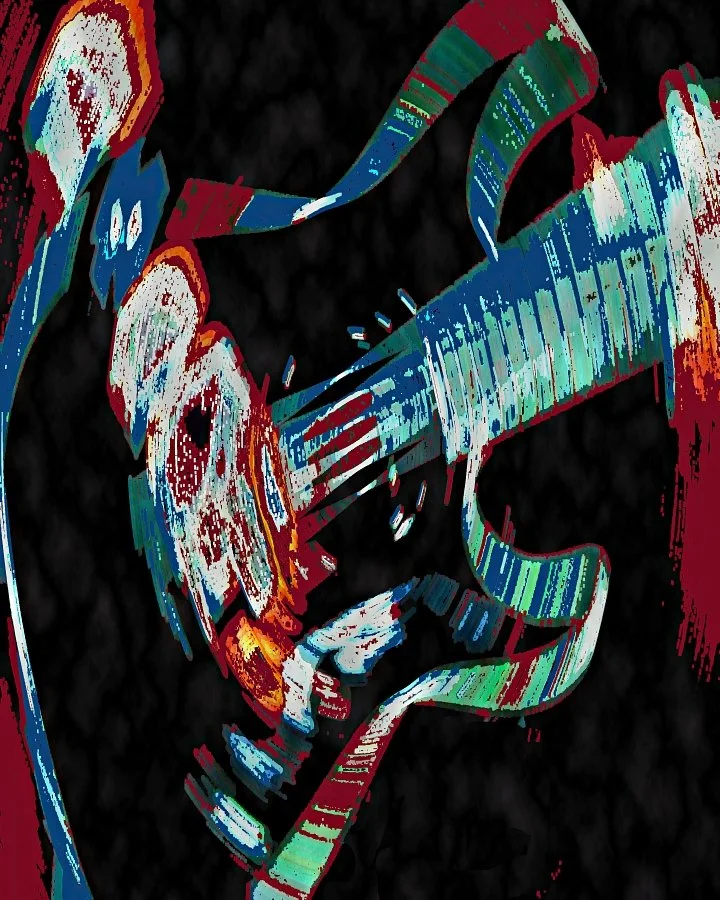
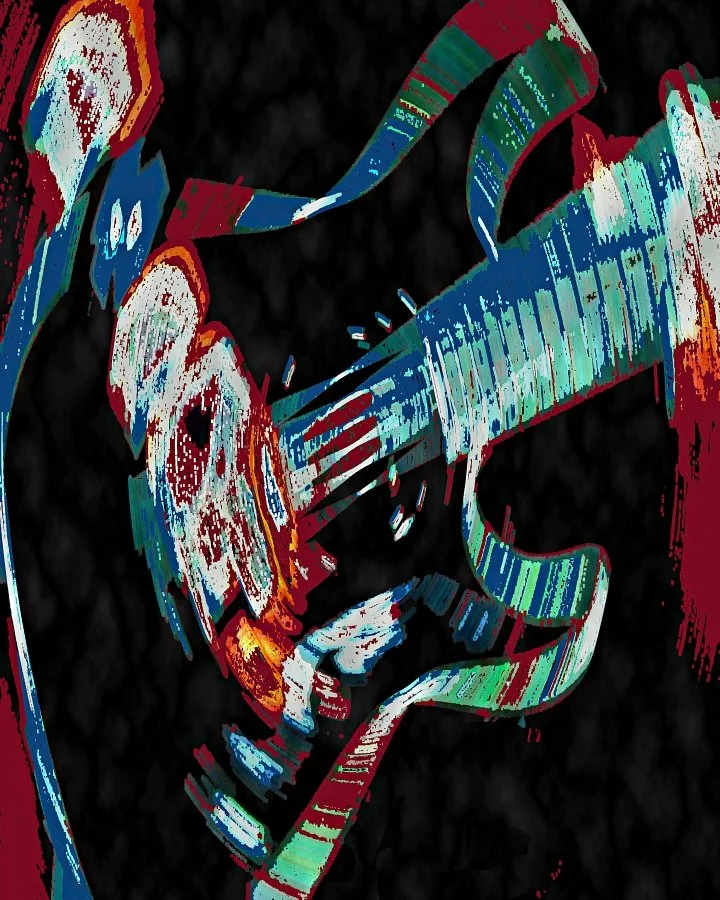
Rediscovered digital artwork from 2006 exploring force, rotation, and contact. Torque quietly previews ideas that would later become Without Square.
Torque
Torque
I found this piece on an old drive dated March 3, 2006.
This was the pre-iPhone world. Before social media feeds. Before filters, presets, algorithms, and named aesthetics. Before “glitch” became a style, before abstraction needed subcategories, before images were built for captions instead of contemplation.
At the time, I didn’t have the language for what I was doing. I only knew I was trying to hold onto a moment — not the guitar itself, but the force acting on it. Rotation. Resistance. The instant where motion stops being visual and starts becoming sound.
The image isn’t about distortion for its own sake. It’s about stress. Torque is force applied through rotation, but it only exists because something pushes back. Without resistance, there is no torque — only spin.
That tension is what remains legible here. The guitar never fully disappears, but it doesn’t resolve either. It stays caught between structure and release. The hand, the instrument, the strike — all present, all unstable.
The background matters more than I realized then. The black here isn’t pure. It’s clouded, textured, unsettled. It still carries atmosphere — a sense of space rather than absence. This differs from the pure black I would arrive at later, where the void becomes absolute and intentional. Here, the black still breathes. It hasn’t yet hardened into silence.
What feels most uncanny now is how closely this work previews what would later become Without Square — years before that language existed, before the decision to remove containment altogether became deliberate.
The image is already resisting enclosure. The guitar does not sit comfortably inside the frame. Motion pushes outward, blurs edges, refuses to settle. Even the background behaves less like a boundary and more like weather. The square is present, but it’s already being questioned.
In later work, the square would disappear entirely. The black would become absolute. Containment would be removed on purpose. Here, none of that had been decided yet — but the pressure against it is visible. The work is already testing how much structure it can dissolve without losing contact.
What’s unsettling is not that this looks like something I would make now. It’s that it feels like something that waited.
This file wasn’t curated or preserved intentionally. It wasn’t carried forward as part of a plan. It simply remained dormant until the surrounding work caught up to it — as if the ideas had to mature elsewhere before this piece could re-enter the conversation.
I don’t experience this as nostalgia. It feels more like recognition at a distance. A signal sent forward without knowing who would receive it — only to find that the receiver turned out to be the same person, years later, finally prepared to understand it.
This wasn’t chasing a trend. It came before most of them.
This wasn’t a beginning or an ending. It was a moment of alignment — captured before I knew why it mattered.
The name came later.
Torque
Because this work predates the term, it’s worth defining what glitch means here.
Glitch (in art)
In art, glitch refers to the intentional use of error, malfunction, or disruption—often drawn from digital systems—to create visual, sonic, or conceptual meaning.
Plain definition
A glitch is a breakdown in a system that becomes the work itself.
Instead of correcting the error, the artist preserves or amplifies it.
Where the term comes from
Originally an engineering term (mid-20th century) meaning a brief fault in an electrical or mechanical system
Adopted by artists once digital tools became common and errors became visible
In visual art
Glitch can include:
Pixel corruption
Compression artifacts
Data misalignment
Color channel separation
Frame tearing or repetition
Distorted edges caused by software or file misuse
Crucially: these effects are not decorative when used seriously—they expose the system underneath the image.
Conceptually, glitch art is about:
Revealing the hidden structure of technology
Interrupting smooth, consumable images
Questioning ideas of perfection, control, and realism
Letting process show instead of hiding it
A glitch says: this image is not natural — it is constructed.
Important distinction
Accidental glitch: a mistake
Artistic glitch: a chosen condition
Once the artist decides to keep it, it stops being an error and becomes material.
Why glitch mattered historically
Glitch art emerged as a recognizable movement in the early 2000s—alongside:
Early digital cameras
File compression
Internet image sharing
Software instability
It was a reaction against the promise that digital tools would make images cleaner, truer, and perfect.
Rocket 99
Rocket 99
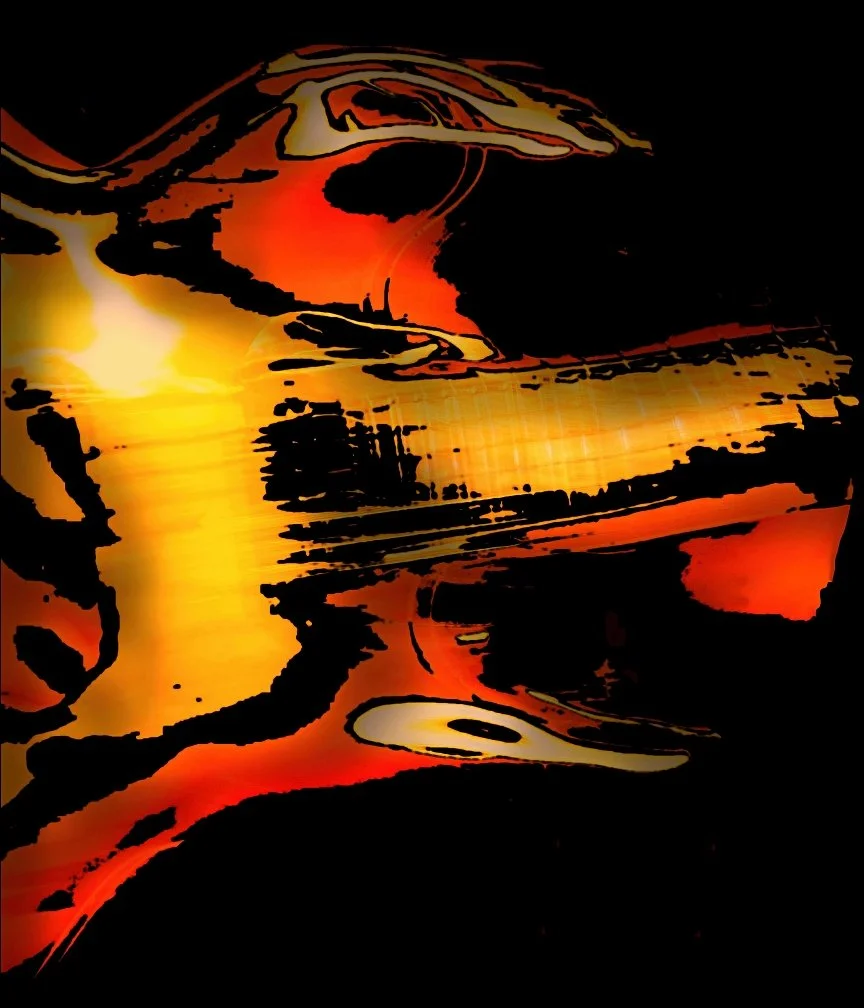
This piece doesn’t sit still.
It moves before you finish looking at it — energy compressing, igniting, breaking loose. There’s no horizon line, no ground. Just thrust. Motion. Lift.
The form rockets upward and outward at the same time, angling like a jet in climb. That angle matters. It’s not drifting. It’s committing. Once the motion starts, there’s no returning to stillness.
The image pushes almost all the way to the right edge — 99% — and then stops. It doesn’t touch. That near-contact creates tension. If it reached the edge, the motion would resolve. Because it doesn’t, the motion continues beyond the frame, carried by the viewer instead. The eye keeps going. The energy stays alive.
Color burns hot against black space, not as decoration, but as velocity. The black isn’t emptiness — it’s resistance. Something to push against. Paper deepens this effect. The blacks feel heavier. The light feels denser. What looked like motion on a screen becomes force when printed.
The edges tear, smear, stretch. That isn’t accident or imperfection. Movement isn’t clean. Takeoff never is.
Hidden inside the abstraction is something familiar: the structure of a guitar, the gesture of a hand. Not illustrated. Not announced. They’re present as truth rather than subject. Some viewers will feel them before they see them. Some will see them suddenly, later. Some will never see them at all — and the piece still works.
That ambiguity is intentional. The image isn’t asking to be decoded. It’s asking to be experienced.
Rocket 99 lives in the split second where everything commits — when momentum outweighs gravity, when hesitation disappears, when staying still is no longer an option.
It isn’t about where it’s going.
It’s about leaving.
What is Real?
What Is Real? — Exploring Reality, Music, and Perception in Contemporary Digital Art
Is it what we touch?
Is it what we see?
Or is it what we don’t see—but feel—in our connection to the power of one that is the universe?
This piece began with that question and never tried to answer it.
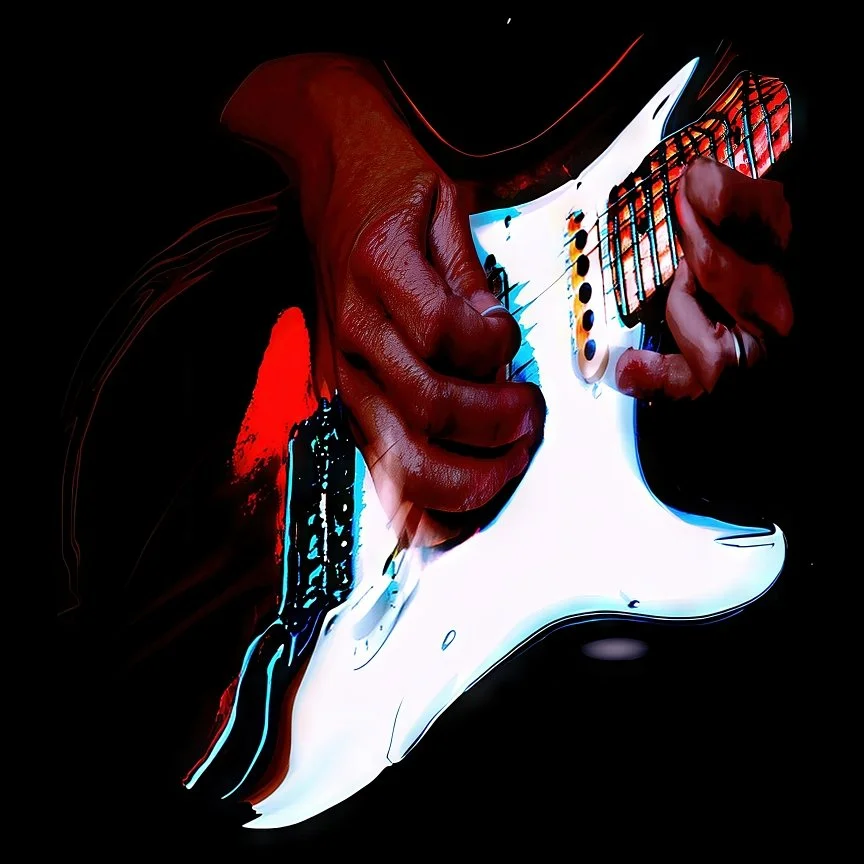
At first glance, the image appears familiar: hands, a guitar, the moment of contact where sound is born. These are objects we recognize. Things we trust. Things we believe to be real because they exist in the physical world.
But the longer you look, the less certain that becomes.
The hands carry a kind of realism—but not a comfortable one. Their surface feels almost engineered, pushed just beyond the natural, sharpened into something intentional and slightly artificial. The guitar, by contrast, dissolves into abstraction. Its form remains, but its certainty does not. Light bends. Edges soften. The instrument becomes more suggestion than object.
Neither side fully claims truth.
This tension is deliberate. The work lives in the space between realism and abstraction, where certainty breaks down. Where what we see cannot be fully trusted, and what we feel begins to matter more than what can be verified.
The act of playing a guitar is not just physical. It is emotional, instinctive, and often invisible. The sound exists briefly, then disappears. The connection remains. That unseen exchange—the pressure of fingers, the vibration of strings, the resonance in the body—is as real as anything solid, even though it cannot be held.
This piece asks whether reality is defined by clarity, or by connection.
Is realism something we recognize with our eyes?
Or something we experience through tension, resonance, and presence?
There is no resolution here. No answer offered. Only a question held in balance.
What is real?
This work exists to sit inside that uncertainty—and to invite the viewer to sit there too.
What Is Real? (Extended)
I realized something today that quietly overturned one of my own assumptions.
I’ve been thinking about art as static — a physical object fixed in space. A print on a wall. A painting mounted and unmoving. Something that exists whether anyone is present or not.
But that isn’t actually true.
The moment art is seen, it stops being static.
What we experience is not the object itself, but light — waves reflecting off the surface of the work, traveling through space, entering the eye, converting into electrical signals, and finally being reconstructed inside the brain. The artwork does not arrive whole. It arrives as energy.
In that sense, visual art is no different from music.
Sound waves vibrate through air. Light waves reflect through space. Both require movement. Both require a receiver. Neither exists as experience without participation.
A painting hanging on a wall in a dark room is inert. Silent. Invisible.
Only when light touches it — and only when that light reaches a viewer — does the work come alive.
So what is real?
Is it the physical object — the paper, the pigment, the aluminum panel?
Or is it the wave event that occurs when light reflects and perception begins?
Music makes this obvious. Sound refuses containment. It escapes the instrument in uncontrolled waves, bouncing, penetrating, expanding outward, changing as it goes — like life itself. Even when recorded, it does not become still. When played back, it once again turns into vibration, breaking through walls, bodies, and space itself.
But visual art does the same thing — more quietly.
Light waves bounce. Reflect. Scatter. Shift with time of day, angle, distance, and the sensitivity of the eye receiving them. No two viewings are identical. No two minds reconstruct the same image in the same way.
The art object may remain unchanged.
The experience never does.
This collapses the idea of “static art.”
The work is not frozen. The work is a continuous event — a collaboration between material, light, and perception.
Which brings me back to the question that anchors this body of work:
What is real?
Is reality the object we can hold?
Or is it the invisible process that turns matter into experience?
This tension lives at the heart of Without Square.
The hands in this work are rendered with a heightened, almost artificial realism — pushed just beyond the natural. They feel solid, physical, present. The guitar, by contrast, dissolves into abstraction. Its edges slip. Its form refuses to settle. It behaves less like an object and more like a field.
Neither claims truth.
Both are unstable.
The hands appear real — but their realism is exaggerated, almost synthetic.
The guitar appears abstract — yet it is the source of sound, vibration, and wave.
What feels solid may be constructed.
What feels unstable may be closer to how reality actually behaves.
This is not an argument against physical art.
It is an argument against the idea that anything we experience is truly fixed.
Even a print on a wall becomes wave, energy, interpretation.
Even a song, once heard, becomes memory and meaning.
Everything passes through the same final stage:
the human nervous system.
Reality is not the object.
Reality is the encounter.
And Without Square is my way of staying inside that question — not resolving it, not framing it neatly, but letting it remain open.
Because the moment we decide something is fully contained, fully known, fully square —
we stop listening to how it actually moves.
Addendum: Particle or Wave
This question keeps widening.
In quantum physics, the most unsettling discovery was not that light behaves like a wave, or that matter behaves like a particle — but that neither description is complete on its own. What something is depends on how it is encountered.
Unobserved, it spreads. Interferes. Exists as probability.
Observed, it collapses. Localizes. Becomes a thing.
So the question was never simply particle or wave.
The question was always: under what conditions does it become one or the other?
That same tension exists here.
An artwork, unencountered, is dormant.
Encountered, it becomes event.
A human body appears particle-like — bounded, measurable, located in space.
But experience is wave-like — emotion, memory, influence, resonance — extending beyond the body, changing others, lingering after presence is gone.
We are solid and diffuse at the same time.
Discrete and continuous.
Observed and observing.
Which brings the question to a place I didn’t expect when I began this work.
The question is no longer What is real?
The question becomes:
Are we particles, or are we waves?
And if the answer is both —The question becomes:
Are we real?
Not as objects.
Not as fixed identities.
But as encounters — changing through observation, collapsing into form only when touched by another consciousness.
Reality may not be what exists.
Reality may be what happens.
And Without Square is my way of staying inside that uncertainty —
not to resolve it, but to remain honest about how unstable, participatory, and unfinished experience actually is.
The Ring
Submitting Chasing the Setting Sound (Float) and Melt 5
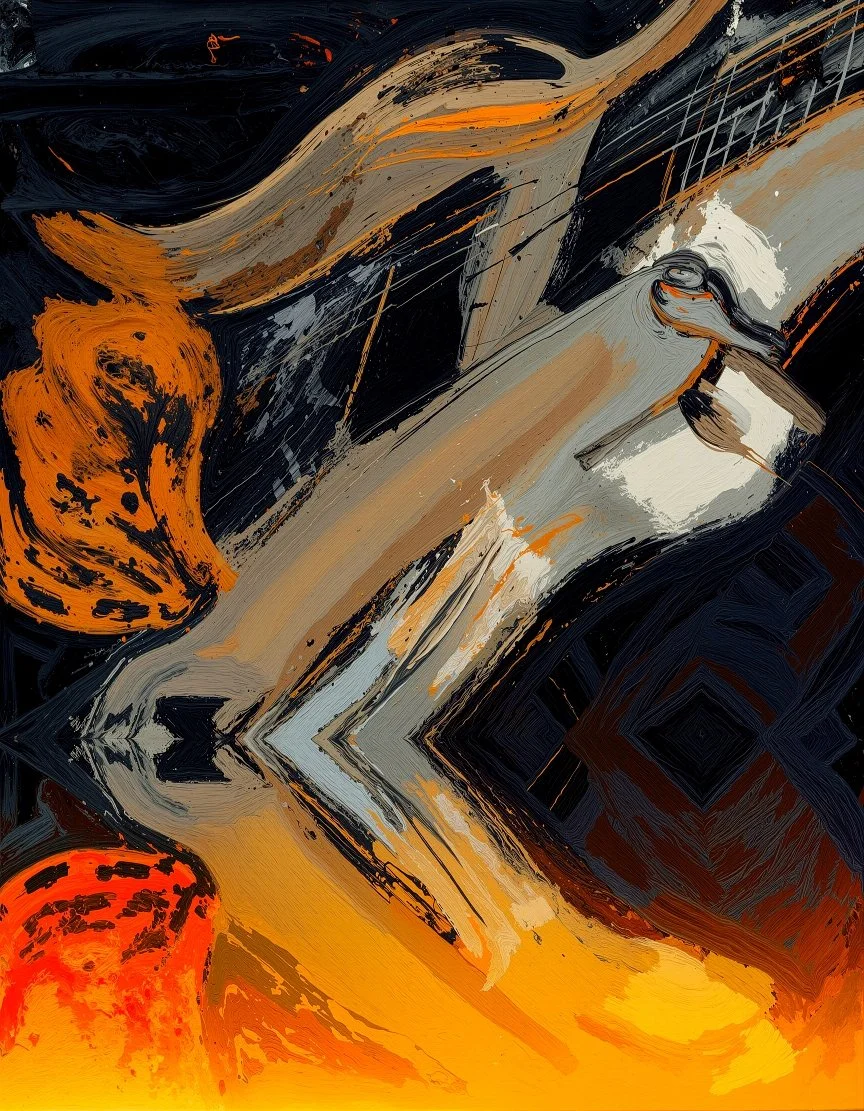
Melt 5
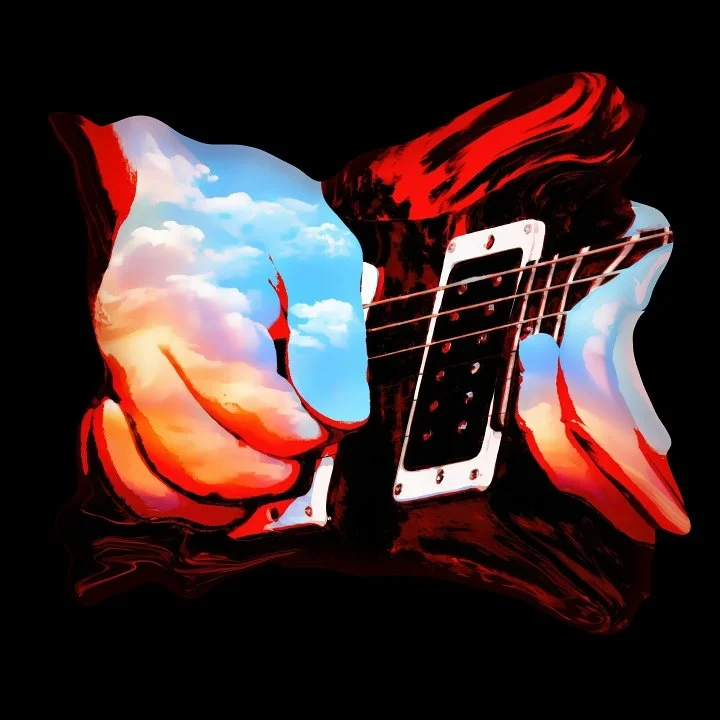
Chasing the Setting Sound (Float)
Lake Effect: Artists from Cleveland Now
I’ve spent a lot of time thinking about what it means to submit work to an institution—not just whether the work is “good enough,” but whether it is honest enough about where it comes from and where it’s going.
For the Cleveland Museum of Art’s Lake Effect: Artists from Cleveland Now, I chose to submit two works: Chasing the Setting Sound (Float) and Melt 5. They are not meant to summarize everything I make. Instead, they mark a through-line—a point of origin and a point of pressure—within the body of work I’ve been developing under the framework I call Without Square.
Chasing the Setting Sound (Float) is where that framework began. The piece originated from a practical problem rather than a theoretical one. I was thinking about how an image might exist on black without being boxed in by a printed square—how to let a form sit directly in space without containment. Removing the square wasn’t a stylistic move at first; it was a refusal. Once the frame disappeared, the image stopped needing to resolve itself. Edges softened. The guitar ceased behaving like an object and began to act more like a presence—floating, provisional, unfinished. That decision became foundational.
The title comes from music. Anyone who plays knows the feeling of chasing a sound that never quite settles. Visually, that idea carries through the work. The image resists grounding. It hovers between recognition and abstraction, between contact and release. What remains is not an instrument, but the sensation of sound just before it becomes fixed.
Melt 5 pushes that idea further. Where the earlier work floats through suspension, Float 5 floats through instability. It originates from the same photographic language, but the form is no longer allowed to hover gently. Instead, it is stretched, torqued, and compressed by opposing forces. There is no central anchor and no resolved edge. The image behaves like a field under stress—directional, charged, unresolved.
Together, these two works outline what Without Square has become for me. It is not just the absence of a frame. It’s a way of working that challenges visual enclosure at multiple levels: compositionally, materially, and conceptually. Cropping avoids symmetry. Space refuses to sit behind the subject. Even when the work exists within a rectangular format, it resists behaving like a contained object.
Submitting these pieces to Lake Effect feels appropriate not because they reference Cleveland directly, but because they come out of a Cleveland way of thinking—working with constraint, weather, friction, and persistence. This exhibition consciously recalls the spirit of the Cleveland Museum of Art’s historic May Show, a tradition that centered regional artists and the conditions they work within. Lake Effect isn’t about nostalgia; it’s about present tense. These works live firmly in that present.
Whether or not they are selected, the act of submitting them together matters. They represent a clear decision about what I’m producing now, what I’m refusing, and what I’m allowing to remain unresolved. The square is gone. What’s left is movement, pressure, and the space where something almost settles—but doesn’t.
Melt Drift
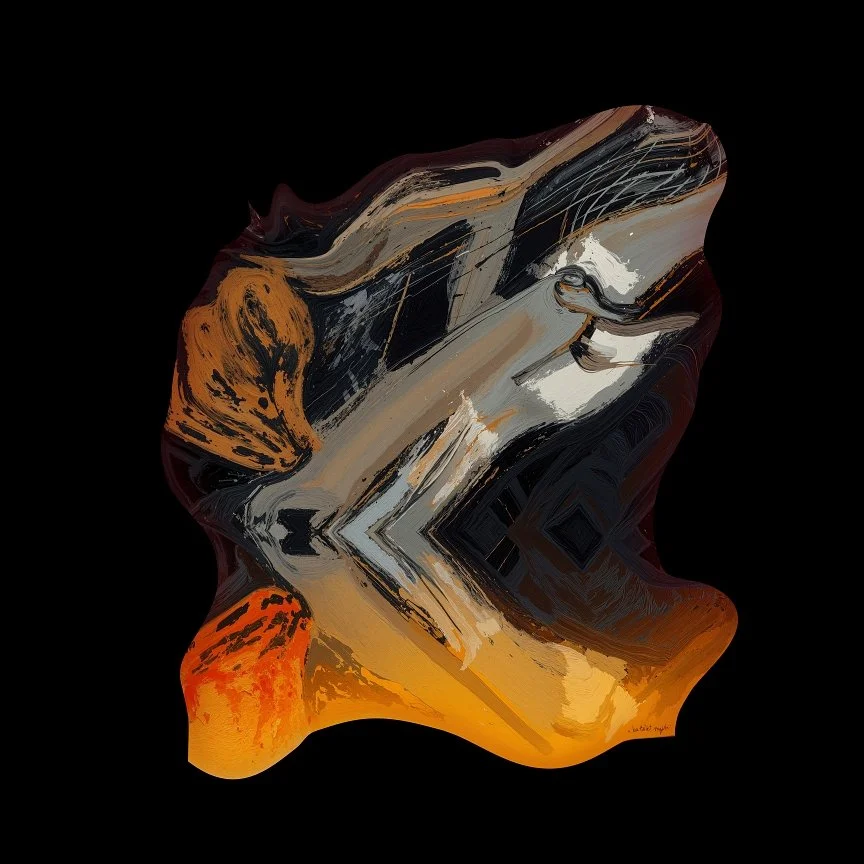
Melt Drift
Without Square is not just about removing borders.
It’s about removing containment.
In Melt Drift, there is no evidence of a frame having ever existed. The form does not appear cropped, broken, or escaped. It appears naturally unresolved—as if it never agreed to become rectangular in the first place.
This is important:
The work does not rebel against structure.
It simply ignores it.
Form and suspension
Melt Drift exists in a state of held motion.
The shape suggests gravity, heat, and flow—but nothing completes. There is no downward collapse, no directional finish. Instead, the piece hovers in a condition where movement has slowed just enough to be observed.
This is where “drift” matters.
Drift is not chaos.
Drift is motion without urgency.
The form bends and softens, but it does not fall apart. It carries weight without heaviness. The edges dissolve, yet the interior remains coherent. That balance is difficult—and it’s achieved here.
Color as temperature, not symbolism
The palette reads as thermal, not emotional.
Warm ochres and ambers coexist with blacks and grays, but none dominate. The warmth does not glow outward; it stays contained within the form, like residual heat. This reinforces the sense that the object is cooling, not igniting.
Nothing here is dramatic.
Nothing is illustrative.
The colors behave like materials responding to pressure rather than signals asking to be interpreted.
Rock Star 12 — Out of Plane
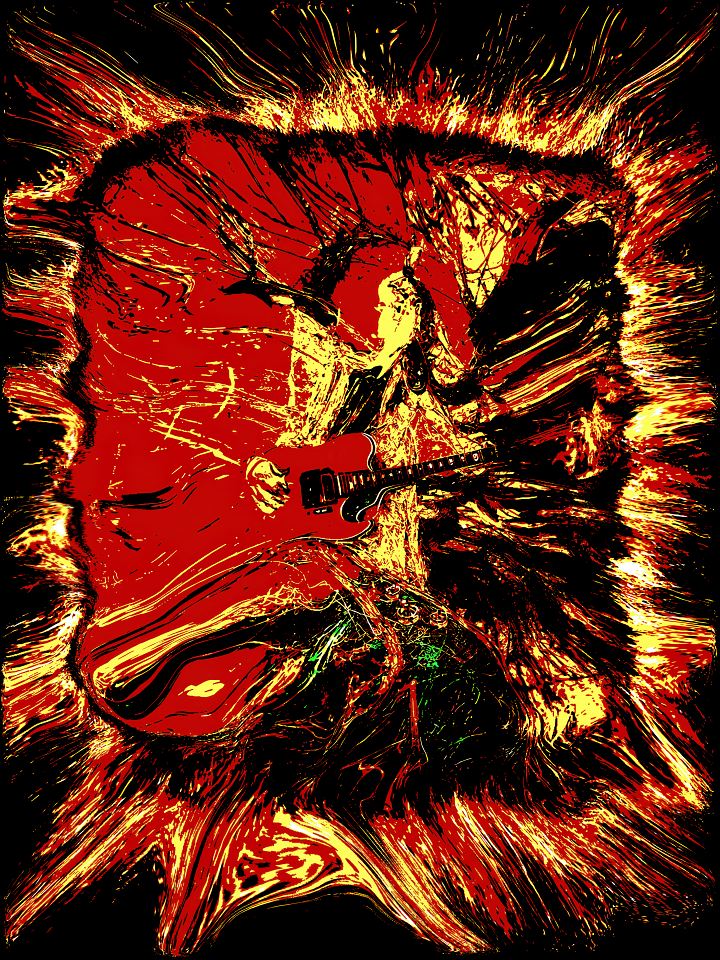
Here, the frame doesn’t simply loosen — it fails.
Rather than extending outward evenly, the image begins to skew, warp, and collapse along its own surface. The picture plane bends. The bottom edge gives way. The sense of “ground” disappears. What remains is not depth in a traditional sense, but dimensional instability — a feeling that the image no longer occupies a single, reliable plane.
This is not 3D, and it is not perspective. There is no vanishing point, no illusion of space receding neatly into the distance. Instead, the space itself appears under stress, as if the image were caught mid-transition between states. The guitar and figure remain legible, but the environment around them becomes volatile — pulled inward in some areas, swollen outward in others.
Liquify tools were used intentionally, not to distort the subject, but to deform the space around it. Subtle applications of “sucker” and “bloat” introduce pressure and curvature, creating a warped field where motion behaves inconsistently. The result is a sense of being slightly out of alignment — as if the image has slipped out of its assigned dimension.
The black surrounding the image is no longer passive background. It presses inward. It behaves like mass. It interrupts, intrudes, and destabilizes the composition rather than framing it. The image doesn’t sit inside the void — it is being eroded by it.
In this way, Out of Plane extends the ideas behind Without Square rather than repeating them. Where earlier works rejected containment, this piece questions the stability of the container itself. The square is no longer something to escape — it’s something that can no longer hold.
Sound has always been central to this work. A guitar is not just an object here; it’s a source of vibration — a frequency strong enough to bend structure. The image behaves the way loud sound feels: not directional, not polite, and not confined to the space it’s supposed to occupy.
Rock Star 12 — Out of Plane exists between moments. Between surfaces. Between dimensions. It is less an image of a performance than a record of pressure — what happens when motion, sound, and energy exceed the limits of the plane meant to contain them.
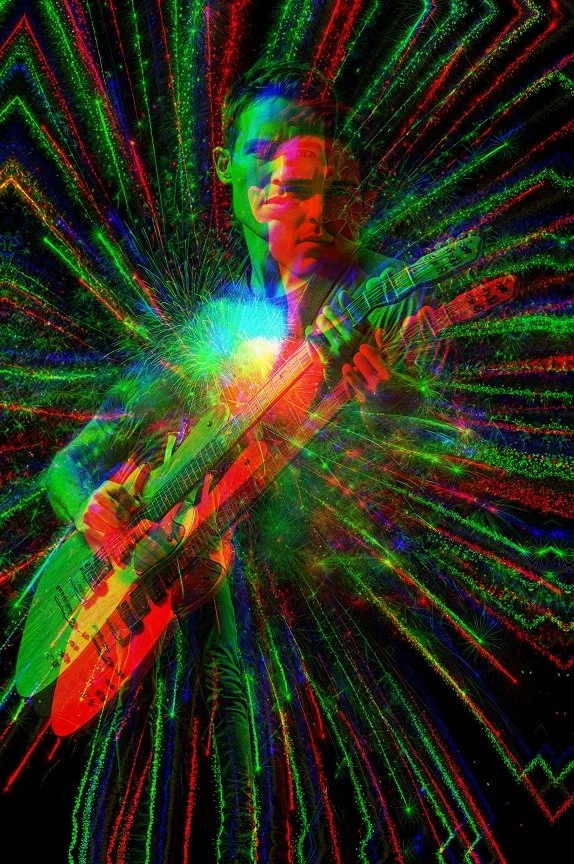
Jonny 5 without time
Jonny 5 Out of Time
Jonny 5 — Out of Time
There is something unsettling about this image, and it took me time to understand why.
When I look at Jonny 5 — Out of Time, I can’t hold the entire face at once. If I lock onto one version of the face, the other disappears. When my eye shifts, the first collapses. I can’t see both simultaneously. The image refuses to resolve.
This isn’t an accident.
The faces are not just doubled in space—they are separated by color. One resolves through red, the other through green. The human eye treats these colors as opposites. When one becomes dominant, the other is suppressed. Perception turns into a switch rather than a blend.
The result is a kind of visual instability. The image doesn’t exist all at once. It exists over time. You don’t see it in a single moment—you move through it.
That experience mirrors what the piece is about.
This isn’t a portrait of a musician frozen in performance. It’s an image of sound outrunning the body that produced it. Identity fragments. Time slips. The figure exists in more than one state but cannot be perceived as whole. What you see depends on where you place your attention.
In that sense, Jonny 5 — Out of Time pushes Out-of-Square beyond form and into perception itself. The square isn’t just abandoned physically—it’s abandoned cognitively. The image refuses a single, stable reading. It demands participation. It requires the viewer to accept incompleteness.
The instability isn’t something to solve. It’s the subject.
If the image feels unresolved, that’s because it is. It exists in transition—like sound, like memory, like vibration. You’re not meant to see everything at once.
You’re meant to move.
And if that feels uncomfortable, it may be because the mind wants edges, certainty, and completion.
This piece offers none of that.
It may only fully make sense
if your mind is not square.
The Firerocks Series
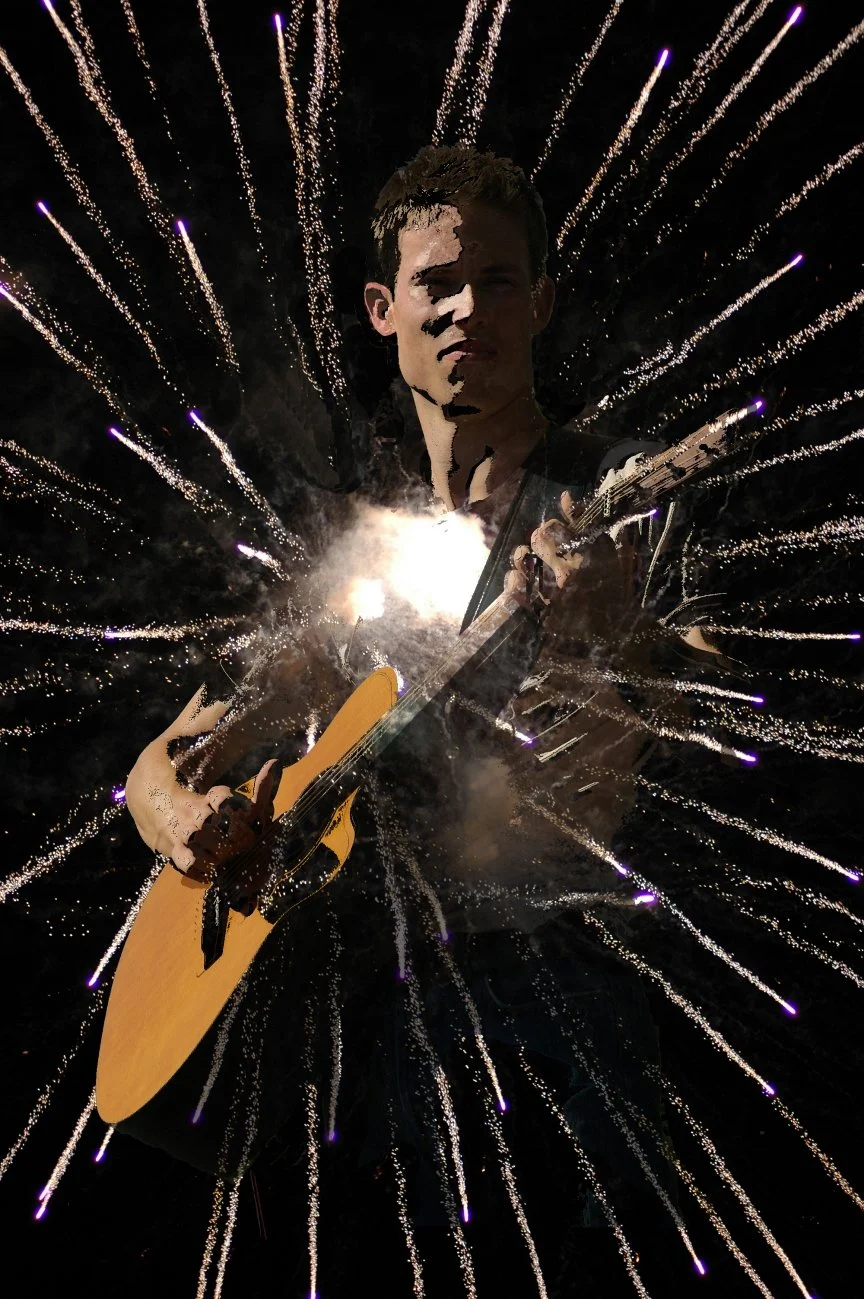
Original Photoshopped Firerocks picture from 30 years ago
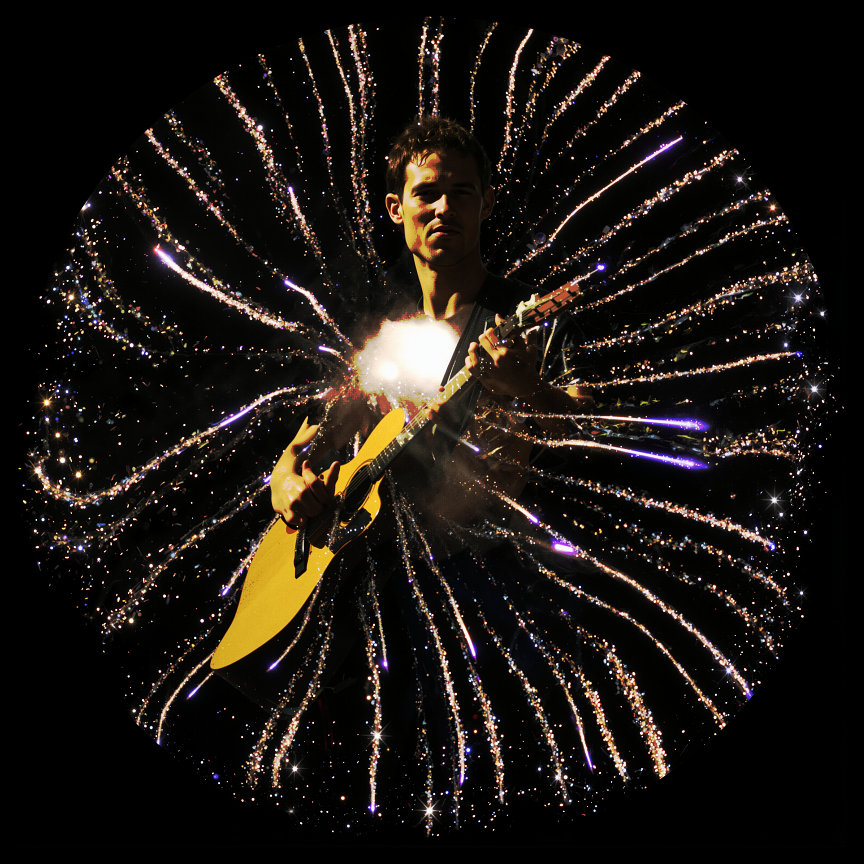
Adapting Firerock to Without Square
To show the progression from then to now, I include this image from my Fireworks series—created roughly thirty years ago—where I combined live musical performance with layered fireworks imagery using early Photoshop techniques. At the time, I didn’t have the language, the tools, or the resolution to fully realize what I was reaching for. I was cutting, isolating, recombining—removing bodies, breaking forms, letting energy exist without its original container.
Looking at it now, this work reveals itself as an early instinct toward what would later become Without Square. The image wasn’t framed in the traditional sense. It was assembled through subtraction and displacement. The subject was already escaping its original boundaries, even if the final result still carried the weight of the square it lived inside.
This wasn’t a finished idea. It was a signal.
What’s changed isn’t the intent—it’s the precision. Today, the tools allow the concept to complete itself. The square no longer needs to be disguised or worked around. It can be acknowledged, stripped of authority, or removed entirely. What began as experimentation has become a deliberate system.
In that sense, Without Square didn’t appear suddenly.
It was forming long before it had a name.
Out-of-Square: The Outer Square Paradox
At the center of Out-of-Square is a simple refusal:
the image does not accept the square as an authority.
The work speaks about floating—about form existing without corners, without containment, without inherited rules about where an image must stop. The subject softens into space. Edges dissolve. The picture behaves as if the square never existed.
And yet, in some pieces, it unmistakably does.
This is where Outer Square appears.
Out-of-Square is the concept—the intent to move beyond the square as a governing structure. Outer Square is a specific condition inside that concept: a deliberate contradiction where the square remains visible, but no longer functions as a container.
Every Outer Square is still a square.
But the image does not live inside it.
Instead, the picture presses outward. It leans against the boundary, breaks the agreement, and visually exits the shape. The square becomes a reference plane rather than a frame—something the image acknowledges, then ignores.
When you look at an Outer Square piece, your eye doesn’t register “framed artwork.” It registers escape. The square becomes residue. A trace of structure. A reminder of how images used to behave.
This tension is intentional.
We are conditioned to trust the square. It has always been the quiet contract between artist and viewer: this is where the image ends. In Outer Square, that contract is quietly broken. The image doesn’t destroy the square. It simply refuses to obey it.
That distinction matters.
The square is not rejected outright—it is stripped of authority.
This is what gives Outer Square its irony. The work claims a no-corner space while allowing the square to remain present. Not as a ruler, but as a foil. The image exists out-of-square while the square itself lingers as an outer reference.
So yes—there are corners.
They’re just no longer in charge.
The work lives in that moment where structure still exists, but meaning has already moved beyond it. Where the image remembers where it came from, even as it insists on becoming something else.
That is the paradox of Outer Square within Out-of-Square:
The square remains—but the picture doesn’t stay.
And once you see it that way, the square never looks the same again.
And then there’s the last, quiet layer of irony.
After all of this—after rejecting corners, after pushing images out of frames, after loosening the authority of the square—the work is presented inside a space literally called Squarespace.
A square space.
It’s not a joke, but it’s not accidental either.
The platform is structured. Gridded. Predictable. It’s built on alignment, margins, and containment. And yet, within that environment, the images refuse to behave. They don’t sit politely. They don’t center themselves for comfort. They push outward, visually and conceptually, against the very system holding them.
This matters.
Because Out-of-Square isn’t about escaping structure altogether. It’s about revealing it—and then moving beyond it. The square still exists. The system still exists. The rules are still visible.
They just aren’t in control.
So the work lives out-of-square, inside Square Space, while asserting a no-corner space of its own. The contradiction isn’t resolved. It’s preserved. Held in tension.
The image doesn’t deny the square.
It simply refuses to stay inside it.
And that’s where the work actually begins.
Out-of-Square is not about showing less detail.
It is about removing so much that the image can no longer complete itself on the surface.
The instrument is largely absent.
The body that once defined it is gone. What remains are functional remnants—surfaces of contact, traces of use—freed from the objects that once contained them. A part is no longer a part. It becomes a shape. A location. A record of motion.
Figures are not rendered in full. They are reduced to fragments. Not anatomical descriptions. Not photographic accuracy. Only the minimum required to suggest action.
This is not a close-up that breaks past the edge of a frame.
This is not an image asserting itself through excess.
It is built through subtraction.
So much is removed that what remains cannot stand alone. The viewer is required to supply what is missing—the instrument, the gesture, the pressure, the sound. The work does not finish itself.
In Out-of-Square, absence is not empty space. It is an active component. Removal becomes the organizing structure. Meaning forms where detail has been deliberately withheld.
If the viewer looks only for what is present, the image will feel incomplete.
If the viewer expects resolution on the surface, it won’t arrive.
The work resolves only through participation—through imagining beyond what is shown rather than staying confined to what is given.
And if nothing appears to resolve at all, that may say less about the image
and more about the shape the mind prefers to remain inside.
The work resolves only through participation—through imagining beyond what is shown rather than staying confined to what is given.
If the image feels unfinished, that is intentional.
If it feels incomplete, that is the invitation.
You may only understand Out-of-Square
if your mind is not square.
Blue Hands 5
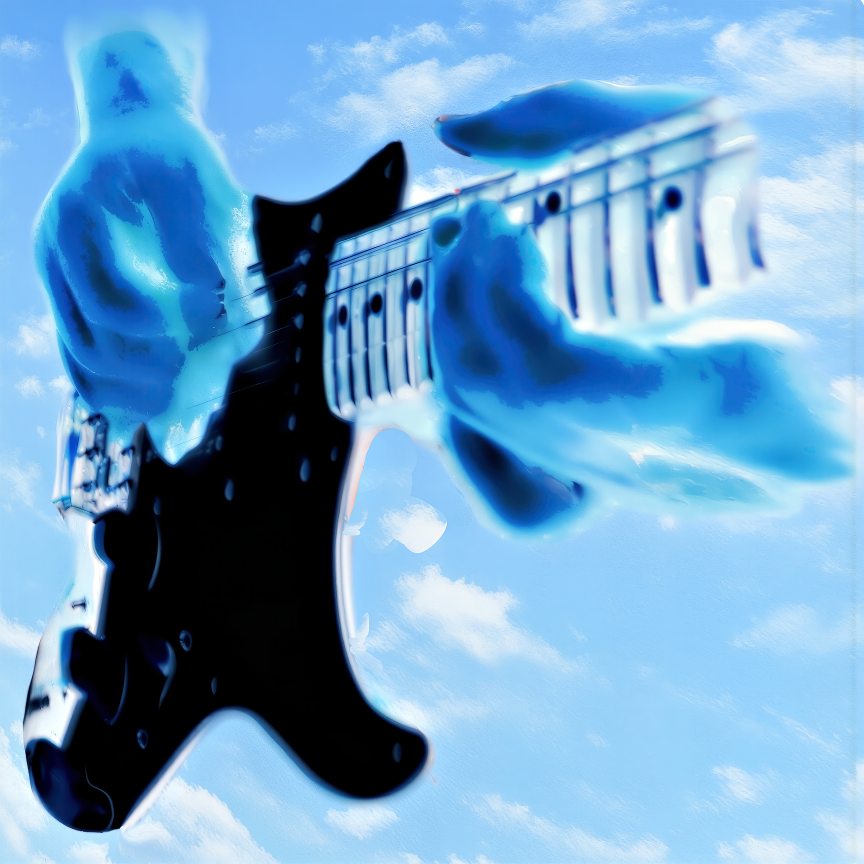
This piece began with a guitar, but it didn’t stay there for long.
What remains recognizable is not the instrument itself, but the place where touch happens. The pickguard — a surface designed to receive motion — becomes the anchor. Everything else is allowed to soften.
The hands are no longer literal. They are not meant to be studied or identified. They exist in motion, dissolving into color and air, somewhere between action and sound. What matters is not the hand, but the act of contact — the moment just before vibration becomes music.
Blue dominates the image intentionally. Not as mood, and not as symbolism, but as temperature. Blue slows the eye. It removes urgency. It allows the viewer to stay rather than search.
The sky is not a background. It is part of the form. There is no edge separating subject from space. The image does not sit inside a square or press against boundaries. It floats, uncontained, the way sound does.
This work is meant to be calming — not decorative calm, but suspended calm. A place where nothing is demanded of the viewer. No story must be solved. No emotion must be named. You can simply remain with it.
Blue Hands 5 is part of an ongoing exploration of work created without square edges — images that resist confinement and allow form to dissolve naturally into space.
Sometimes the most honest moment in music is not the note itself,
but the touch that brings it into being.
Title: Lighter 9 — The Note Without Edges
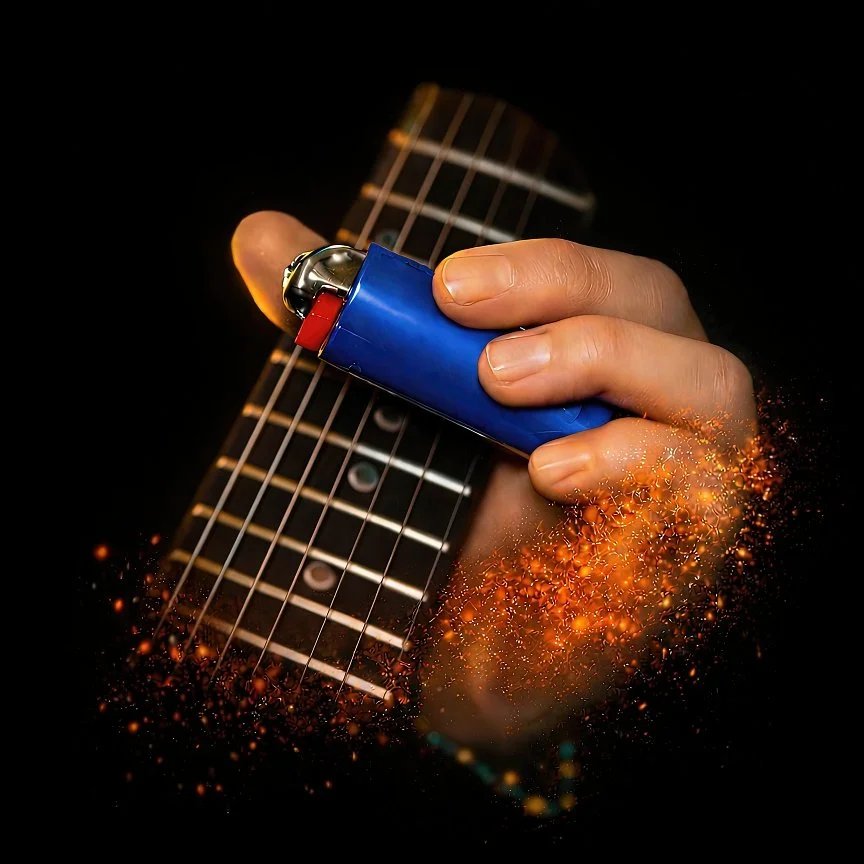
Lighter 9
There is a moment before sound exists.
Before a note is struck. Before a voice opens. Before intention becomes vibration. It is the instant where possibility gathers inside the hand.
Lighter 9 lives inside that moment.
What appears to be a lighter is not simply an object—it is a slide. On a guitar, a slide removes the boundaries between notes. There are no frets. No fixed positions. Pitch becomes continuous, fluid, infinite. You are no longer choosing a note—you are traveling through sound.
That matters.
This image is not about flame. It is about unbounded pitch. About sound without steps. About movement between notes instead of arrival at them. The slide allows the guitarist to pass through frequencies that are not normally accessible, creating tones that exist between the expected and the unknown.
That is the true subject of this piece.
The hand is real.
The guitar is real.
The slide is real.
But the edges are not fixed.
Using what I’ve been developing as my micro-edge, the form dissolves almost imperceptibly into the surrounding black. Nothing is cropped. Nothing is framed. The subject is not contained. It emerges, transitions, and releases into space—just as the slide releases sound from rigid structure.
This is what I call referential abstraction: the physical world remains recognizable, but its boundaries soften. The object is still there, yet its meaning is no longer limited to what it is. It becomes what it does.
The orange micro-burst at the wrist is not decoration. It is not “sparkle.” It represents energy leaving the body—the moment of transformation. Not fire from the slide, but motion through sound itself. The slide does not create tone. It reveals it.
And the black surrounding the form is not background. It is silence. It is the unplayed frequency. It is the space where sound has not yet entered.
This work exists within my ongoing exploration of “without square”—art that refuses containment, refuses geometry, refuses edges that say where something must stop. Just as the slide has no fixed pitch, the image has no fixed boundary. It does not sit inside a frame. It breathes into the void.
In Lighter 6, the guitar is present but not dominant. The slide is visible but not the focus. The true subject is continuity—the smooth, unbroken movement between states. Between silence and sound. Between one note and the next. Between what is defined and what is still becoming.
This is not an image of performance.
It is an image of possibility.
A note without edges.
A sound without borders.
A moment where art is no longer fixed—but free.
Fractured Float 4
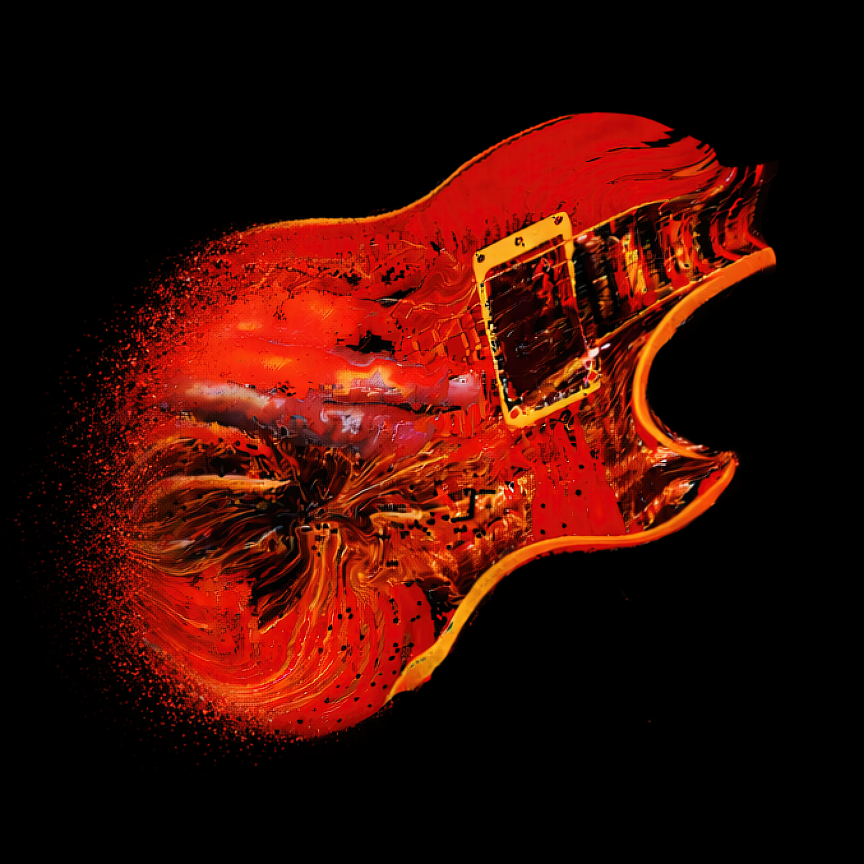
A first work after the manifesto. A statement of what comes next.
There are moments in an artist’s life when a piece arrives not as an experiment, but as a recognition. Not as a variation, but as a confirmation. Fractured Float 4 is that moment for me. It is the first work completed after articulating my manifesto—my commitment to referential abstraction, to Without Square, and to a language that refuses containment while remaining anchored to a real object.
This piece is not simply an image. It is an event in which form, energy, and perception meet. What follows is an extended articulation of what Fractured Float 4 is, what it is doing, and why it matters within the larger arc of my work.
From Object to Event
At its core, the work still contains a guitar. The referent is not erased; it is honored. But it is no longer illustrated. The guitar is no longer presented as a thing to be looked at. It has become something to be experienced.
This is the defining principle of referential abstraction: the object remains present, but meaning is carried by transformation rather than depiction. The guitar does not disappear—it evolves. It becomes vibration, memory, resonance, fracture. The image does not represent the guitar; it behaves like it.
In Fractured Float 4, the instrument is liberated from geometry. There is no frame, no rectangular boundary, no architectural containment. It is form without enclosure—a presence that exists without edges, floating in a void that is not emptiness but possibility.
Without Square: Form Without Boundary
Much of art history is defined by containment: canvas edges, frames, borders, and architectural limits. Without Square is my refusal of that inherited geometry.
Here, the form is not cropped to fit a rectangle. It is not subordinated to the logic of the wall or the screen. Instead, it occupies space on its own terms—organic, asymmetrical, and unconfined. The piece does not sit inside a shape; it is the shape.
This is not merely aesthetic. It is philosophical. The work asserts that meaning does not require containment, that presence does not require a box, and that an object can exist fully without being enclosed.
Fracture as Energy, Not Decoration
The internal distortion of the form is not a stylistic effect. It is not a filter applied for visual novelty. The fracture reads as force: vibration, pressure, memory bending, time pulling the image apart. It behaves less like surface ornament and more like an energetic field.
This is where the work crosses from image into process. What you see is not just what the guitar looks like—it is what the guitar does. Sound becomes visible. Motion becomes form. Resonance becomes structure.
The fracture is not destruction. It is transformation.
Color as Structural Force
The dominant reds, oranges, and golds are not simply chromatic choices. They are doing conceptual work. They carry heat, compression, ignition. Color becomes architecture.
Rather than decorating the form, color becomes the mechanism through which the form is understood. It is not added; it is intrinsic. This is not “color on an object,” but color as the object’s internal logic.
In this sense, Fractured Float 4 treats color as time, as pressure, as force. It is not describing energy—it is energy.
Micro-Life: The Presence of the Small
One of the most important aspects of the piece is almost invisible at first glance: tiny two-pixel artifacts embedded within the form. These minute details act like grain in film, fiber in paint, or surface noise in vinyl. They introduce biology into the digital.
They give the piece animal life.
Perfection would have sterilized the image. Instead, these micro-elements make it breathe. They introduce irregularity, vulnerability, and presence. The work feels alive not because it moves, but because it is imperfect in the way living things are imperfect.
Flow and Solidity: A Quantum Object
One of the most striking qualities of Fractured Float 4 is its dual nature. It feels simultaneously fluid and solid. It occupies space while resisting containment. It appears stable while suggesting motion.
In this way, the piece behaves almost quantum-like: wave and particle, motion and stillness, identity and dissolution coexisting in a single visual field. The guitar is there—but so is the event of it becoming something else.
This is the visual language I have been searching for: an object that is both itself and the process of transformation.
The Giving Image
I describe this piece as “giving” because it does not exhaust itself. It rewards sustained looking. There is always another micro-event to discover, another path for the eye to travel. The work does not present a single conclusion; it offers a field of attention.
This is the difference between decoration and art.
Design satisfies quickly. Art continues to reveal.
Position Within the Body of Work
Fractured Float 4 is not a variation. It is a threshold.
It stands as the first work created after my manifesto, and it functions as a declaration of intent:
The guitar remains the referent.
Geometry no longer contains the form.
Color becomes structure.
Fracture becomes energy.
Presence replaces representation.
Without Square — Defining the Architecture of My Work
After nine pieces and nine reflections, something has become clear to me.
What I have been making is not a series of images.
It is a system.
I have been circling one idea again and again—sometimes quietly, sometimes forcefully, sometimes intuitively—but always with the same underlying condition:
Without Square.
This is not a style.
It is not an effect.
It is the architecture of how my work exists.
What “Without Square” Means
The square is the default container of images. It tells us where a work begins and where it must end. It feels neutral, but it is not. It imposes order before meaning. It decides space before the image has earned it.
In my work, that geometry is removed.
Without Square means the form is not governed by a frame.
It is governed by presence.
The image is not placed into space.
It must justify its existence within it.
Black is not background.
Black is structure.
It is the void that defines what is allowed to remain.
Two Forces Within the Same System
Everything you’ve seen in the last nine pieces operates under this same condition—but with different emotional physics.
In Chasing the Setting Sound (Float), the form emerges.
The energy is continuous.
The edges are quiet.
The image does not challenge the space—it inhabits it.
The void remains dominant.
The form exists by permission.
In Rockstar 7: Bam!, the relationship shifts.
Here, the energy is compressed.
Color does not drift—it strikes.
The form presses outward, testing how much presence it can claim without breaking the discipline of black.
This is no longer emergence.
This is impact.
Yet both pieces obey the same rule:
The black is not decorative.
The square is not in control.
The form must earn its place.
Different forces.
Same architecture.
Why This Is Not Abstraction for Its Own Sake
My work is always anchored to something real: a guitar, a musician, a gesture, a moment of sound. I do not erase the object—I distill it. What remains is not representation, but energy, motion, and structure.
This is what I call referential abstraction.
The image does not illustrate the object.
It reveals what the object is doing in space.
Without Square is how that revelation is made possible.
What This Changes Going Forward
I am no longer experimenting with this language.
I am working inside it.
Every piece now asks the same question:
Does this form deserve to exist within the void?
If it does not, it is removed.
If it does, it remains—uncontained by edges, unsupported by decoration, defined only by presence.
This is not about making louder images.
It is about constructing visual objects that can survive silence.
The Work Is No Longer About the Frame
The square is gone.
The background is no longer passive.
The image is no longer protected by geometry.
What remains is the work itself—
and the black that allows it to speak.
This is not a phase.
It is the structure of what I am building.
Without Square.
Two Forces in the Void: Rockstar 7: Bam! and Chasing the Setting Sound (Float)
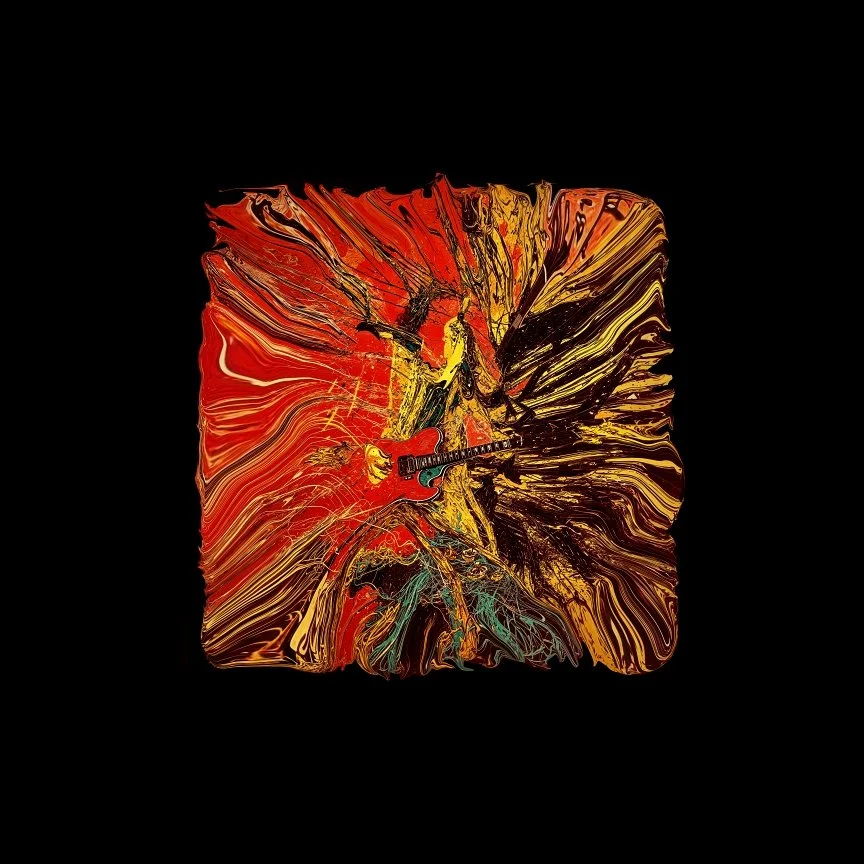
These two works exist inside the same language, yet they speak in completely different tones.
Both Rockstar 7: Bam! and Chasing the Setting Sound (Float) are built on my ongoing discipline of black — not as background, but as structure. Black is not the absence of image. It is the governing space that defines what is allowed to exist.
But what separates these two pieces is how the image behaves inside that void.
Chasing the Setting Sound (Float) — Emergence
In Chasing the Setting Sound (Float), the form feels discovered rather than declared. The image appears to be carried by the black, as if the void itself has allowed something to surface.
The edges are quiet.
The motion is continuous.
The energy flows without interruption.
This piece is about presence without force. It does not compete with the black — it respects it. The void remains dominant, and the form exists only by permission of that space. The result is meditative: a floating moment suspended in silence.
If there is a philosophy here, it is this:
The image does not claim space. It inhabits it.
Rockstar 7: Bam! — Impact
Rockstar 7: Bam! does the opposite.
Where Chasing the Setting Sound emerges, Bam! collides.
The motion is compressed.
The energy is concentrated.
Color does not drift — it strikes.
Here, the image no longer waits for space to accept it. It pushes outward, testing how much of the void it can occupy without breaking the discipline of black. The form still floats. The edges are still controlled. The black remains pure. But the relationship has shifted from harmony to tension.
This piece asks a different question:
How much energy can exist before the void must push back?
Same Language, Different Forces
What unites these two works is the same underlying architecture:
• Both reject the square as a governing container
• Both rely on pure black as a structural element
• Both treat form as something that must earn its presence
But their emotional physics are different.
Chasing the Setting Sound (Float) is continuous.
Rockstar 7: Bam! is punctuated.
One breathes.
The other strikes.
One suggests motion through time.
The other captures a moment of impact.
Why They Belong Together
Placed side by side, these pieces define the two poles of my current work:
• Emergence vs. Impact
• Permission vs. Assertion
• Silence vs. Compression
Neither is decorative. Neither uses black as negative space. In both, the void is active — shaping what exists by how much it refuses to yield.
If Chasing the Setting Sound (Float) is about how little can exist and still feel complete, then Rockstar 7: Bam! is about how much can exist before structure must assert itself.
They are not opposites.
They are the same philosophy under different pressure.
And that tension — between form that floats and form that collides — is where this body of work now lives.
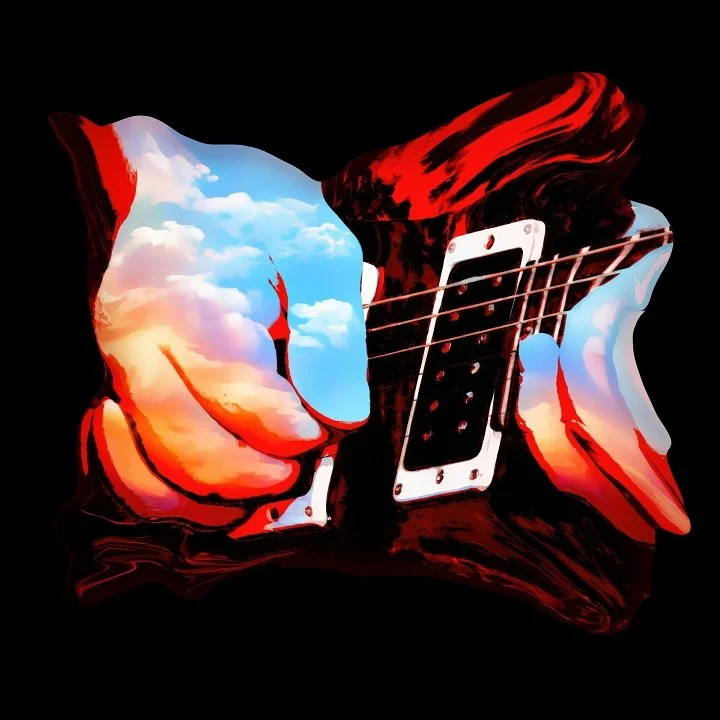
Rockstar 7: Bam! — When Form Breaks Free
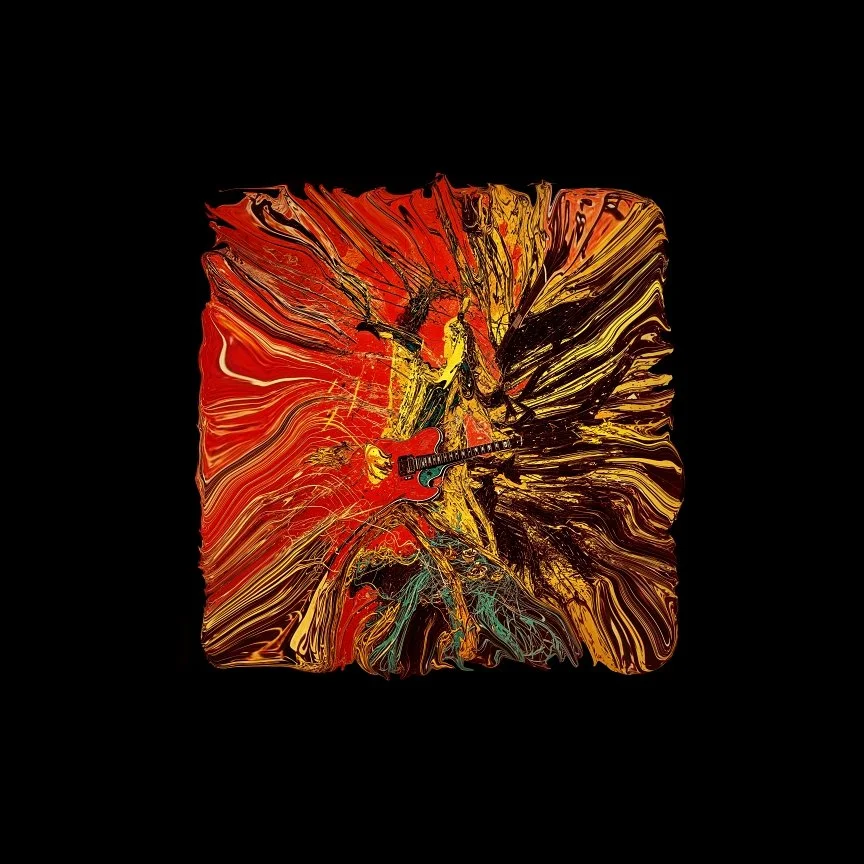
Rockstar 7 Bam!
This piece didn’t begin as an image. It began as pressure.
I wasn’t trying to make something pretty. I was trying to answer a question that keeps surfacing in my work:
What happens when the square is no longer in charge?
Rockstar 7: Bam! is built on the idea that the object — the guitar, the musician, the energy — doesn’t need a rigid frame to exist. Instead of containing the form, I let it erupt outward. Motion replaces borders. Flow replaces geometry.
This is not realism. And it isn’t abstraction for abstraction’s sake either.
It is what I’ve come to call referential abstraction: the image is always anchored to a real object — a guitar, a body, a moment — but what you are actually seeing is its emotional and physical force, stripped of containment.
The black surrounding the piece is not background. It is structure.
It is discipline. It is the void that allows form to speak.
I have a deep affinity for pure black — not “almost black,” not textured darkness, not atmospheric gray. I mean true black. Absolute negative space. When everything extraneous disappears, the image either holds on its own… or it doesn’t deserve to exist.
In Rockstar 7: Bam!, the figure doesn’t sit inside the black.
It confronts it.
The color isn’t decoration. It’s impact. The motion isn’t a filter. It’s the residue of sound, movement, and presence. This isn’t a guitar being shown — it’s a guitar being felt.
This is where my work is going.
Away from frames.
Away from squares.
Toward images that stand in space on their own terms.
Not floating for effect —
but existing because they don’t need permission from the edges anymore.
Bill’s Black — Why the Space Matters as Much as the Form
Rockstar 7 Bam!
For most of my life, I’ve been obsessed with what surrounds the subject as much as the subject itself. That instinct didn’t start in art. It started years ago when I was in the paint business.
Customers would come in asking for “black.” Not charcoal. Not soft black. Not warm black. Just black. But anyone who’s ever worked with color formulas knows the truth: most blacks aren’t truly black at all. They’re mixtures. They carry undertones—blue, brown, red—that soften the depth. They behave politely. They behave safely.
I wanted something different.
So I began making my own: a gallon of clear base, loaded with eight ounces of black colorant. No compromises. No undertones. Just density. The blackest black I could physically create. We called it Bill’s Black, and it did exactly what I wanted it to do—it erased distraction and let everything placed against it speak with absolute clarity.
I didn’t realize it then, but that instinct never left me.
Today, in my artwork, I find myself returning to the same idea: black not as background, but as space. Not decoration. Not framing. Space. The place where form either survives on its own strength or disappears.
In my current body of work—what I’ve come to call Without Square—the image is no longer confined by tidy edges or polite borders. The subject floats. It breathes. The black is not there to “fill in.” It is there to remove everything that isn’t essential. What remains is presence.
This is where my idea of referential abstraction lives. My work always refers back to something real—a guitar, a player, a gesture, a moment in sound. But instead of illustrating that object, I reduce it to energy, movement, and structure. The black field becomes the silent stage on which that form exists. The object is not framed. It is revealed.
Just as in paint, pure black allows no excuses. If the edges are sloppy, you see it. If the composition is weak, you feel it. There is nowhere to hide. The form either holds its own, or it doesn’t.
That is what I’m after.
The black around these pieces is not absence. It is discipline. It is honesty. It is the same instinct that once drove me to mix a color so dark it absorbed everything else in the room. The space matters because it tells the truth about the object inside it.
This is not about making images that decorate walls. It’s about creating forms that exist—forms that stand in silence and still carry sound, motion, and meaning.
The square is gone.
The frame is gone.
What remains is the work—and the black that lets it speak.
The Medium Is Not Neutral: Why Art Presentation Is Philosophy
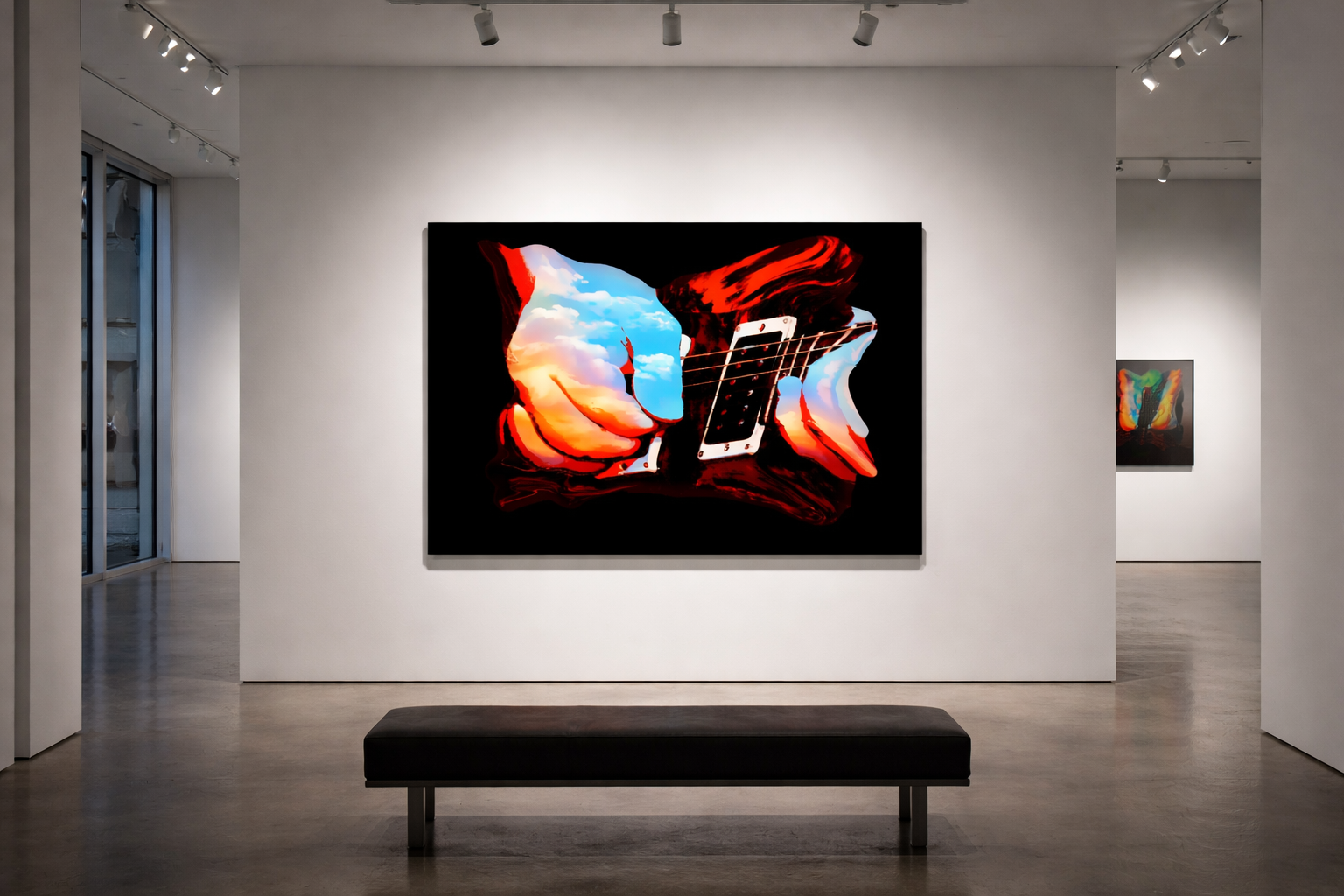
For most artists, presentation is an afterthought. A frame. A mat. A surface choice. Something solved at the end.
But when the work itself is built on reduction, structure, and conceptual restraint, presentation is not cosmetic. It is philosophical.
The way an artwork exists in space is not separate from what the artwork means.
When the Surface Becomes the Message
Paper has a long tradition in fine art. Giclée prints on cotton rag are beautiful, archival, and respected. But paper is fragile. And fragility demands protection.
Protection means glass.
The moment glass enters the equation, the work changes:
• Light reflects.
• The black becomes surface instead of void.
• The viewer sees themselves in the work.
• The image becomes something “behind” something else.
What was meant to be spatial becomes contained.
For art that depends on negative space not as background but as structure, glass is not neutral. It introduces shine. It introduces distance. It re-asserts the rectangle. The square comes back.
At that point, the work is no longer an object in space. It is an image inside a system.
And that system is not what my work is about.
When an Image Becomes an Object
My recent work has moved toward what I call referential abstraction: images anchored in real objects, but stripped of environment, context, and decorative detail. They are not depictions. They are constructed forms.
The black is not background. It is space.
The edges are not borders. They are boundaries of form.
This kind of work does not want to be looked at through something. It wants to be encountered.
That distinction matters.
Why Aluminum Changes Everything
When printed directly on aluminum using archival UV pigment inks (not glossy dye-sublimation), something fundamental shifts:
• There is no glass.
• There is no frame.
• There is no reflective plane between viewer and work.
• The black remains absolute.
• The edge becomes physical.
• The piece casts a shadow and occupies space.
The artwork is no longer an image in a container.
It becomes an object in the room.
This is not a production choice. It is an ontological one.
Paper says: I am an image that must be protected.
Glass says: I must be separated from the world to exist.
Aluminum says: I exist as I am.
That is the difference between decoration and structure.
Gloss Is Not Innocent
A common mistake is to assume that richness comes from shine.
For my work, gloss is not enhancement—it is interference.
Reflection turns space into surface.
Surface collapses void.
Void is the architecture of the piece.
If the black reflects a window, a gallery light, or a passing body, the work is no longer holding space. It is reacting to the environment.
Restraint is not absence. It is authority.
And authority does not shimmer.
Without Square Is Not a Style Choice
The idea of Without Square is not simply removing a border. It is the refusal of containment as a governing principle.
Not “how can I make the image look like it floats?”
But: “What is this object allowed to be?”
If the format reintroduces enclosure, reflection, or decorative surface, the philosophy breaks—even if the image itself is unchanged.
This is why certain materials feel wrong even when they look “better.” They add. They embellish. They soften. They turn structure into surface.
My work is not asking to be enriched.
It is asking to remain precise.
Presentation Is Meaning
Every decision—paper, glass, acrylic, aluminum—is a statement about what the work is.
Is it:
• an image to be viewed?
• a surface to be admired?
• or an object to be encountered?
My work is not trying to be beautiful in the traditional sense. It is trying to be clear.
Clear in form.
Clear in edge.
Clear in space.
Clear in intent.
Which means the medium cannot be decorative. It must be structural.
The Conclusion
Art is not finished when the image is done.
It is finished when its physical existence aligns with its philosophy.
For this body of work, that means:
• No glass
• No frames
• No gloss
• No reflective surfaces
• No reintroduced square
• Black as absolute space
• The edge as form, not border
Because in the end, the medium is not just how the art is shown.
The medium is what the art is allowed to be.
Evolution
I started with a piece of art that I created the other day. I kept looking at it with great pleasure. It is called “Chasing the Setting Sound.”
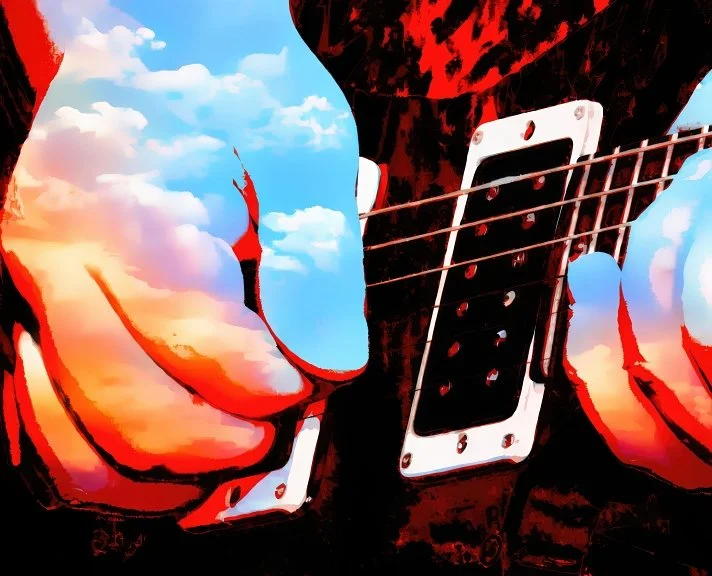
Chasing the Setting Sound
From a T-Shirt to Unbound Energy
I didn’t begin this as “fine art.”
I began it the way a lot of visual ideas begin in real life —
thinking like a T-shirt design.
A strong image.
Immediate impact.
Something that could live on the body, move through the world, and be understood without explanation.
That instinct comes from growing up with album covers, posters, and shirts that carried meaning without asking permission. Images that were bold, emotional, and lived with you — not hung behind glass.
That was the first form.
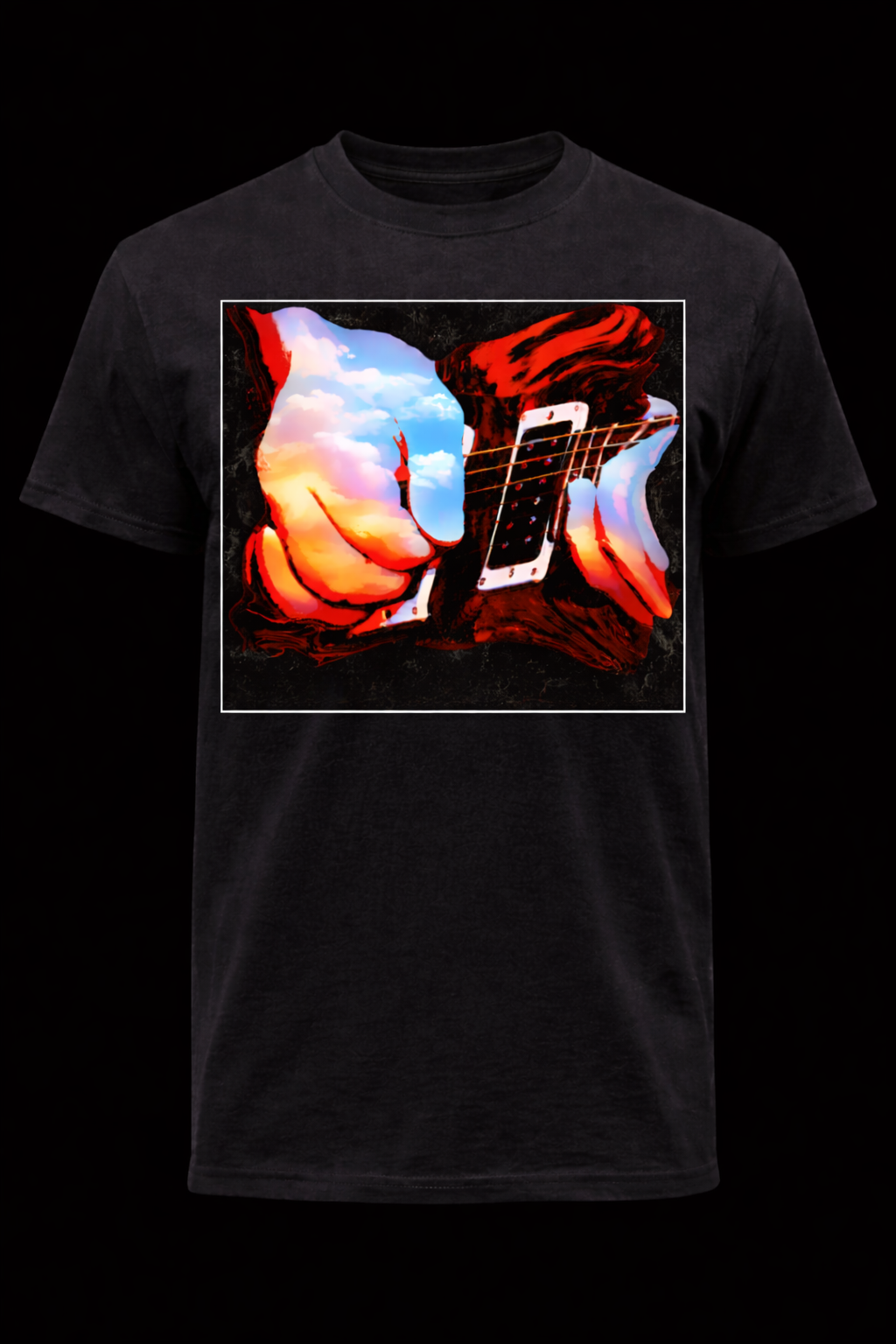
Wearable image.
Stage One: The Wearable Image
The early image was direct:
a hand on a guitar, energy visible, color doing the work emotion usually does.
It wasn’t meant to be polite or restrained.
It was meant to hit — the way music hits before you think about it.
At this stage, the image was doing exactly what a shirt or an album cover does best:
communicating fast, emotionally, and honestly.
But something about the shape still felt contained.
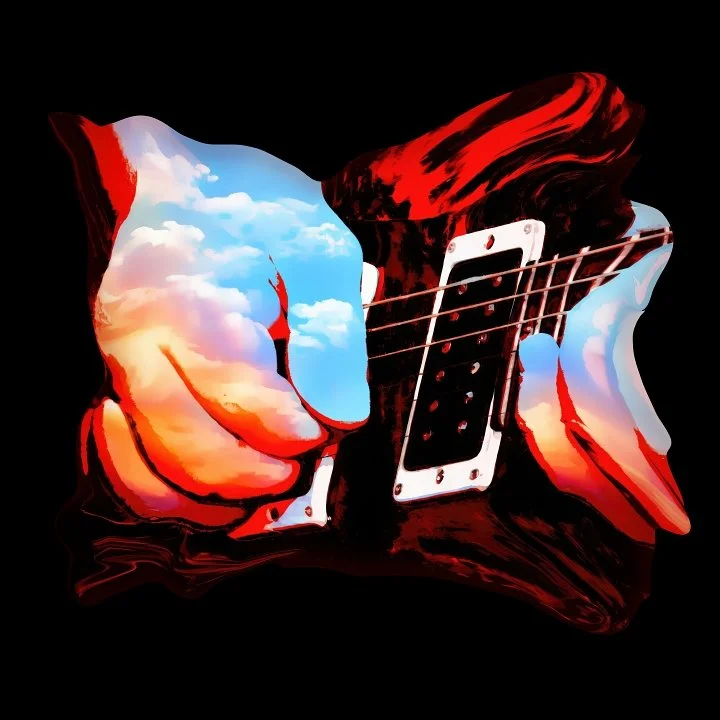
Floating Form.
Stage Three: Floating in Black
In black space, the image changed again.
Without a frame, without context, without utility, the piece became quieter — but more intense. The color and motion had nowhere to escape to. They had to hold their own.
This version felt closest to how music exists:
invisible, immersive, and uncontained.
But something was still missing.
Not explanation — recognition
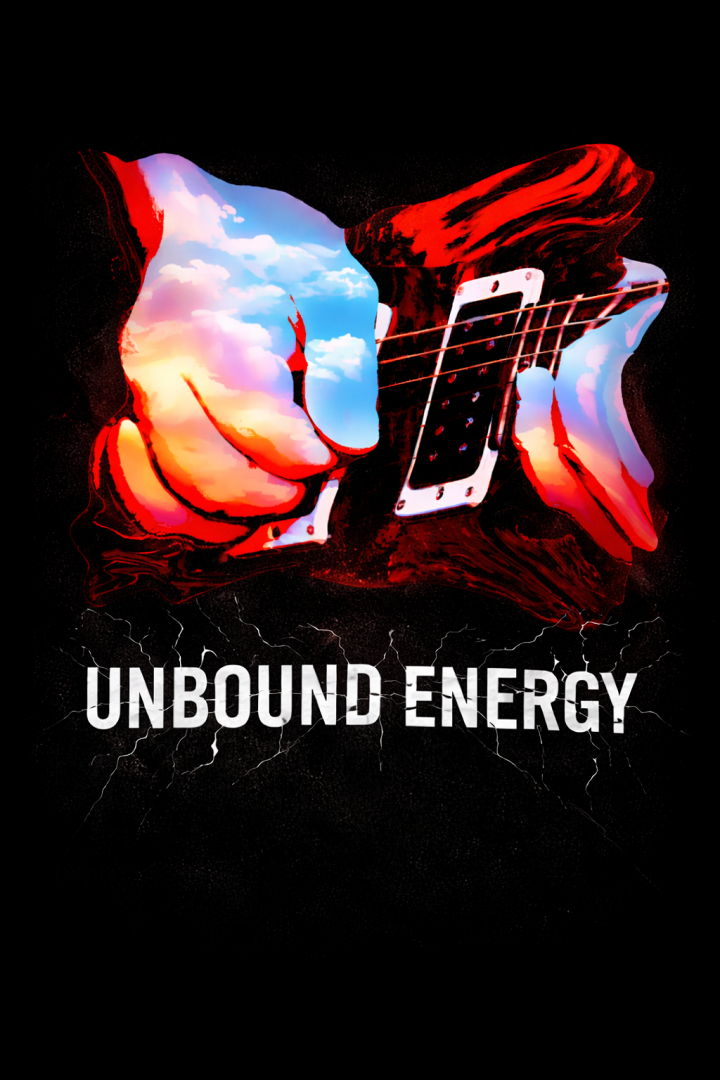
Declared Presence.
Stage Four: Returning With Language
The final shift was unexpected, but inevitable.
The piece returned to its origin —
the album cover, the T-shirt, the declarative statement —
but this time with everything it had learned along the way.
The words UNBOUND ENERGY didn’t describe the image.
They completed it.
The type breaks the way sound breaks.
It doesn’t sit politely under the image — it fractures, carries force, and absorbs impact.
This became the third form of the work:
not just image,
not just object,
but image plus declaration.
What I Realized Along the Way
This process helped me recognize something important about my work.
I’m not interested in choosing between beauty and meaning.
I’m interested in proving they belong together.
The visual language of T-shirts and album covers taught my generation how to see. That language is fast, emotional, and beautiful — and it’s capable of carrying real weight.
This piece traces that path:
from wearable image,
to floating form,
to declared presence.
It isn’t an ending.
It’s a recognition of where I stand — and where the work wants to go next.
—
UNBOUND ENERGY
From Sound to Color: Where Chasing the Setting Sound Began
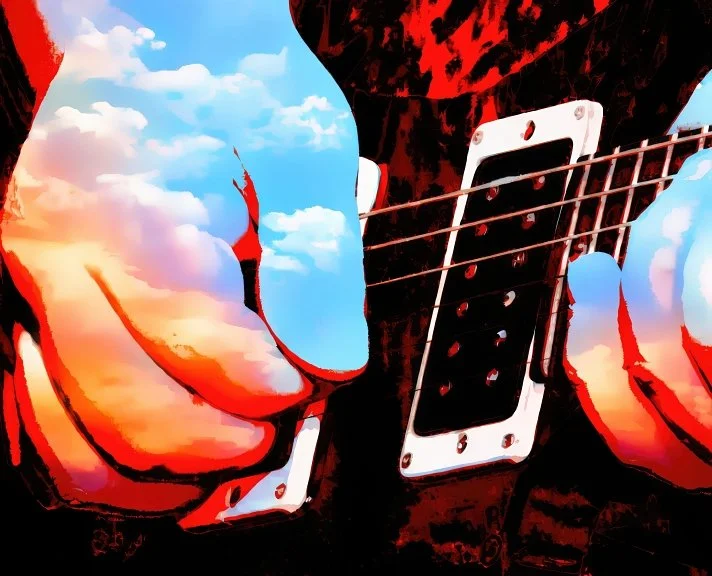
This photograph captures the real moment that became Chasing the Setting Sound.
It’s a live performance — a guitarist mid-phrase, mid-emotion — frozen in black and white. At the time, it wasn’t meant to be anything more than documentation. But over time, certain images begin to carry more than what they show. They hold direction.
The sound was already there.
What followed was letting the image dissolve.
Rather than illustrating the photograph, I allowed it to release its visual gravity — the physical details loosening, the sound becoming color, motion becoming atmosphere. The original image didn’t disappear; it stayed present as a referent, an anchor. What changed was the way the moment was allowed to exist.
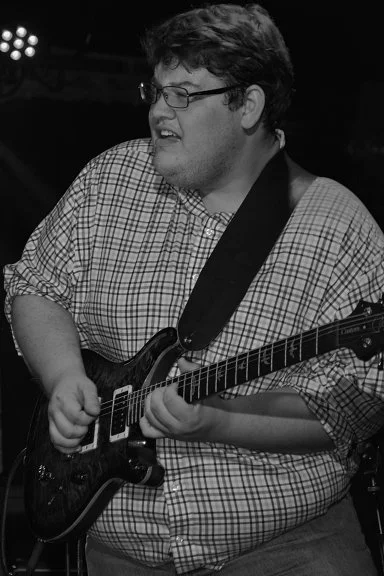
This is the same moment, translated.
The black-and-white origin matters. It strips the scene down to structure, weight, and gesture — the raw data of the experience. Color enters later, not as decoration, but as resonance. The sound spreads outward, no longer bound to the room or the instrument, but to the emotional arc of the performance itself.
This is part of my method.
I’m not abstracting away from reality — I’m abstracting through it. Each piece begins with something specific and lived, then moves toward a visual language that reflects how sound, memory, and presence actually behave over time.
Chasing the Setting Sound exists in both places at once:
the documented moment, and the space it echoes into.
Abstraction
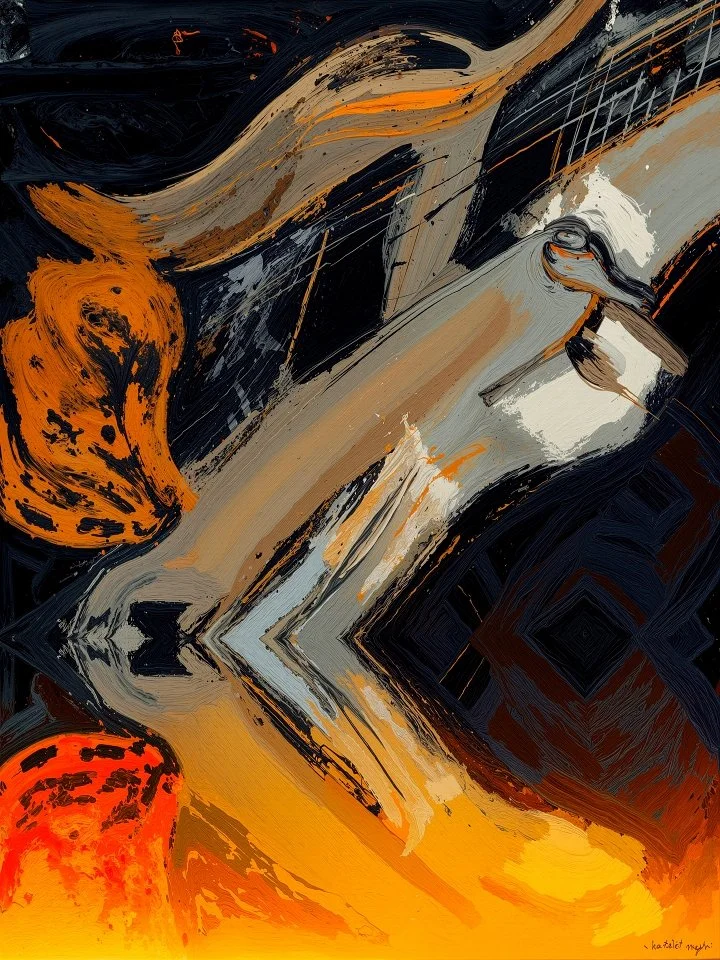
This work exists in referential abstraction.
The guitar is not illustrated or reproduced — it is invoked.
What remains is surface, gesture, pressure, and residue.
The image carries the memory of sound rather than its depiction.
Edges dissolve the way notes do when they leave the room.
What you’re seeing isn’t an object; it’s a trace of touch and rhythm.
I’m less interested in what a guitar looks like than in what it leaves behind —
the afterimage of vibration, the quiet weight of use,
and the emotional space sound occupies once the instrument is gone.